
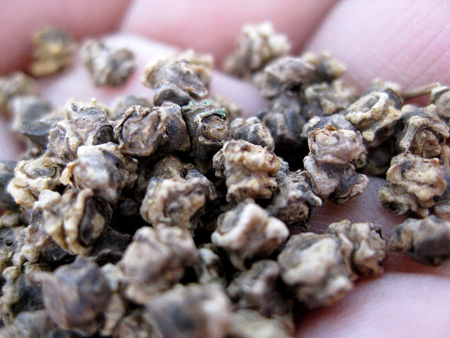
It's no secret that I am adamantly against all use of GMOs. I have done a lot of reading and considering on this subject and have come to the conclusion that having food with systemic pesticides cannot be good for either people or the planet. I am already against pesticides applied externally on crops. The wind takes it aloft spreading it across everything, not just the targeted crops, so that we all breath it whether we choose to or not. It pollutes our water through runoff. Traces of it stay in the food people eat, even after washing.
So why would I think it's a good idea to create a plant whose dna includes a pesticide? It can't be washed off at all. A pesticide in the genes can cross with clean plants giving it some of it's altered genes without you even knowing it and this is what's already happening: GMO crops contaminate other crops through their seed being carried on the wind and by birds. Even when we purposely choose to eat only non-GMO foods we still may be eating them because farmers planting GMO crops can't prevent contamination to other farms.
I am becoming increasingly angry and alarmed at the disregard my country shows towards my health and my ability to make what I consider to be good choices for my body. There isn't a lot you or I can do to stop the GMO companies from spreading their seeds to industrial farmers and it feels hopeless sometimes but I would like to suggest that our income is still the best place we can assert our power. Our income and our voice through voting and protesting.
Here are a few things we can all do to help fight against GMOs infiltrating our lives:
I buy most of my seeds from Territorial Seed Company because they have seeds that have been acclimated to my climate, they've taken the safe seed pledge, and they offer a good variety of open pollinated seeds which is about 90% of what I plant.
If you would like to find out what other seed companies have taken the safe seed pledge you can look up "safe seed pledge" online or you can go to this link I found:
Safe Seed Resources
I also found this interesting article by Greenpeace on GMO seeds:
Facts and Figures About GMOs
(that will give you the link to download the article)
So why would I think it's a good idea to create a plant whose dna includes a pesticide? It can't be washed off at all. A pesticide in the genes can cross with clean plants giving it some of it's altered genes without you even knowing it and this is what's already happening: GMO crops contaminate other crops through their seed being carried on the wind and by birds. Even when we purposely choose to eat only non-GMO foods we still may be eating them because farmers planting GMO crops can't prevent contamination to other farms.
I am becoming increasingly angry and alarmed at the disregard my country shows towards my health and my ability to make what I consider to be good choices for my body. There isn't a lot you or I can do to stop the GMO companies from spreading their seeds to industrial farmers and it feels hopeless sometimes but I would like to suggest that our income is still the best place we can assert our power. Our income and our voice through voting and protesting.
Here are a few things we can all do to help fight against GMOs infiltrating our lives:
- Do you purchase any packaged food? Write letters, e-mails, or make phone calls to the producers of the food you buy to ask them if they use GMO produce in their products. If they say they do, stop buying that product and find one that doesn't use GMOs. I have actually done this once and plan to do this more. If you make your preference and your concerns known to companies it puts pressure on them to respond. They need your money.
- Don't vote for any candidates who are known to support (in any way at all) the companies that produce and promote GMOs. Read up on them and you can find out what corporations they are affiliated with.
- Campaign for labeling. Write letters to the government and also to the stores where you shop. Labeling of all foods with GMO ingredients should be mandatory so that those of us who don't want to ingest or support them can choose not to. Here is a link with suggestions on how to use guerrilla tactics to get your message across: Do it Yourself GMO and Factory Farmed Foods
- Plant open pollinated seeds from seed companies who have taken the safe seed pledge. The corporations who are selling GMOs aren't targeting the civilian population any more (having failed to gain support) and are mostly targeting industrial farmers, but even so, supporting seed companies that have taken the safe seed pledge is important - these are the people preserving clean seeds and our future depends on our ability to save our own seeds (you can't save your own seeds if you plant GMOs, it's not only illegal, it is often not successful).
I buy most of my seeds from Territorial Seed Company because they have seeds that have been acclimated to my climate, they've taken the safe seed pledge, and they offer a good variety of open pollinated seeds which is about 90% of what I plant.
If you would like to find out what other seed companies have taken the safe seed pledge you can look up "safe seed pledge" online or you can go to this link I found:
Safe Seed Resources
I also found this interesting article by Greenpeace on GMO seeds:
Facts and Figures About GMOs
(that will give you the link to download the article)

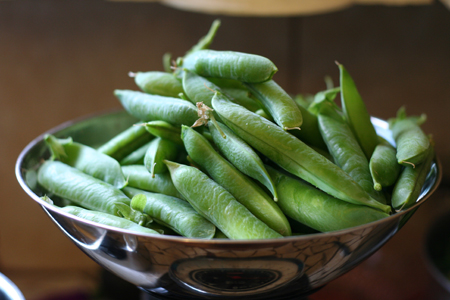



 It's HOT. It's too hot to go out and water anything but it's hot enough that everything needs watering. Except for the peas and favas which I'm almost done harvesting. I grew two kinds of peas and as soon as I can find the packages and finish weighing them up I'll write a post about the total yields I got from them.
 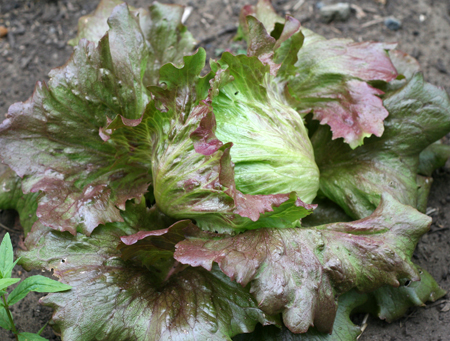 This is the first time I've ever grown iceburg lettuce. This is "Red Iceburg" which was really crispy and delicious. I only got two heads of it because I wasn't careful in my sowing of the seeds and had some cat interference as well. I will definitely be growing more crisphead lettuces!
 The favas didn't get very large this year. I attribute this to how late I planted them. As always, they are very tasty and were effortless to grow. No pests (now there are black aphids on them but there were none all season up until harvest time).
 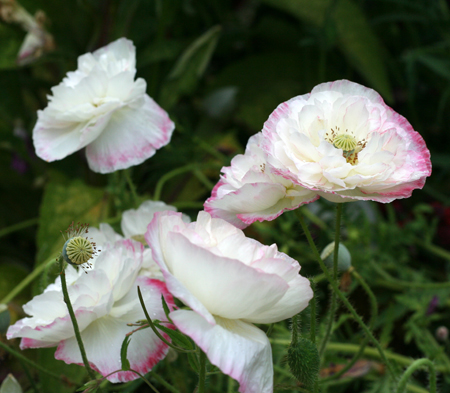 The poppies continue to amaze me. I find them mesmerizing and I look at them all day from my window while I work. I love the scarlet ones, of course, but these pale ones may be my favorites.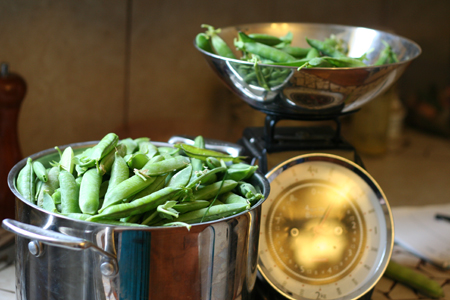
 This whole yield is from second year plants that I planted at the base of my three peach trees (which are in 3' x 3' raised beds). I wish I had recorded exactly how many plants I put in each raised bed but since I didn't I'll have to estimate that there were about 7 plants per bed.

 There are so many good things happening in my garden right now. My Red Rome apple has set a ton of fruit even though it's still sitting in a dirt pile in the driveway. We dug it up from the other house and haven't decided where to put it yet.
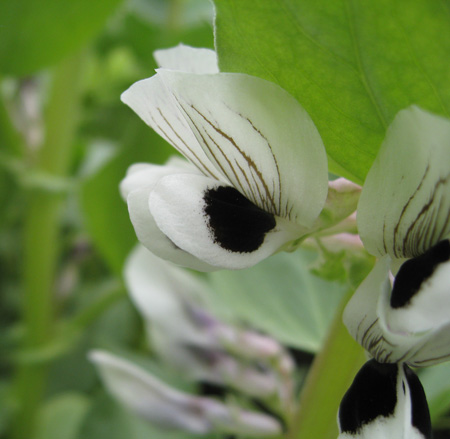 I love fava flowers with their bold black marks and stripes. I planted them late this year so I'm not sure how they'll do but it seems they're doing fine so far. It just might be later than usual when I get to harvest them.
  All of our blueberries were transplanted from our last house and are doing pretty well. This particular one is in the same dirt pile as the Red Rome. In spite of not having a deep place to send its roots down in, it looks pretty happy.
  The peas are very tall and covered in blossoms though I have yet to find any pods. Peas really love our cool climate here.
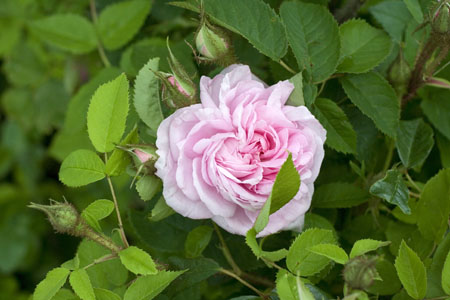 The moss rose Gloire de Mousseux is in full bloom. I didn't prune any of the roses this winter so they're a riot of tangles. This one gets very tall. I'm pleased it didn't ball up in the spring rain.
 The arnica has just started blooming and I have promised myself not to miss out on harvesting it this year. I got lots of blooms last year and never managed to get them. They trickle in for a while then bust out in full flower mode and then are suddenly done. I'm determined to make an arnica salve from my own plants this year.
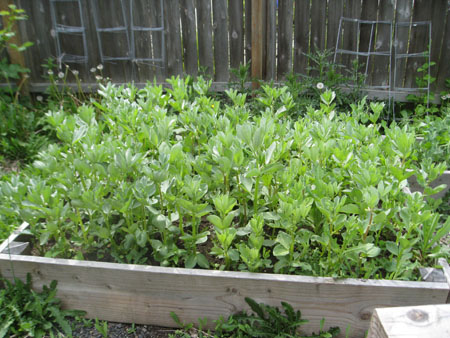 The favas are beginning to set flowers. I wish they'd had a chance to get taller first but I planted them late in the season. Still, I can't complain about getting such a great
  The peas are very busy vining up. I have a perennial problem of not providing support before it's too late. This variety is semi-self supporting. We'll see what happens. No blossoms yet.
 The
The 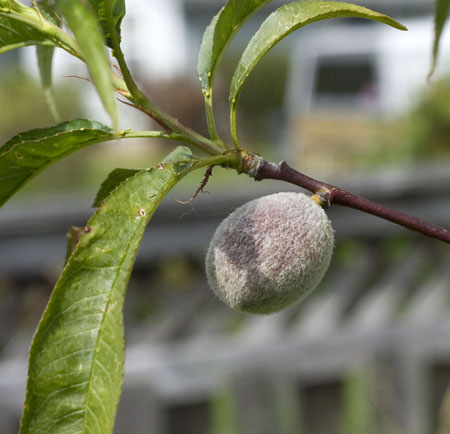 Of the three peach trees this is by far the healthiest. It's "Frost" and seems to be much less inclined to succumb to peach leaf curl. It has a few peaches that might not drop. Fingers crossed!
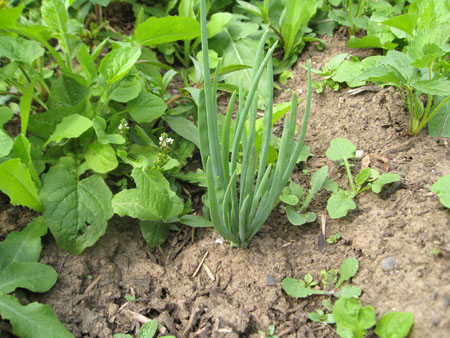 I took the picture before I weeded. I let this bed go nuts with weeds but when I was out there yesterday I started pulling them out and saw that most of my shallots had successfully come up. Only a couple of rotters. Now that I've cleared the weeds they should do even better. They're planted in a bed with strawberries.
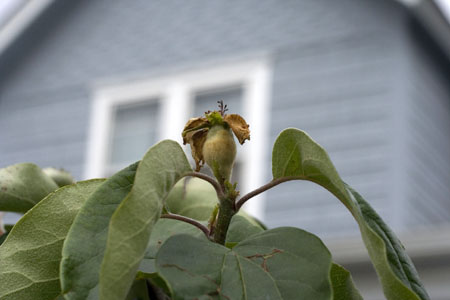 The
The 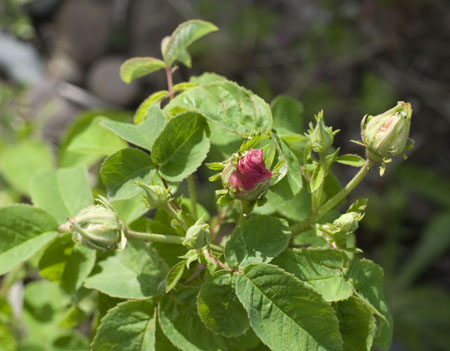 This is my
![Reblog this post [with Zemanta]](http://img.zemanta.com/reblog_e.png?x-id=0f346f2b-b591-4b28-843a-bcd07ca69408)

![Reblog this post [with Zemanta]](http://img.zemanta.com/reblog_e.png?x-id=d4016f16-7d92-4ec2-95bc-3d14c81cf223)
 We've had ameraucanas before and love them. Not just for the colorful eggs they lay but because they're cool looking and our experience is that they have great personalities. We have never had a pale one, which in some places are referred to as lavender
  The naming of new chicks is a very important ritual. You can name your
 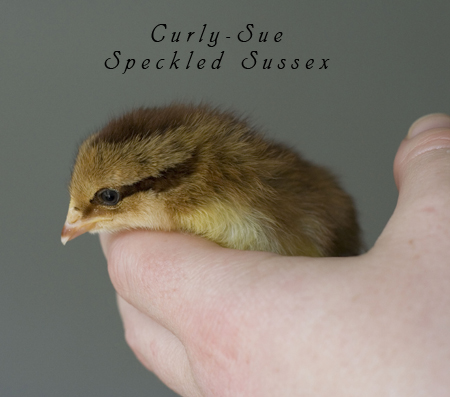 I'm willing to bet that no one can guess who named which birds. Naturally if you're a farmer who has more than a small flock you don't indulge in the great chick naming event. It's too bad, I must say it adds some lively fun to family life and my kid is much more interested in chicks he gets to take part in naming than chicks he doesn't. It becomes more personal to him. Naming is not recommended for those birds being raised for meat. We raise ours for the eggs, the manure, and the pleasure of having them around.
 We have a favorite
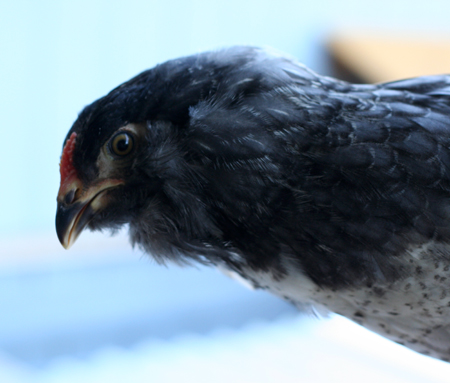
 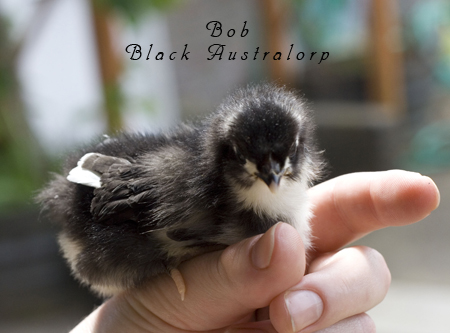 Bob is difficult to photograph. She's not very cooperative and her head being so dark adds another challenge. We've never had Australorpes so we're pretty excited to have two of them. Of course, any or all of these chicks could turn out to be a
 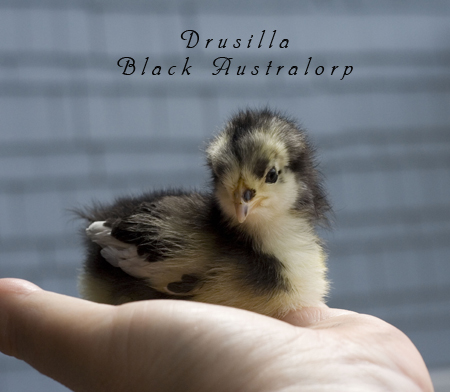 I'm curious to see how different Bob and Drusilla will turn out. Drusilla has a lot more yellow on her but I thought the grown Australorps are all black.
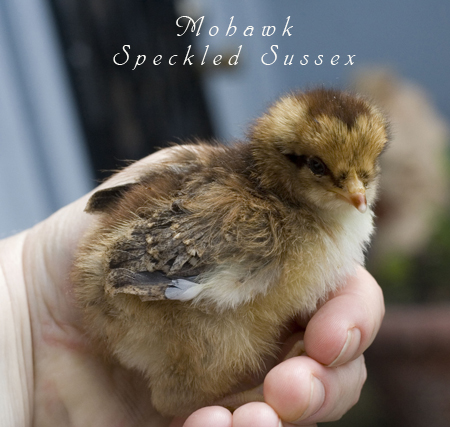 This is Mohawk who had a very stressful weekend during which she very nearly signed off after becoming cooked by the heat lamp. My next chicken post will give some tips about reviving chicks that have collapsed from overheating. It is amazing that she made it. She's still a little ruffled looking but she's completely recovered.
  Taking pictures of the chicks in their box is hard. The lighting is tough on the pictures. This is Mohawk just after making her full recovery.
![Reblog this post [with Zemanta]](http://img.zemanta.com/reblog_e.png?x-id=af81280f-6786-47ac-907e-aaf994d042b8)

Recent Comments