Category Archives: Around the Farmhouse

My photo book is finished- come look!

my book cover.jpg

I have taken a break from writing my novel to create a book of my photos with some of my very best observations, meditations, and advice from my years of writing Dustpan Alley.  Please come take a look inside:

Preview of “Straight from the Jugular”

I had intended (and worked hard) to get it done in time for Christmas ordering but unfortunately I didn’t make it.  Doing it well was more important.  I’m not gonna lie to you, I’m very proud of this book.  Even if you don’t buy it, go check it out and leave a comment if you like it.

Here’s the introduction to the book which explains the connection between writing and photography and what I look for in photos:

When I first started taking pictures for my blog, Dustpan Alley, I committed all the usual photo crimes: lots of flash, not quite in focus, poor lighting, and no working on the pictures in Photoshop later. I am, above everything else, a writer, so at first I just used the photos to punctuate and illustrate posts in a perfunctory manner.  The writing was all that counted to me, but something happened along the way; I started playing with the photographic possibilities.  I started caring about the composition of my pictures.  I took pleasure in getting a sharp picture, a picture with its own story, a picture that could stand on its own.

My pictures still mostly sucked until I got my first good quality point and shoot.  My Canon SD850 took sharper better quality pictures than my ancient point and shoot could.  I could take much better macro shots and it was faster, capturing natural light better.  Suddenly my pictures were speaking to me, guiding my writing, inspiring posts rather than simply punctuating them.  I took my camera with me everywhere keeping my eyes peeled for anything interesting to capture, anything that might bring me more words, that might have something to say to me later.  Getting my first DSLR camera was a fresh revelation and though much bulkier to drag around than my little point and shoot, it takes even better pictures so I am rarely without it.

This is a book of my photographs that have sparked narratives and uncovered stories.  As is true with my writing, I’m not interested in capturing only the pretty or the awe-inspiring.  I’m not interested in self portraits that show me always at my best or pictures of other people that they would put in their school yearbook.  What I look for is motion, color, transitory moments; I want to uncover the blood and the guts, the trash, and the paint underneath the paint.  I want to see the sting, the opening, the flight, and the dreams that live and die just beyond our sight.  I want to revel in the minutiae, the detritus, the flecks of light that catch us, and follow the eye where it goes when we’re not thinking too much about it.  I want to find the humor, the daily irreverence, and the jubilation of daily life.

Just like my writing, my photographs come straight from the jugular.

I have collected in this book some of my best and each picture is paired with observations and thoughts I’ve taken from my writing.  The words don’t always immediately seem to go with the photographs and I’m not going to tell you why I paired each one as I have, I am only going to say that in each pairing there is something that binds them for me, whether it is mood, color, texture, or narrative.   

Home is Wherever My Hands Get Dirty

Pinny who never moults 2.jpgAfter five months of applying (and reapplying) for a HAMP loan to stay in our home, we’ve decided to let it go into foreclosure.  It could be many months before the bank will even look at our continually resubmitted paperwork and in the meantime we’ve had time to consider the direction our life has been going in, what our true needs are, and what “home” really means.

We’ve been homeowners for 10 years and I admit that I fell into the faulty belief that if I owned a home I would be stable, wouldn’t ever have to move, and I could plant fruit trees and watch them mature.  When I moved into my first home and gushed to my dad that I would never move again he said I was wrong, that I would outgrow that house and move at least once or twice more.  Turns out he was right.

I’ve planted fruit trees in three out of four homes I’ve owned in a decade and seen not a single one mature because we have either outgrown our house, been forced to sell it in order to not to lose our equity in it, and then two more homes later and we just keep moving, just keep moving.

Curly-Sue or Mo 2.jpgOwning a home gave me the freedom to discover cooking, gardening, housekeeping, and keeping hens.  It gave me the inspiration to learn to can my own food and it taught me to ask what I can do for myself so that I can avoid calling someone in to do it for me. 

Owning a home guarantees nothing.  Most people don’t own a greater percentage of their home than the bank does.  Most people don’t live in the same home for more than a few years because in spite of how far civilization has come, people are becoming more nomadic again. 

orb weaver out front 2.jpg

I have had this hunger to “settle” for as long as I can remember because I resented moving so much as a kid.  I hated it.  My son is learning to hate it too.  I kept thinking that the best thing in life is to have a little plot of land of your own to grow food on and a house you love and will grow old and die in.  It’s a combination of an American myth and my own fairytale.  It’s what we’re supposed to want.  It’s what we’re supposed to work ourselves stiff for.

I had the house I never wanted to leave.  I had the house I wanted to die in.  I had it all.  I had every bit of that dream and life carried it away from me on a foul wind.  Ever since losing the house of my dreams I’ve clung to the same ideal, trying to recreate what I had.  Every time I try to recreate it rips right out of my hands and leaves me with a wrecked foundation and a bunch of matchsticks to start over with.

I knew there had to be a message in there somewhere.

Sometimes life has to kick you in the head until you learn to duck and cover.  Sometimes you have to stop trying to rebuild the same thing over and over again.  Sometimes you have to look at everything differently and under the bare-bulb light of raw interrogation.  What if what you think you want so bad isn’t what you need and what if creating the life you need leads to to a life you really want?

Home is not about ownership of property.  Home is not about owning anything at all.  Home is about what kind of a life you can make with the materials you are given and that you are able to find.  Home is about nourishment.  It’s about self sufficiency.  Self sufficiency isn’t just about having a garage full of tools or a field of wheat, though those things are good if you have them and can keep them.  Self sufficiency is about rolling your sleeves up no matter where you are or what you’re doing and asking what you can do to improve a situation, a person, or a place.  It’s about rolling up your sleeves to make things with your own two hands.  You don’t have to own a house to make things with your hands or to fix situations, places, or people.

I despise the old saying “Home is where the heart is” because it’s such a shameless oversimplification and meant to provoke a warm (predictable) emotional response from people and the people who say it usually aren’t homeless or heartbroken.

Home is where you nourish yourself and your family.  Whether you do that in a house you own, or a rental, in an apartment, or in a commune.  Home can be the shelter you took your kids to to be safe and warm.  Home isn’t anything as simple as your heart. It’s earthier, harder, and primal.

As we’ve been waiting and waiting for the bank to answer our plea for assistance I’ve had a lot of time to ask myself what I need and whether what I need is what I want.  They aren’t necessarily the same thing.  What I need, and what my family needs, is to reduce our responsibilities and burdens.  We need to cut out about fifty percent of our belongings.  We need to pare down, lighten up, get back to the core things we need in order to take care of ourselves.  We need a living space that’s half the size of what we have because we can’t take care of what we’ve got with our limited time and income.  We need to either have a postage stamp yard or no yard because as passionate as I am about gardening, that’s not what I need right now.

We need to have time to enjoy each other’s company without constantly dealing with all the little/big things that are falling apart right now or the things we’ve obligated ourselves to do or the things we should be doing as homeowners and can’t and are therefore constantly stressed out about.

The decision to let the house go into foreclosure hasn’t been an easy one and though I have to admit that it’s making me more emotional than I like being, it already feels like a tremendous load is about to lift from my life.  It feels as though this is the first right decision I’ve made in five years.  It isn’t easy to pry my fingers from the ghost of the dream I spent ten years fixated on.  It’s hard to let go of something everyone else thinks you should die trying to hang onto.

A house is just a house.  I can’t live my life as though an apocalypse is about to render all people without acreage into starving vagabonds.  A house isn’t a home if it keeps you from doing what you’re really supposed to be doing.  A house isn’t a home if it drains more from you than it fills you with.

The only truly sad thing about this decision is that I must find a home for my 9 loved hens.  The oldest three, Dot, Flower-bud, and Pinny are my sweet old biddies who have served me so well and who will take hens that are at the end of their laying cycles to let them retire in comfort?  I’m heavy with the need to relocate them but there’s no question about it and there’s so much to do to prepare for the future move, the sooner they get settled somewhere safe and good, the sooner I can deal with the change ahead.

My life has never been settled and I see now that
it doesn’t matter.  What matters is that the best day of every week is when Philip, Max, and I go out to dinner together.  What matters is that I can cook amazing food and support local growers and sew and nourish my family in any shelter.  What matters is that I finish writing my book and get it published.  What matters is that I teach my son not to dogmatically hang onto ideals that don’t work for him as an individual. 

What I hope for is a cottage no bigger than one thousand square feet, a tiny yard for my pets to enjoy, a good kitchen, and a corner to write in.  Or perhaps we’ll find a cool old apartment downtown above the stores.

We won’t likely move until late spring so I have time to weed through and curate my belongings down to an essential collection.

Yesterday Max asked me what I most want.  What thing do I really really want the most?  I couldn’t think of anything I want.  I need some new sheets but that’s not what he meant.  I don’t want anything.  I haven’t got an appetite for things the way I used to and it reminds me of when I was first married and I was filled with earthly wants and desires.  I remember burning with the desire to own a home when I was living in our sweet old apartment in San Francisco and here I am, seventeen years later, on the other side of it all.  What I’m remembering is how amazing my apple green vintage kitchen was. 

I’ve been in a lot of different kitchens and I expect I’ll cook in a lot more before I die.

Home is wherever my two hardworking do-it-yourself hands dig in and get dirty.

Enhanced by Zemanta

So Much Abundance

best fennel 2.jpgI think it’s funny that when I’m in the middle of canning it’s almost impossible to prepare actual meals.  I end up eating a lot of sandwiches and easy food.  Back when we had more money it was a great excuse to order in from restaurants.  This week the best thing I ate was this pan of roasted vegetables all of which I got from the two organic farms I buy from.  The tofu isn’t organic and came from the regular market. 

I cut up two sweet potatoes, a few small Yukon potatoes, an enormous fennel bulb cut into six wedges, one whole block of tofu, and an entire head of garlic on my roasting pan.  I cut everything into (roughly) 1.5″ size pieces.  I sprinkled it with salt and pepper and drizzled a generous amount of olive oil over the whole thing.  I cooked them at 400 degrees, turning them about every ten or fifteen minutes for an hour.

Best meal I’ve had all week!  I’m not usually a huge fan of fennel but I have to say that eaten this way has changed my mind.  I can no longer remember how I’ve fixed them in the past.

The best thing I ate the previous week was a pasta sauce I made with chanterelles and caramelized onions added to a sharp white cheddar cheese sauce.  The sauce was so thick it worked well to spread on toast and broil. 

All my other meals have been breakfasts of eggs, cheese, and tomatoes or lunches of cheese tomato sandwiches. 

best roasted tomatoes 2.jpgI did make (and freeze) some tomato soup.  I consulted friends for herb ideas and everyone has something different to suggest.  I ended up using fresh thyme from the garden and the very last of the fresh local basil.  I thought it was really nice but Philip preferred it as a dip for a grilled cheese.  He didn’t love it on it’s own merit, which is why I didn’t bother posting my recipe here.  It needs work.  All soups should be worthy of standing alone. 

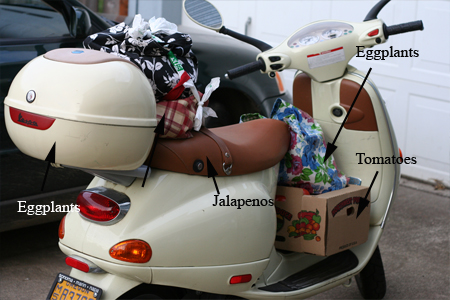
Vespa pack mule 2.jpgI made my annual trip to the local farm Bernard’s this year for tomatoes, summer squash, and eggplant – all upick.  I ended up getting some jalapenos even though I promised myself I wouldn’t.  Here’s what I packed on my scooter:

74 eggplants
3.5 pounds jalapenos
34 pounds green and red tomatoes

All of this food cost only $36.95.  I am not kidding.  The eggplants were 25 cents each, the tomatoes were 47 cents a pound, and the jalapenos were comparatively expensive at 99 cents a pound.

free walnuts 2.jpgLast year my friend Laurie brought me a box of walnuts she’d collected from her mother’s tree.  I put them in the freezer and only just cracked them all open in the last few weeks.  I portioned them into vacuum sealed bags and put them back in the freezer.  Walnuts are expensive to buy and I can go through a lot making this recipe for walnut pesto sauce.

aphid pickle 2.jpg

The pickles.  This was not my year for pickles.  There weren’t any pickling cucumbers available for upick so I decided I’d make dilled beans.  When I tried picking at the farm it was not a great moment for them either.  So I resolved to just make extra cauliflower pickles.  I love dill cauliflower pickles so I figured I’d be just as happy eating these as the usual cucumber dills.

The day I brought home my giant bunch of dill-heads I was so giddy with excitement that I got chatty with the Rite-aid check-out guy who could be expected to have no interest at all in pickles.  To my surprise I was wrong.  I said “Dill!!” and he said “Pickles!” and I spazzed out at him when I found out his grandmother makes cauliflower pickles and it turns out this barely-twenty-something kid is a fan of cooking blogs and home canning

Those dill-heads would turn out to be a grim* reminder of the superiority of insects.  For anyone who doesn’t know, it is generally best not to wash herbs any time you can get away with it.  I have been pickling for 4 years and have never had any problems with my dill.  I’ve grown complacent and careless, apparently.  I canned 17 quarts of pickles and every single one of those jars has a few tiny floating pickled aphids in them. 

I thought I was going to have to dump the jars out and cry over a very large beer.  Luckily my husband and my mother are more intrepid eaters than I am and have declared that they are perfectly happy to rinse the pickles before eating. 

I obviously had to make some aphid-free cauliflower pickles for myself.  I got more dill heads, really nice looking ones that didn’t seem to have any aphids on them.  But I wasn’t going to take any risks so I soaked my fresh dill heads in vinegar for a few hours thinking this might make all the aphids die and let go.  It worked!  (Yes, there were aphids on these ones too.)  But then I made the mistake of taking them out of the vinegar and waiting to use them the next day by which time they had developed a truly suspect odor.

In the end my last 14 quarts of pickles had no dill-heads.  Instead I used a quarter teaspoon of dill seeds and a quarter teaspoon of dried dill leaves.  I have no idea how they will turn out.

I am now done with my preserving season!  I am ready to concentrate on actual cooking, curtain making, and writing. 

*Possibly an overstatement.

Enhanced by Zemanta

Big Kitchen Fail: around the farmhouse 8/31/10

corn stack 2.jpgThe corn is good this year!  The corn is very very good and plentiful and not too expensive but I still choke at the thought of seven ears wasted!  However, the cobs, after giving up much of their flavor to a stock, made the chickens very happy.

As I mentioned in an earlier post, I’ve been working on a corn chowder recipe.  One version had too much heat and too much cilantro in it but was otherwise PERFECT.  (I know this because right before adding one too many jalapenos and the entire bunch of cilantro I tasted it and it was so incredible I almost stopped right there.)

roux 2.jpgMy basic roux always has a little dash of cayenne in it- but for this project, the corn chowder, it made it too hot! 

So yesterday was my remake day and I was really excited.  Not just to make a new better batch which I suspected would then be ready to share with you, but because I was simultaneously experimenting with an olive oil roux in hopes of making a superb vegan version for my vegan friends.  I had already made some corn stock (more about that when I write the recipe) and the roux worked beautifully, the sauteed vegetables were added and then, then was the moment of truth: adding the corn.

This is the moment where everything went wrong.

I had cut all my corn off the husks and had it ready in a bowl.  7 ears’ worth of it.  The only problem is that I’d had it prepped and ready to go for a day and a half.  All that time it was sitting on the counter.  I can’t tell you now why I didn’t put it into the fridge.  I have no explanation for my actions at all.  I smelled the corn (I have an excellent sense of smell) and it was sort of sour.  Not deeply sour.  But sour.  It wasn’t moldy, it hadn’t been hot (thank god!) and I had the most misguided thought in my entire cooking career: maybe it would be fine to use in the soup.  The cooking would kill anything dangerous and maybe the slight sourness would add a good flavor, the way soured cream does…people do intentionally rot fish in holes and call it a delicacy.  What’s a little fermented corn?

What’s a little fermented corn?!

Pretty unappetizing, as it turns out.  I followed through anyway.  Cooked it for about half an hour and in that time all the soured corn kernels turned brown in the soup and it didn’t smell delicious.  I gave up.  It makes me so angry when I achieve such incredible waste in my own kitchen.  What’s worse is that I didn’t even compost it which would have saved it from being complete waste.  I have a very active compost going on in my yard and I don’t throw much food in the garbage or down the garbage disposal. 

But sometimes I get overwhelmed by giant pots of soup that fail and I do weird things like panic about what to do with it and the thought of huge wet pots of soup getting slimy on the compost pile gives me palpitations.  So I tossed it in the rarely used garbage disposal. 

Today I’m feeling properly subdued about so much waste: 7 ears of corn, 4 home grown potatoes, two stalks of celery, some flour, a quart of home made stock, an onion, two jalapenos, and a can of evaporated milk (I was proceeding with the non-vegan version).

knock knock 2.jpgKnock knock?  Anyone home?  Can I come in?  Surely there’s a grub or two you need cleaned up?

When these kind of things happen you just have to let it go.  Now that I’ve shared my calamity with you and come clean about not composting, I am letting it go.

In other farmhouse news: the hens are LOVING their free-ranging in the early evenings.  The big girls have become much mellower and follow us around in the garden and up to the porch where they hope to be included in all family activities such as family movie night.  Sadly, they must be put to bed before the movies start. 

The adolescents have no problem finding their way back to the coop when the sun sinks but our big girls gather up on the porch railing instead and we have to put them away each night by carrying them to the coop.  They are already in their middle age and this is the first time in their lives they’ve been allowed to roam around outside their run a couple of hours a day so they don’t really know what to do.

They’ve been eating all the blackberries that I haven’t wanted from the garden (the too sour ones and the overripe ones).  It’s made for colorful messes on the patio.  While I am not loving all the messes, the benefit to my hens is obvious and I can tell that they are feeling much more fulfilled and happy.  Yes, you really can tell.  Birds may not be as smart as pigs but they are sentient beings and they do have some thoughts and emotions.  

Dot arrives inside 2.jpgHey Dot, whatcha peckin’ at?  Thanks for dropping in the kitchen for a chat!

 
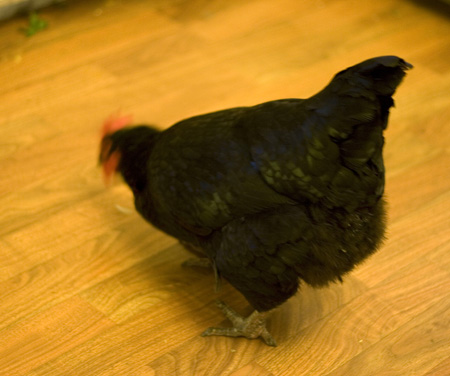
Dot even made it inside the kitchen once!  She didn’t care for the slick texture of the floor but was much interested in joining me in the cooking… lest you think I am a completely dirty scary person who lets her farm animals make a manger of the farmhouse… I audiosed the bossy gorgeous Dot almost at once.

Though I secretly really do wish my chickens could follow me everywhere. 

For all you germaphobes out there, I promise you this floor has since been mopped well.

saffron from Sharon 2.jpg

My long time close friend Mrs. E brought me this amazing gift when she visited me a couple of weeks ago: Spanish saffron!  Look how many packets!  It’s like gold!  I’ve never experimented with saffron because it’s always been just a little too precious for me.  This gift is so treasured- thank you Mrs. E!  I can’t wait to play with it!

Enjoying my hens running around has deepened my enjoyment of my old farmhouse and garden both of which have experienced serious neglect as we’ve  been struggling so hard to hold everything together.  As many of you know, we are going through a process with our bank that may take many months in order to try not to lose our house.  Not knowing if I’ll get to stay here is stressful and could easily overwhelm me and prevent me from enjoying it while I am still in it.

The truth is, there is a curious little circle going on where the more I emotionally let go of my farmhouse and accept that at any time in the next year we may end up having to rent an apartment and give up our birds and our garden and the peach trees which have just begun giving us fruit, the more
I find myself enjoying it in the moment, the more I enjoy it in the moment the more I realize I don’t want to let it go.

I’m amazed at how I’ve managed not to let that drag me into a horrible pit of anxiousness.  I just keep coming back around to letting it go and deciding to enjoy it while I have it.  As long as I keep coming back to that I can’t lose because even if I have to walk away in a few months, I’ll know that I didn’t waste all my time worrying about it and dreading it.

In an effort not to live in the past or the future I’m going to finally make winter curtains for this house and share the instructions for doing the same in your own if you need to make some for yourself.  In the past I wouldn’t have done it knowing that I might not even be in this house by winter time.  But what if I am?  This will be our third winter here in the farmhouse and if we don’t have to move it will be COLD because we don’t turn the heat up past 58 and may go a little lower this year.  Keeping an old house warm is a challenge and one of the very best ways to keep heat in is to have lined winter curtains on all of your windows. 

I’m also planning to do a tutorial on making coasters.  They don’t seem important until you can’t find any around the house and the few pieces of good furniture you have are getting damaged by drink rings.  I haven’t done sewing tutorials in a long time and that’s one that almost anyone can do.

So, though there have been some epic failures around here, there is a lot of good going on and I’m really taking the time to enjoy those good things.  Every day we go outside for a little while to walk around with the birds and feed them blackberries and kitchen scraps and talk to them, which they like.  I’ve been cooking really good food and have been enjoying the process of recipe development which sometimes ends in a mess but nearly always evolves into something really delicious worth sharing with you.

I hope all of you are taking the time to enjoy what’s good in your life right now too and with so many of my friends in such tough circumstances right now I just want to say that all of you are in my thoughts and when you navigate your own tough moments with grace I keep that with me as inspiration.

Eating Seasonally: summer 2010

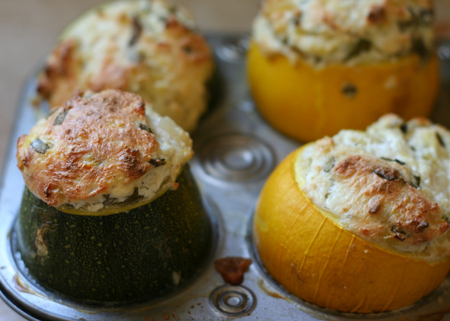
stuffed round zuchs 2.jpgThis is a recipe in the works.  The ricotta stuffing was excellent but the squash skin was kind of tough which was disappointing.  Hopefully I’ll be able to present this in the next week or so. 

We’ve been committed to eating mostly local produce for the last three years.  What “mostly” really means is that I buy almost all local produce all year but each week I allow myself to buy one or two produce items that aren’t grown locally.  Avocados are one of them.  I don’t believe I can live without avocados and I’m okay with that.  Because of buying avocados frequently I don’t buy oranges or tangerines (this winter I got three boxes full of them grown by a family friend which was an incredible treat) or bananas or pineapples or most other things that never grow in my climate.  If I decide I want any of those things then I make sure that I don’t buy avocados that week or I give up buying lemons or limes which I buy periodically for cooking.  It’s all about maintaining a high proportion of locally grown produce all year round. 

Nearly always if you’re eating locally you’re eating seasonally.  Eating seasonally has changed the way I think about produce for the better.  When you eat tomatoes all year long you not only support an unsustainable system of shipping produce worldwide but you commit to eating sub-standard quality food.  Wait, but that wasn’t what I was going to say- the best thing about not eating tomatoes until they’re in season is that they become infinitely more treasured.  I cheated this early summer and bought some locally grown organic tomatoes grown in a greenhouse, which, it turns out, weren’t that great anyway.  What can I say?  After ten months of buying NO “fresh”* tomatoes I was dying for my first taste and was disappointed.

This week the tomatoes are truly in season!  Here in my area they are beginning to show up at the farmer’s markets and they have flavor and I’m making a ridiculously poor sentence just because I’m so excited about it I can’t decide what to make with them first and I’m buying as many as I can at each market.  (That’s a lot of excitement.)

Right now the summer produce is at its peak and I’m finding that there are so many things I can only cook during the summer because this is the only time I can get the real deal: the ripe local flavorful food that epitomizes warm weather and prevents me from relocating to the North Pole during the heat.  Seasonal eating makes me savor food so much more than I did before.  I’m experiencing a little bit of sensory overload right now.

Here are some of the things I want to make with what’s available right now: 

Tomatoes: fresh salsa, pico de gallo, tomatoes on salad, stuffed tomatoes, slow oven roasted tomatoes, tomatoes in eggs, tomatoes in sandwiches, tomato gratin, pasta with tomatoes, a strange but unbelievably delicious casserole my mom makes with tofu feta and fresh tomatoes and cauliflower, tomato soup, Mexican rice, enchilada sauce, and Caprese salad.

Corn: corn chowder, corn on the cob, black bean chili with fresh corn, fresh in salad, corn in enchiladas, corn relish, creamed corn, and corn fritters.

Summer squash: squash gratin, stuffed squash, grilled on sandwiches, sauteed with fresh herbs and garlic, squash in summer soup, grilled as a side, zucchini bread, ratatouille, and in zucchini and feta fritters.

Eggplant:  grilled for sandwiches, grilled and cubed on pasta, baked, stuffed and baked, ratatouille, made into sauce for pasta with tomatoes and basil, baked with garlic and put on sandwiches, eggplant lasagna, and pickled!

Cucumbers: added to an assembled salad, sliced and dressed in mustard vinaigrette, in a raita sauce, tzatziki sauce to go over falafel, eaten plain, and dipped into ranch dressing.

 Those are just the main players.  Now I’m seeing beets- I love a salad with beets dressed in lemon and olive oil with kalamata olives and feta over a bed of lettuce.  Or roasted beets in couscous.  Or just roasted and eaten.  I love them pickled too.  Soon I’ll be seeing a little celery which is exciting because I gave it up for most of the year when I went seasonal.  I used to put it in almost everything I cooked.  I sometimes blanch and freeze it but if I don’t get around to it then I don’t eat celery for 11 months out of the year. 

What to make?  How to make everything I want to in such a short time?  The hardest part is that a lot of the time I’m truly happy just eating a cheese sandwich with fresh tomato, mayonnaise, spicy mustard, on wheat bread.  Just like that.  So simple.  It’s what I had for lunch today and it’s so good!  I’m one of those people who doesn’t think a sandwich is complete without tomato on it so I don’t eat sandwiches during most of the year either.  Except for grilled cheese with home made dill pickles

I stand in my kitchen the moment I have time to cook something and am paralyzed with choice.  Winter and spring cooking is about finding 100 great ways to use celery root and chard and carrots but summer cooking is about becoming drunk with the limitless possibilities for meals. 

Before I ate seasonally I didn’t appreciate what I was eating half so much or was nearly so conscious of the changes in my diet or of the seasons themselves in a broader sense; how when the air is hot and redolent of ripe blackberries it is also a time when I am most profoundly physically uncomfortable, my hens coo happily every late afternoon when the sun sinks and the heat eases and I toss them such succulent scraps as watermelon rinds or whole pieces of watermelon that Max has rejected, young squash trimmings, corn cobs full of corn scraps, and the low hanging blackberries in the garden.

Then there’s the way the air feels just as we turn the corner from the first two weeks of ripe tomatoes, when the nights start biting ever so slightly and underneath the lingering heat of summer is that queer smell we all recognize that tells us fall is coming; it’s time to preserve food madly, pick apples, clean up the summer garden if you’re normal and not lazy like me, and when the local giant cauliflowers start showing up downtown it means it’s time to pickle and it means that the last of the eggplants has drifted into the farm compost pile. 

Seasons still drive humans on a truly primal level but so many of us have allowed ourselves to operate outside them, to ignore the natural drives that tell us when to eat every rich vitamin-laden piece of produce we can get our hands on against the coming bleaker months, when to store things away for the co
ld months, when to pull out the blankets, hibernate, go inward, and when to come back outside to watch the first green fronds ignite the icy cold with bright hope…and it matters.  I feel more connected to myself and the earth when I eat seasonally. 

This makes sense since eating is such a basic need we are constantly trying to fulfill and without it, like light, we will die. 

So while I find it overwhelming to have so much lush produce at my disposal at a time when I am most inclined to eat salads and simple sandwiches, I also love this feeling of possibilities.  I just ate a salad with all organic locally grown (affordable) produce: lettuce, tomatoes (ripe!), raw corn, and cucmber, and it was soul satisfying. 

Tomorrow I hope to experiment with corn chowder.  I’m chasing a memory of a bowl of corn chowder I ate in San Francisco in a cafe that has been gone for over 15 years and who’s name I can’t even remember: a bowl of corn chowder that was so sublime I completely forgot who I was sitting with while I ate it and ever since then there has been no corn chowder to match it.  I keep trying.

Perhaps I’ll get it right this week and if I do I’ll share it with you.

Happy summer eating!!  


*I do buy canned tomato sauce and canned diced tomatoes and when I can I try to can my own.  The year before last I canned enough tomatoes myself that I didn’t even buy canned tomatoes for a year!  They tasted better and were actually cheaper than the factory canned tins.  If you don’t believe me you must read my article on the cost analysis between home canned and store bought canned tomatoes:

Is it cost effective to can your own tomatoes?

First Week of August Around the Farmhouse

first artichokes 2.jpgThe first two artichokes!  They are so gorgeous.  I haven’t eaten them yet.  I plan to cook them today because I’m leaving for New York tonight. I’m so not freaking out.
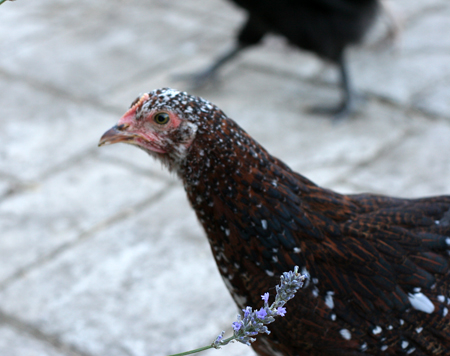
mo or curly sue 2.jpgIs this Curly-Sue or Mo?  They grew up to be the same size so I can’t tell!  The flock integration has worked out well.  There are enough of the young ones to huddle together for safety when Dot charges them.  Yes, Dot wants dominion.  Actually all of the older hens rush at the young ones but there has been no substantial bullying, no eyes have been pecked out, and the little ones are getting bigger every day so that soon I think there will be less rushing at them and a true pecking order will be established.
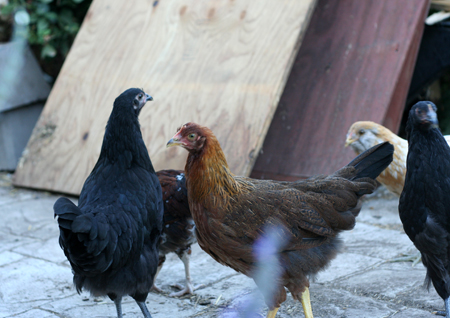
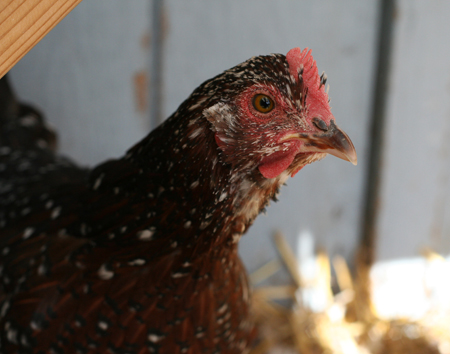
I love the way the Speckled Sussex hens look!  So pretty!

the pullet gang 2.jpgIt has been such a pleasure to see all the hens running around in the garden.  They’ve been plucking at the low growing blackberries.  That’s fine with me.  It will make their eggs richer and better.  But they probably won’t taste like blackberries.

most beautiful fruit 2.jpg

Here they are.  The fruit of my laziness.  I have been letting some brambles get out of control in the past two years and my reward are these plump, finely perfumed, sweet (though I like them with just a hint of sour still in them), summer berries.  I believe that blackberries are my all time favorite fruit.  They remind me of everything wild and scrappy.  They have been, for many years, the only thing I love about summer.*  In Oregon there are so many of them growing wild by the roadsides that when the heat rises the air smells like ripe blackberries.  It’s a heady experience to go whizzing down a country (or town, or city, or freeway…) road on my scooter and pass through a great cloud of warm rich blackberry scent.  It is the essence of summer.

It’s true that they are the scourge of the cultivated garden.  There are a few varieties that are fairly tame but I tend to doubt those ones taste as good as the ones that misbehave and sprawl all over the place like a bad boyfriend.  I can’t say if this is true elsewhere but here in Oregon if you have a blackberry popping up in your yard, or you see them by the roadside, they are most likely not truly wild blackberries but a variety first created by Luther Burbank called “Himalaya” which was so successful that it has taken over this whole state. 

I learned that fact from the Master Gardening program I took a few years ago.  I haven’t done any research to verify if it’s true but I like to think I have a little piece of Burbank in my garden that just arrived randomly to bring me these amazing free fruits.  I also happen to have a Santa Rosa plum tree, another of his finer works.

My house is in a state of mad chaos.  I’ve been working hard at my job, and doing my Kung Fu, and shopping the farmer’s market, cooking, and generally ignoring everything else.  I had meant to get the house really cleaned up before my departure but we’ve all been down with gastroenteritis this week so not much got done but what absolutely had to.  So I’m packing up and printing some Stitch and Boots business cards because I’m heading off the the Blogher convention.

When I return home I hope to get my house in better shape and to share several posts here that I’ve been sitting on while finishing the details (cooking times, photographing, etc.).  In the meantime I hope you are all stopping to smell the brambles in the air and taking the time to enjoy the amazing produce of summer!

*This is patently untrue as I have been known to say the same thing about home grown tomatoes.

Enhanced by Zemanta

Mid-Winter: What To Eat

It is exciting to me that so many more people are making their way back to seasonal eating.  For those people dedicated to eating as locally as possible this isn’t something they have to think about because eating locally forces you to also eat seasonally.  Learning to eat seasonally isn’t easy when nearly all grocery stores are always stocked with tomatoes and summer squash in winter.  How do you know what’s in season?  Different regions are going to be a little (or a lot) different.  In Florida right now it’s strawberry season but by the time it’s strawberry season where I live, in the Pacific Northwest, it will be much too hot for strawberries in Florida.  So I can’t tell everyone what’s in season for their area specifically.  I can only give some general guidelines to help you find out what’s in season where you live.

Here are some tips to discover what’s in season where you live and following that I will list what’s in season specifically for my area.

Shop your local farmer’s market: this is the number one way to discover what’s in season.  Though many farmer’s markets close during winter, be sure to do some research including nearby towns or cities that may have year-long markets that you can visit.  A winter farmer’s market will have only the produce that could be grown in your region and stored (such a root vegetables) in winter.  At the one farmer’s market in Portland that’s open all year many vendors have produced their own jams and pickles and sauces from the produce they grew in summer so you may not be able to buy tomatoes from them but you can buy salsa produced locally.  Even if you don’t make a habit of regularly shopping at a winter farmer’s market, go to one to educate yourself.

Ask what produce is local at your regular supermarket: many large supermarkets will carry a few local items even if they aren’t labeled as such.  Be sure to talk with the produce manager to find out if they carry anything local.

Read garden books about your region: here in the Pacific Northwest we have a fantastic garden guide (but only for regions west of the Cascades) put out by the Seattle Tilth that is a month by month guide to what to plant and when.  Even if you don’t garden you can easily see what grows during different seasons in your specific climate.  Look for climate specific guides.
I would love to see some Southerners and Southwesterners compile a region specific list of what’s in season for them in winter.  The list I give below should roughly apply to most of the top 2/3 of the United States but will not apply at all to people in the South and Southwest for which I apologize! If any of you out there have been working on this topic and studying your region for seasonal eating and can provide a detailed list, I would love to publish it here.

What to eat in mid-winter:

Fresh eating: (either pulled from your own garden or bought from the store, these items should be available picked fresh)
Chard

Kale

collards

leeks

citrus (though it comes from the southern states if you buy them, winter is their season)

watercress

chervil

mache (corn salad)

parsley

sorrel

Asian greens (tatsoi, mustards, bok choi…etc.)

endive

radicchio

persimmons (depending on region, may be done by early winter)

mushrooms (if you have a local cultivated source)

From the root cellar: (even if bought from local farmers, most likely these things were harvested in fall and stored)

potatoes

carrots

onions

cabbage

winter squash

celery root

parsnips

rutabagas

sunchokes

turnips

beets

shallots

apples

pears

kiwis (usually harvested in late fall and ripen in storage in winter)

garlic

From the pantry:

fruits

pickles

jams

sauces

dried things

We have become very accustomed, us modern people, to eating tomatoes in winter and apples in summer but it isn’t natural and except for the root vegetables that store well nearly all year, no produce is at it’s best when it’s no longer in season.  Winter is a harsh season, especially for people living in the extreme north.  Our diets should become more limited in the winter.  When you spend all winter eating mostly greens and root vegetables punctuated by things you preserved for the pantry, you will look forward a great deal more to the change in diet the spring brings with asparagus and radishes and lettuce.  It may sound bleak if you’re used to eating lettuce salads all winter but unless you’re eating lettuce from your own green house, it isn’t natural to eat lettuce in midwinter.  It’s a time for soups and root vegetable roasts.  While it may seem counter intuitive to some people, eating preserved food (particularly made by you) is healthier than eating out of season vegetables.  It takes a big shift in habit but I think you’ll find that when you eat seasonally you become more connected to your own region, the earth’s natural cycles, and your food will taste better and provide more optimal nutrition for you.

While I eat mostly seasonally and still stick mainly to locally produced food, I do have exceptions.  What I learned from going mostly local for ten months (a couple of years ago) was that there are a few things in my diet that I don’t want to live without.  Avocados and citrus do not grow in my region so buying them means I’m always getting them from hundreds of miles away.  Though sweet potatoes can grow here, this isn’t their ideal region and very few people grow them.  Tropical fruits such as bananas don’t grow here ever.  Pomegranates are another thing that I used to enjoy but which don’t grow where I live.  While I was being more strictly local I bought none of these things.  What I learned was that I can live life without bananas.  I can live life only buying sweet potatoes at the same time my organic CSA has them (we don’t get a lot of them, I bought some extras), and I can live without eating citrus often.  But I cannot live without eating avocados.  I cannot live without imported coffee and olives.  While I was doing my local challenge I had a small list of imported foods that I allowed myself to have such as coffee, tea, oil, sugar, and some other essential items.

I consider imported items as a flexible list but a list that must remain roughly the same size at all times.  So while I’m buying avocados, I don’t buy other non-regional produce such as other tropical fruits.  If I really want to buy bananas for a special occasion (I bought them for the first time in two years a couple of weeks ago) I don’t buy some other non-regional item.  I am happy with the balance I’ve reached for now.  I am constantly looking for closer sources for things like oil and while cost is obviously a factor since I have very little padding in my budget, I can’t always afford to buy things made closer to home.  However, I found an olive oil that’s produced in California (organic!) that costs only slightly more than the cheap imported olive oil I can buy at my discount grocery store*.  California is a lot closer to me than Spain or Italy so buying from California not only reduces the number of miles my food had to travel to get to me, it also supports the economy of my own country.

Seasonal eating has given me a greater appreciation for the food I cook and the flavors I associate with each month of the year.  I would like to end this article with a little list of the foods that you shouldn’t be putting in your grocery cart unless you live in one of the southern regions in which these things might be showing up at your local farmer’s markets:

Not in season in winter:

tomatoes

fresh basil

eggplant

summer squash

green beans

lettuce

strawberries

berries of any kind

peppers (unless preserved)

cucumbers

Happy seasonal eating!

*I should note here that even at my discount grocery store the olive oil is surprisingly expensive.  If a Trader Joe’s was closer to me I’d probably buy theirs because it’s such a great price.  But I heard from a friend that even Trader Joe’s has some California oils available.

Farmhouse News

This is the market tote I’m making for my Etsy shop but will offer a tutorial on later so you can make your own.

Here at my farmhouse in town winter is really getting under way.  This morning we had our first hoar-frost with the temperature down to 22 degrees.  I know that in many areas across the country it has already gotten much colder and everyone is bundled up in their wool and mittens.

I am busy making market bags for my Etsy shop.  We have long since stopped using paper or plastic bags to put our groceries into and use cloth grocery/shopping bags.  Every time I leave the house I grab at least one of them because I can never be sure when it will come in handy, when I return home I hang it up on my bag hook.  We have many shopping bags because our kid can’t go anywhere without an entire tote bag filled with snacks and things to amuse himself with.  He’s an intensely picky eater and a grazer so he’s always hungry when we’re out and about but there is rarely anything “out there” for him to eat.  We always travel with a protein bar, some crackers, and filtered water.  He also has ADD and it has been a lifesaver to us since he was a toddler to always bring a collection of things/toys for him to play with while we’re out.  He will panic if he doesn’t have a bag of his things because his view of the world, depending on his mood, is that it’s either insanely boring or very hostile.  In either case, we never travel light and so some of our market bags are always packed with his things.  Some are also always in the wash.  So we have three hooks in our kitchen dedicated to aprons and market bags.

It took me a long time to get into a good habit of always having a cloth bag with me, and even now I forget once in a while, but the real trick for me turned out to be having those bags near my kitchen door, which also serves as our front door.  So if you have trouble remembering to bring bags with you, try this out.  Also be sure you have an abundance of them.  If you only have one or two you will never have them handy.

The bag I made (in the picture above) is a simple tote with no pockets.  It’s lined with muslin and has sturdy woven cotton handles that are long enough so that you can carry the bag on your shoulder.  This bag is currently in my Etsy shop and when I’m done with this post I am heading to my sewing machine to make several more in a couple of other patterns so if you would like to buy one please visit the Etsy shop.  If you want to make one of your own I have decided that this is one of those sewing projects that is ideal for beginners so I’m going to do a tutorial on how to draft this bag to your own sizes needs and how to make it.  But if you are already familiar with my timing you will understand that it may be a while before I pull it all together to present to you.

In a little garden news I want to share the surprise I found underneath my bean tee-pee: 4lbs of carrots!  I will probably do a separate post to talk about underplanting in the garden, but today is just a little post to share what’s been going on around here.  The carrots were completely neglected and thrived- they are so sweet I’ve actually been snacking on them raw.  I don’t often like snacking on carrots raw and plain but these are so sweet I am really enjoying them!  I absolutely love garden surprises whether they are volunteers shouting up at me from the ground (often the legacy of previous gardeners) or if I planted something and thought it died only to find it thriving later on.

It’s time I got to my sewing room so until next time- happy homesteading!

Come visit the Stitch and Boots Etsy Shop!

Stitch and Boots Etsy Shop

Here on Stitch and Boots my main objective is to help people learn as many of the skills an urban homesteader might need to know that are within my realm of expertise to share.  I want to be a conduit to DIY success in cooking, sewing, fixing, cleaning, and growing.  Sometimes with the help of much-loved and respected friends, often on my own.


In my former life I have been many things including: fast food cashier, electronics salesperson, shipping manager for Weston Wear in San Francisco, custom costume designer, needlewoman, assistant designer at Mulberry Neckwear, color swatcher at Mulberry Neckwear, coffee jerk (several times), technical writer, unpaid novelist, retail store owner, product designer and manufacturer for my own retail store, metal grinder (very briefly wonderfully satisfying), housewife, stay at home mom, and currently I am a headline editor for an online ad network.


I shut down my Etsy shop that followed my retail brick and mortar store because I wanted to be done with sewing for commerce.  I have a good job and not a ton of time.  Having a good job at this time must be counted as one heck of a blessing and I couldn’t be more thankful that I have one.  However, in spite of both my husband and myself being employed, like so many people we know we make very little money together and we are facing the tough prospect of a winter with no extra room in our budget for things like heating our house*.

I have some wonderful back-stock from my retail store that I made myself and I have decided to reopen my Etsy shop to sell what I have and to make some new things for it as well.

I have thought a lot about what my purpose is, what my usefulness to people is, and I believe that the real service I can offer to people is to help them learn to do things for themselves.  Trying to sell people ready-made things isn’t my main goal nor my ultimate gift.  The service of helping to teach others to do for themselves needs to be free.  I need to offer this as a real service.  A thing I do not for commerce but for sheer joy and personal fulfillment.  Money, just to have lots of it, is not an end goal I have, though I admit that like most people I don’t despise the dream of being  comfortable.

Most of the things I am listing in my Etsy shop are things I’d like to do as tutorials  here so that everyone can, if they want to, make them for themselves.  What I would ultimately like to do is to offer tutorials on how to make all these projects for yourself and then offer patterns only for sale at some point.

One pattern I will be working on this coming week is a little pattern for the mushroom applique I designed for the men’s shirt smock project.

I hope that all of you will visit my shop if only to say hello and see what’s going on there.  I know that so many people are in the same situation that I am financially and aren’t in a position to be shopping.   I am going to include links to my Etsy shop in any post where it seems appropriate but I ask you not to feel importuned in the least nor pressured to buy.  If I have something for sale that is exactly what you need or want then I will be delighted to provide it to you, but what I really want is for you all to continue visiting to see what new recipes, projects, and plant profiles are being added to this urban homesteading database.  I want all of you to continue to feel empowered to do things for yourselves.

Here is a link to my newly minted Etsy shop:

Stitch and Boots on Etsy

I have some new recipes to post in the next few days so come back soon!  Thank you all so much for spending time reading Stitch and Boots, this is one of my greatest achievements in progress!


*I’m not kidding.  The interior of our house has been between 53 degrees and 56 degrees all day.  We’ve always been known to keep our house at a fairly crisp cool temperature but this is ten degrees lower than we usually go.

Urban Homesteading: Doing What You Can

lettuce seeds 2

For the past ten years my summers have been punctuated by preserving projects.  Every summer I make jam, pickles, dry tomatoes, dry herbs, make relishes, and put up dilled beans.  This is the first summer in a decade when I have not had the time or the energy to do my usual preserving projects.  It was my plan to do at least a few of my usual projects and photograph them for tutorials to share with all of you here.  I want you to be able to come here and find all of the basic canning projects you might want to do and feel confident that you can do them with really clear instructions.  I was putting off posting much because I didn’t want to post unless I had a tutorial of use or an informative article.

But then I realized something; I realized that many of you out there are in the same boat as I am in myself: you’re working many hours a week to pay your bills and are scrambling to find the time to do the homesteading projects that you love doing.  I have been lucky to have been able to have stayed home and not worked outside the home for most of the past decade.  I am equally lucky that when the time came that I had to get paid work in order to keep our house and our son clothed, I landed an excellent job.  So I’m not complaining about having to work, but trying to figure out how I can work 30 hours a week and still find time to make my own lip balm, can tomatoes, and sew curtains for my old house.

What I have been telling other people for years is that urban homesteading is about doing things for yourself within a modern and urban context.  It isn’t a contest in self sufficiency.  It’s an exercise in learning to make things that are higher in quality than you can buy.  It’s about empowering yourself with the know how most of our grandparents had because there is something deeply satisfying in being capable of taking flour, water, salt, and yeast and producing a loaf of bread that is as good or (often) better than you can purchase in the store.  When the bread shelves in the grocery store are empty you won’t be afraid, you can make your own.  It’s the spirit of doing things for yourself even though it will take longer than it would to pay someone else to do it.  I have begged people not to feel left out if they live in small apartments in a big city because the spirit of urban homesteading can exist and be satisfying  on all scales.  In a small apartment you may not have room to store a year’s worth of tomato sauce and jam but you can do small batches that will still give you a profound enjoyment and satisfaction.  You can still make your own dinner napkins and you can do all kinds of repurposing projects.

What I realized this week is that no one is reminding me of these things.  No one is telling me to stop worrying about the fact that I am quite possibly not going to have the time or energy to can at all this year and instead just make spectacular use of the seasonal produce we have right now.  I might not be able to make tomato sauce to last me all winter (I usually can about 500 pounds of tomatoes) but I sure as hell can make some tomato sauce from scratch right now while the tomatoes are flavorful, local, fresh, and properly ripe.  It’s so easy to forget that the most natural thing any of us can do is to eat seasonally.  Soon enough I won’t be buying any tomatoes at all because their season will end.  So why waste time fretting over what I can’t do and simply enjoy what’s fresh now?   So this post is to remind myself, and anyone else in my position, to not get overwhelmed by what we don’t have time to do and instead make the very best out of what we do have time for.

I believe that if I prepare better this fall and winter around my house and garden I might be able to make more time next summer for the kinds of projects that I look forward to each year.  If I find good ways to fit more homesteading into my schedule I’m sure you’d all like to hear about it so I promise to share details.

In the meantime I will start posting more often.  It won’t be the preserving tutorials but there are smaller projects I have going on around here like saving carrot seeds from the garden, cooking (more recipes for making the best of seasonal produce) and I realized that it isn’t particularly time consuming for me to write plant profiles.  I want to have a ton of those for people to reference so that you can come here and access a comprehensive volume of information on all the vegetables, fruits, and herbs that an urban homesteader might find useful to grow.

So this post is to remind you and me to go easy on ourselves.  If you are working full time and don’t have a ton of time for homesteading activities, don’t let yourself become mired in frustration.  Rejoice in the things you can do with the time you do have.  It’s the spirit of urban homesteading that feeds our spirits and builds our confidence- it isn’t about doing everything.

On this happy note I’m going to go clean my kitchen and then do an experiment with substituting lemon juice for citric acid for curdling milk.  The question has been asked how this substitution might be achieved and I’d like to discover and share the answer to it which I can do today since I have the milk for making ricotta and plan to make a casserole of grilled vegetables in ricotta. 

Happy homesteading!

Headmistress Mrs. Williamson (Stitchy)

 Homemade Ricotta (A tutorial on making your own ricotta)