Behold My Inspiration Doors!

My friend Sarah suggested that I start an inspiration board to help me keep my weight-loss goals in my mind.  I thought it was a great idea except for the fact that my office is nearly all windows (it’s a windowed-in porch) so I have nowhere to hang any boards.  An idea came to me, I’m not sure how, that I could make a free-standing board that could be decorated with fabric swatches and garments I love and want to wear again, and magazine pictures.  And then I realized that what I really needed was the equivalent of closet doors to hang outfits on for inspiration.

So I went on a quest to find a couple of old doors.  You might not be amazed to know how many hideous doors there are out there and how much the cool vintage ones cost but I was kind of surprised.  I ended up lucking out at a salvage place (and don’t think “junk”, this place has crazy cool and $$$$ stuff in it) in Petaluma called Heritage Salvage.  I saw an exquisite turquoise hobbit door with a metal grill in it for $600 but Philip said I wasn’t allowed to sell Max just to have a gorgeous door.  I did find two old doors that suited my purpose perfectly and paid a total of $40 for the pair.

Missing doorknobs, peeling paint, and dirt all included in the price.

Plus rusty paint-clogged broken hinges.  But the best part you will see in the last picture: two hooks for hanging things on!

One door was taller than the other so I had to cut it down with my banged up circular saw.  I did an alright job, not my best work, but it served.

Then I hinged the doors together.  This was easy to do but not easy to figure out.  I didn’t want to take the old hinges off because I like them but then I couldn’t use those sides of the doors for the new hinges and the hooks on the front of the one door made putting the hinges on so they wouldn’t be visible impossible.  So I just put them on the inside where they are all super shiny and ugly.  Who cares?  I might paint them later on.

I do have some wood that I plan to cut down and fashion into “feet” to stabilize the doors so that I can open them up all the way when I feel like it.  For now I’m fine just keeping the doors slightly bent.  I love them!

I spent (including the lumber I haven’t used yet) a total of $70.  I know a cork board is less than $30 but not nearly as cool as my old doors!

A Walking Tour of San Francisco: Chinatown Groceries

Last Friday I went into San Francisco to meet a friend I hadn’t seen in over 15 years.  I did a lot of walking, as I always do.  If you want to see more of my walk in San Francisco you can read A Walking Tour of Down Town San Francisco: Angelina Style over at Better Than Bullets.  This post is all pictures of groceries in Chinatown.

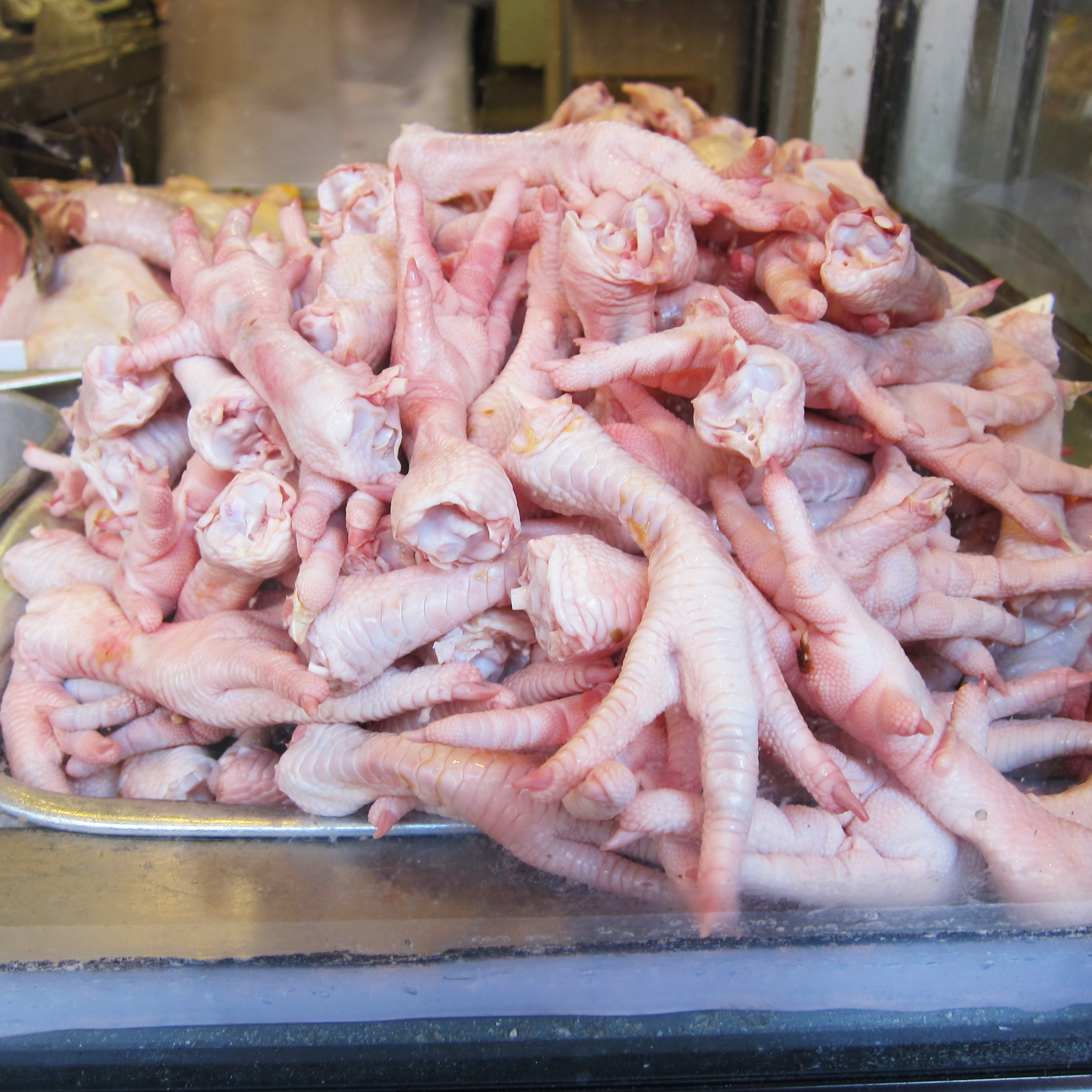
Starting with those chicken feet.  A big bin of chicken feet.  As a vegetarian who prefers that animals not be killed for eating I am happy when people use as much of an animal as they can.  But I have to say – the sight of those toenails is about as unappetizing as food gets.  I’d rather eat fried brains than suck on a chicken toe for juices or eat soup that was stewed with chicken toenails.  If I was going to eat a human being – I would definitely not eat their fingers or toes.

What I love best about Chinese markets is how unpretentious they are – there is such a melee of STUFF.  Such a jumble of dried goods and grains and nuts and packages of mysterious ingredients (only mysterious to me, not to the regular shoppers of the markets) and the bins and boxes used to hold all these interesting edibles are always bedraggled and funky.  It may sound like an insult but it really isn’t.  I think this is how people have been shopping for a thousand years before there were fancy big-ass grocery stores with shiny shelves and precious rustic (new) bins for vegetables*.

Like so many shops in Chinatown – the windows of this one don’t look like they’ve had a good scrub-down in ages.  I don’t really know what that stuff is in the window.  Maybe pastries of some sort?  Except that I think they were selling live seafood too.

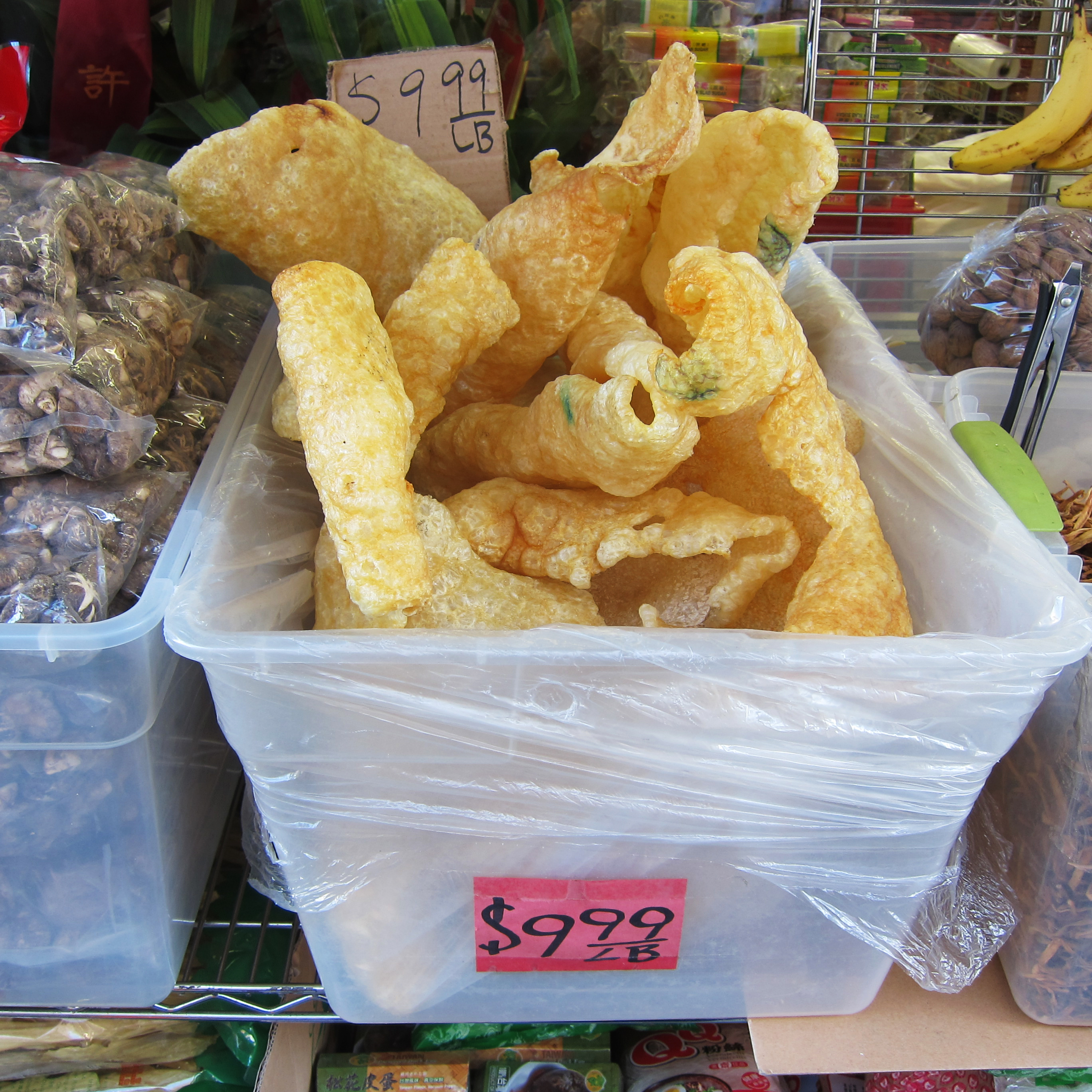
This fried skin interests me because it still has the ink markings on it.  Waste nothing!  I couldn’t figure out what it originally was.  I thought maybe fish except that I don’t think fish scales would puff up like that with frying.  I have no idea.

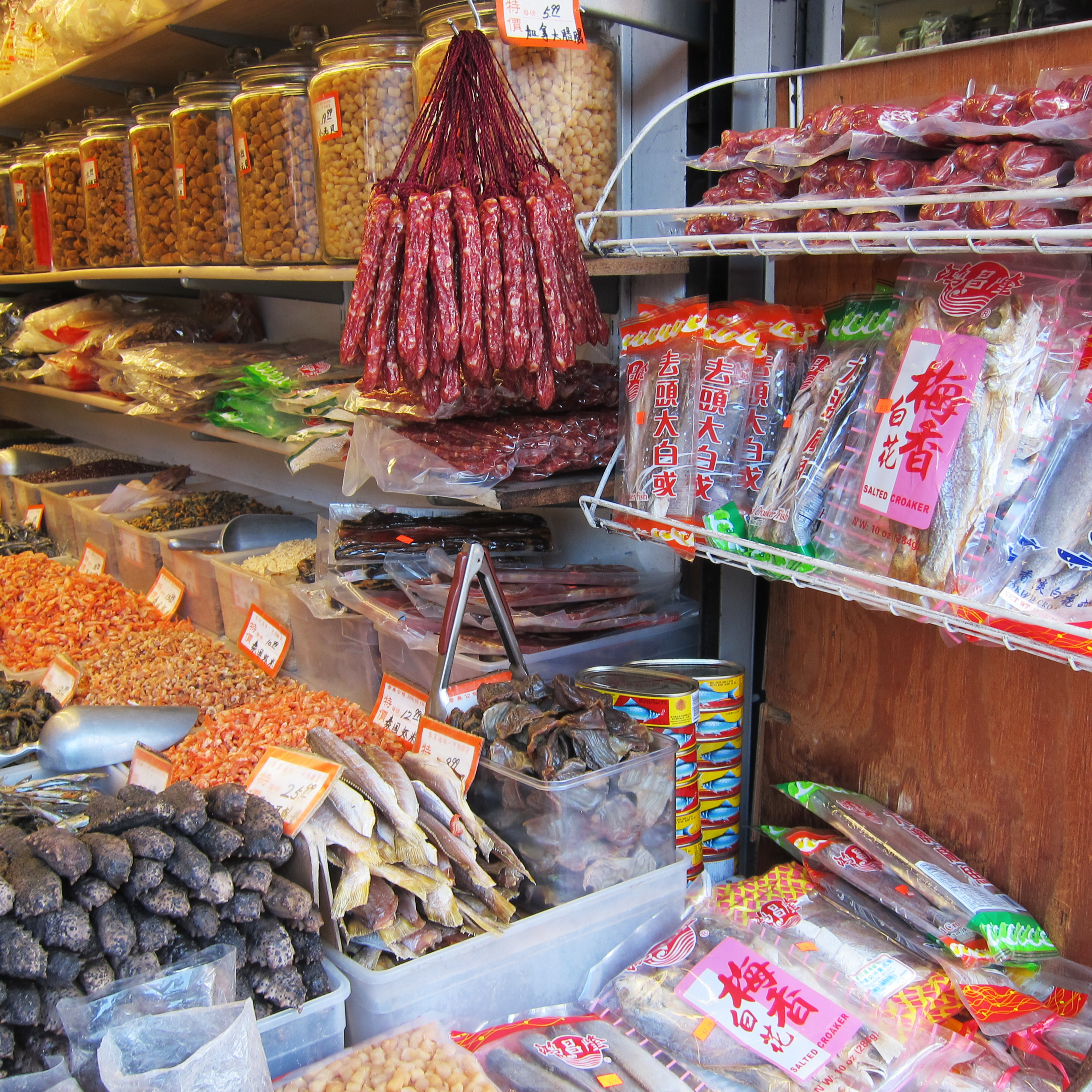
This shop has all kinds of packaged up fish.  Are they cured fish?  The fish in the bags in the front here aren’t vacuum sealed and they aren’t dried.  Are they pickled in some way?  Being in a bag on a warm day in San Francisco with no refrigeration makes me think these fish are preserved in some way.  I’ll tell you what – this market was the stinkiest one I passed.  What’s in those jars up high?  Next time I want to explore more closely.

All of these pictures were taken on Stockton Street except for the chicken feet.  Grant Street is pretty much all shops exploding with tourist crap and jewelry stores.  Stockton Street is where most of the real markets are for kitchen supplies, food, and useful groceries.  I think this is sugar cane.

When shopping in Asian grocery stores or Chinese shops like this one the thing that impresses me most is how much dried and pickled food there is.  I think this is because the Chinese have had an established culture for so much longer than most others and traditions run deep – think about all those hundreds of years when there was no canning or refrigeration to keep foods good.  People of all cultures relied on dried, fermented, salted, and smoked foods for getting through lean seasons until the last 150 years when people figured out how to can foods in sealed jars.  While all cultures have a food history rich in dried foods – I think Chinese people still rely a great deal on dried and fermented foods out of tradition rather than necessity.  Who’s going to fare the best in an apocalyptic situation?  I’m betting on the Chinese people both in China and in the United States.  People who know how to make meals from a handful of dried mushrooms and fish and fermented soybeans have a leg up on those who rarely use dried goods or keep much in their pantry.  By the way – if you want to read more about the history of food preserving you should read the book “Pickled, Potted, and Canned” by Sue Shephard.**  I don’t rely on dried goods much in my own cooking but I plan to play with my dehydrator more and explore the potential there.

That concludes my food tour of Chinatown.  I hope you enjoyed it!

*Full disclosure: I love all grocery stores and food markets.  I love those fancy ones too – I just don’t feel the same sense of curiosity when in them and sometimes it annoys me when stores get a little too precious over a carrot or charge $5.99 p/lb for tomatoes during the height of tomato season.  But seriously – put me in a grocery store, open food market, or farmer’s market and I’m going to be in my happy place.

**No one I mention that book to ever wants to read it but it’s a truly interesting read – very entertaining and informative.  It’s not some boring book about making jam.  It’s a book that talks about how the cod industry grew a nation and how salt pork made exploring by ship possible and how dried goods made fighting wars on other people’s turf possible.  Please ask for a copy for Christmas if you like food at all.  I get nothing for recommending it to you.  No affiliate links here and no sponsorship.  In fact, the copy of this book I read was checked out from the library.  (See if yours has a copy)  and as I’m talking about it I realized that I want a copy of this for myself – so I think I’ll ask for it for Christmas.

An Olive Update: the first taste test!

This past weekend we tasted the first batch of olives.  I flavored them two ways.  1) bay, lemon, garlic, and rosemary and 2) bay, lemon, garlic, and thyme.  I removed the garlic from each jar after one week.  Holy mother of garlic fiends!  Does that garlic get strong in the brine!  Lesson learned: use one clove per jar and see what happens.  Several is much too pungent.

I love rosemary so I fully expected to love it in my olives.  I did not.  Philip didn’t like it much either.  You know who tasted both and preferred the rosemary olives?  Max.  I am amazed that he wanted to try either of them – he recently tried his first commercially made green olive and didn’t like it.  But he wanted to try mine.  The texture of olives is still throwing him off but he liked the flavor.  Especially the rosemary flavor.  My take on them: very sharp and much too piney, overwhelming herb flavor.

Philip and I both loved the thyme flavored ones.  SO GOOD.  Excuse me but this is what I said when I tasted them “These are SO FUCKING GOOD!!”*  The texture is perfect.  The flavor of these ones was more subtly herby but with the briny flavor of olive coming through.

I was completely excited by how good these turned out until Philip put a damper on my excitement ten minutes later by saying he felt a sudden wave of nausea and broke out in a little sweat.  He thinks it was the olives.  I denied the possibility very strongly.  I do not poison members of my family with my preserving projects!

However – I had just burped up pine flavor before he poked a giant hole in my triumph so I had to admit to myself (but not to him!) that there might be something in his experience.  That rosemary flavoring was really harsh and Philip has a delicate stomach.  I’m not saying that to be mean.  He’s tough in many ways but his stomach is not an organ of great fortitude.

It is the easiest thing in the world to make him get queasy.  Here’s how you do it:

You “Hey Philip.”

Him “What?”

You “I think that milk was bad.  I feel queasy.”

(wait two minutes)

Him “I feel queasy too.”

See?  Or you can just make him clean out the litter box 15 minutes before having him taste your olives.  Or just ask him “Are you feeling queasy?” just asking him that question has often been effective.**

My theory is that those rosemary olives are unpleasantly potent and upsetting to stomachs.  Until I have proved this is the problem I will not share my olives with anyone else.  The next step is to taste only the thyme olives and see what happens.  But I have to let Philip’s fear fade a little bit first.

Fingers crossed.

Next up – flavoring the second batch.  But not with rosemary.

*That’s what I said in my head and then put on facebook.  I did not say it in front of Max.  Although I completely approve of swearing on general principle, I don’t swear in front of him.  Except by accident.

** While I can make fun of him for being so highly suggestible – I have to remind you that I’m emetaphobic and this means that if I know someone is sick with the flu and are vomiting or if I see or hear vomit – I will become nauseous immediately.  However, my stomach is very strong and rarely feels a twinge that is not produced as a byproduct of anxiety or proximity to sick people.

Fermentation Fail: witness my moldy pickle

It was time to check up on my fermenting pickles.  The cloudy water was not encouraging.  When I opened up the jars the smell was: garlicky dill with a hint of food-gone-bad.  It almost smelled right but really didn’t.  I suppose that they might be safe to eat when you consider that people have been burying fish to rot them for eating joy for hundreds of years.

But I am not a person who buries things until they’re rotted just-so.  My dog does this.  There is nothing finer to her than to bury a bit of rawhide in a good rainy spot, let it acquire a strong odor of dead body, and then dig up the blackened delicacy to eat at my feet.

I don’t know what I did wrong.  The cauliflower I fermented two years ago never went bad.  I had it in the cupboard for months before we finished it off.  I was completely confident in it and we enjoyed eating it.  I followed essentially the same process.  An acquaintance of mine has suggested they got too warm.  This is a very real possibility as September and part of October was pretty hot and there isn’t a truly cool spot in the house to store pickles.

I’m disappointed, obviously.  Such a waste of pickling cucumbers.  But as with all skills – there is a learning curve and some failures are expected.  My olives seem to be doing alright still and I can start a new fermentation project using winter vegetables like cauliflower, carrots, and possibly some greens.  My friend Cam suggested fermenting mustard greens like her mom did when she was growing up.  She says she’ll see if she can get the recipe for me.

On the bright side of the food preserving front – last night I didn’t want to make dinner.  I was too tired.  But hungry.  So I pulled a jar of my tomato sauce from the pantry and whipped up a super easy and quick marinara sauce and had spaghetti with roasted cauliflower and it was so good!  This is why I do all the canning work I do.

Have any fermenting tales to share?  I want to hear them!

Georgia O’Keefe Should Have Painted Figs

My too-dry-dried figs sat on my desk for quite a few days before going into storage.  So I had a lot of time to look at them.  And it came to me one day that they looked like small mean vaginas with teeth.  I put them away the next morning.

Can I offer you a fig?

I didn’t photograph my Thanksgiving dinner.  I cooked for three people.  I missed having my sister with us.  Needless to say – we kept our meal simple and we watched Miss Marple while we ate.  Here’s what we had:

Casserole: poblano peppers stuffed with tofu, corn, and zucchini on a bed of green rice (rice with pureed tomatillos, cilantro, and lime juice) and topped with a cashew cream sauce.

Mashed sweet potatoes: plain for my mom but for ours I added salt, pepper, and butter.

Salad: romaine lettuce, apples, walnuts, and cranberries with a vinaigrette.

The salad and yams were predictably good.

The casserole was an experiment – something I thought up to use the last of the summer peppers and tomatillos and summer squash.  It turned out really good – it was delicious!  Except that I have come to realize once again that I really don’t like peppers and can’t eat them.  Except for pickled jalapenos, crushed red pepper, and cayenne – peppers do NOT agree with me.  They made me burp for hours.  So if I did this casserole again I would not use the peppers.  I would just do a bottom layer of the green rice, then do a layer of the tofu and vegetables, topped with the cashew cream.  I’d eat that again in a second.  I don’t love rice, as you may have observed from the lack of it in my recipes.  I don’t hate it but I never crave it and generally speaking – I’d be fine never eating it again.  Even so – the rice layer of the casserole was really good!  I think what I liked about it was the tanginess of the tomatillos and because I precooked the rice and then mixed it with the puree – it was a little bit like risotto – not fluffy and dry – but not soupy either.  It was perfect.

About cashew cream: it’s really good stuff!  I have discovered that you need a blender that doesn’t suck to get it really smooth and creamy.  If you have a blender that has issues with blending things you may have to do small batches and add a little extra water to it.  I could smell my blender motor burning.  Nice.  But it managed to get the job done with a lot of coaching.  Cashew cream is rich without being heavy and it browns nicely like cheese does.  I definitely want to play with this again.  It’s certainly not a low fat food so using it won’t be less fattening than using cream or cheese – but it is a really nice vegan option and it is full of good protein and nutrition.  Biggest problem is that cashews cost a fortune.  So I won’t be using this a lot – but it’s worth experimenting with some more.

Over all we had a really nice Thanksgiving.  If you want to hear all about my thankfulness you can read my post Gratitude for All of You over at Better Than Bullets.

So how was your Thanksgiving?  I hope you all had a good time with people you love!

Salt Curing Ripe Olives: First Batch

First of all – this process is known as “oil curing” not “salt curing” but since the actual curing is done by the salt and the oil is just a finisher – I think it’s ridiculous to keep calling it oil curing, even though that’s what it’s traditionally known as.  I like to be specific as much as possible.  Henceforth everyone will be confused about what I’m talking about – except for me.  Once again I am following curing instructions by one of my favorite food bloggers Hank Shaw.  His post “How to Make Oil-Cured Olives” is a must read if you want to try this.  There are other articles you can read about this – but make sure this one is part of your research.

My dad has a rental property in the town of Sonoma on which he has a small vineyard of pinot grapes and a small orchard of olive trees.  They are all varieties of olives grown specifically for pressing oil which he does at various community presses.  I have missed out on his olive adventures because they only started maturing while I was living in Oregon.  He said I could come pick some for curing before the big harvest for pressing which happens in a couple of weeks.  So my friend Sharon and I headed out to his place yesterday for some olive picking.

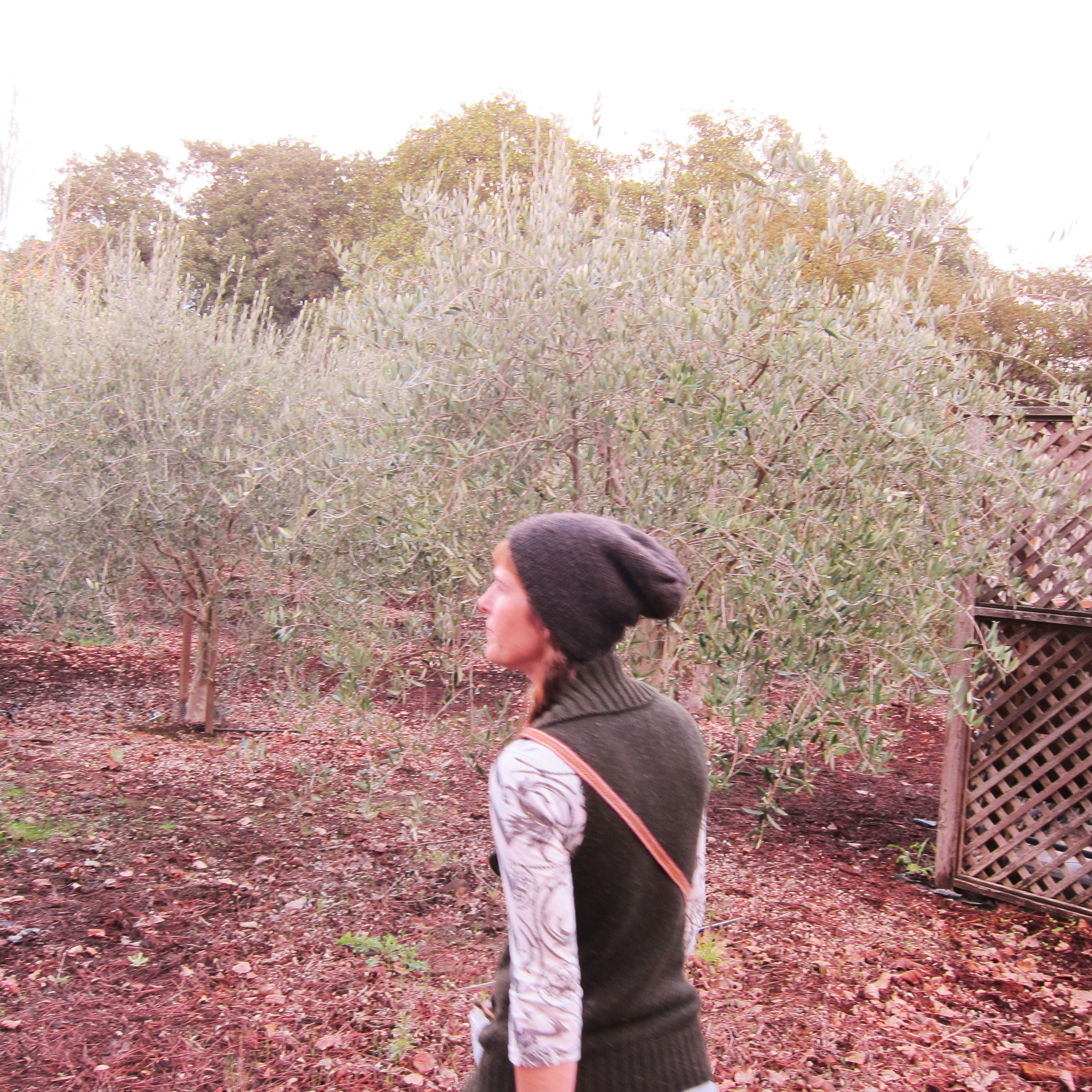
The orchard is very pretty.  I love olive trees.  However – the first thing we noticed and what I ought to have realized before going up there is that the olives are very small.  Olives for pressing have a much smaller flesh to pit ratio and tend to be much smaller than eating olives – I know this because I’ve read a whole book about olives.  Never the less – we both picked a small bag of the small ripe ones to cure.  Since I didn’t get to use many of them for curing I am going to come back to help my dad and his crew pick them for pressing.  Hanging out in olive orchards, even little ones, is really peaceful.

We were disappointed in not having had more olives to play with but Sonoma is absolutely covered in olive trees so we kept our eyes peeled for promising trees.   We ended up finding a couple of trees in front of a house-turned-radio-station on a main street and got permission to pick them.  These babies were ripe and nice sized.  In the end this is what I came home with:

1 lb 3 oz  of my dad’s small olives

2 lbs med olives from Sonoma (town tree)

Hank suggests putting them in old (but clean, obviously) pillow cases.  Because I wanted to keep my two varieties separate and because I didn’t have many of either I cut my pillow cases down in size.  I used about a 1 to 2 ratio of salt to olives (in pounds).

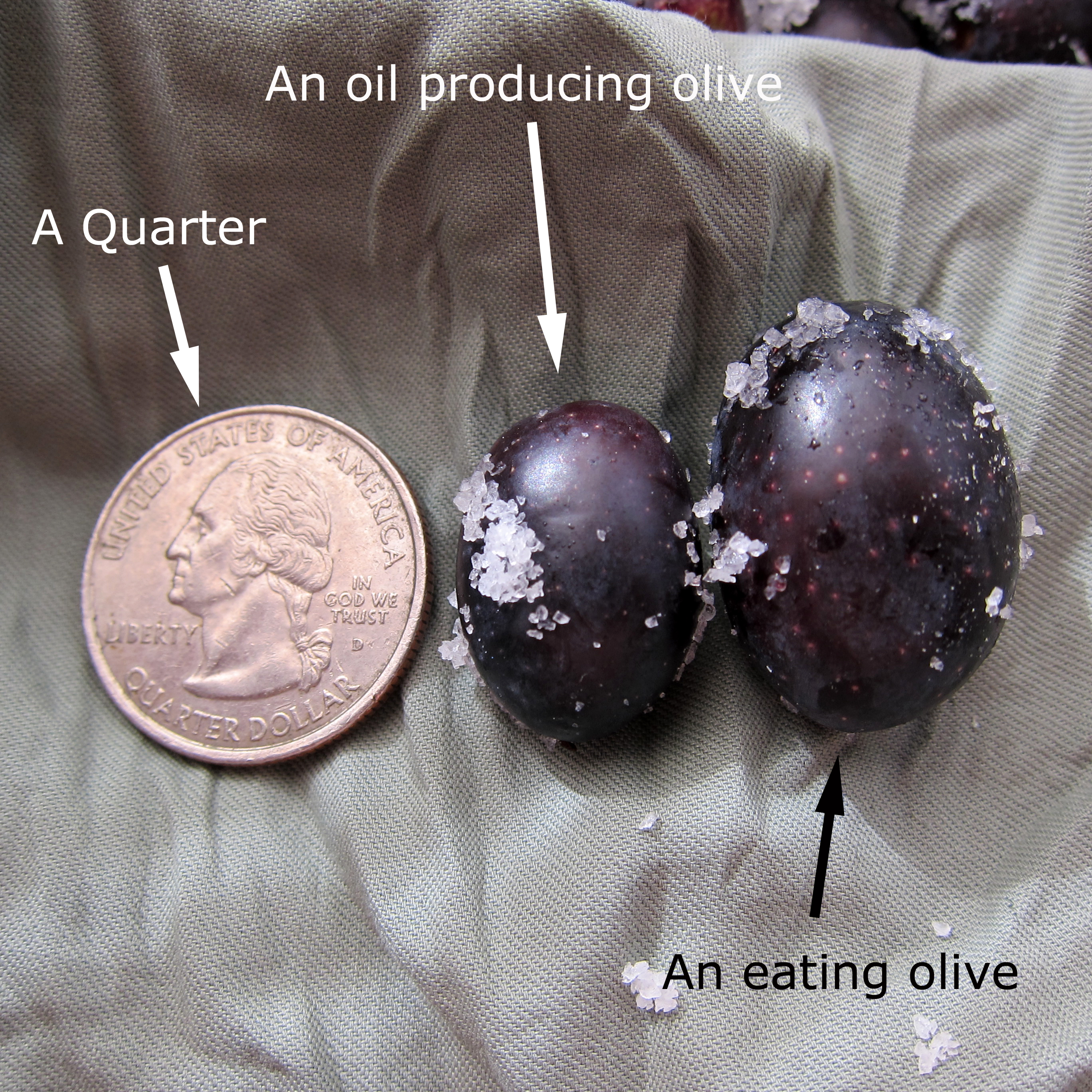
Here’s an informative image to demonstrate the size of my olives to each other and to a quarter for reference.  I am annoyed by quarters being used for sense of scale but when I tried using a thumb tack for contrast it wasn’t effective.  Oh well.

Hank hangs his olives out in his back yard.  Since I don’t have anything rigged up yet or a good spot chosen I just hung them on a rod in my tall bucket.  These will live in my office until they’re done or until I find a good spot in the yard.  They will eventually start dripping black olive juices.  Yum.  I’ll keep you posted on the progress.  I’m hoping to get a lot more ripe olives to cure in the next few weeks.  I definitely have enough green ones at this point.  Tomorrow I will jar up my first batch in their second brine with flavorings.  I’m pretty excited.  I want to do it right now but I need to get back to the paid job.

If any of you have salt cured olives and want to share your results or methods that have worked for you – please do!

Further Adventures in Olive Curing Plus a Fig Experiment

My mom and her friend have been bringing me free food.  I don’t like fresh figs but I love them dried.  Fresh figs are really expensive and I haven’t had access to any free ones to experiment with until now.  So I was excited to haul my dehydrator out of the shed.  First thing I discovered is that whole figs don’t fit in my dehydrator so I had to cut them in half.  Second thing I discovered is that figs take a lot less time to dry than I thought.  I over-dried mine.  They are now as hard as tree bark.  Ooops.  I wish I could get my hands on more to do a second trial with but I may  have to wait until next year.

I plan to soak these before using them.   I think I’ll make some fig bars with them at some point.

I am still shamefully lagging on my olive project.  Between big transitions at work that are requiring a lot of extra attention and all the stuff going on around the house – and my kitchen always being dirty – I have yet to get my olives in their second (stronger) brine.  The top of the brine has some mold growing on it.  Having experimented a little with fermenting things and reading all about it – I’m not worried about it.  But I do want to get to the next step.

My friend Sharon who is learning to cure olives with me already has had hers in the second brined for two weeks with flavorings.  I got to try some at her house the other day and I’m pleased to report that they were really good!  I want mine to be saltier than hers are – but they had a really nice flavor and the texture was perfect.  So this method of curing can definitely get you good results.  We’ll see how mine come out in another few weeks I guess.

Walnut season is done.  DONE.  And I felt sad about it the way all you strange sun loving people get sad when summer is over and the air changes.  Two weeks is as long as walnuts were dropping.  I foraged a total of 15 lbs and 1 little oz of them.  I’m really happy to say that my mom’s friend who brought me figs also brought me a big bag of walnuts!  So now I have a more respectable haul.

Here’s the jar of pickled habanero peppers that I’ll be giving to my sister’s close friend Emily.  I’ve known Emily for a long time and now she’s a grown lady with a husband and two kids.  She and her husband like super hot peppers.  I don’t but I couldn’t resist pickling some of these because of their beauty.

I’m trying to menu plan now.  I’m not doing a very good job of it.  Here’s what I plan to make during the following week.

Menu “Plan” for the Week of 11/12/12:

  • Lentil soup  (done!)
  • Stuffed pasillo peppers – stuffed with seasoned tofu and baked in a cashew cream sauce served with Mexican brown rice.
  • Baked potatoes.  What?  You have to have something easy.
  • Salad(s) with apples and walnuts, feta, and dried cranberries.
  • Kashmiri-style eggplant in yogurt

I just got what might be the last three eggplants grown by Imwalle Gardens.  That means epplant is OVER.  I don’t buy them out of season so when you can’t get them locally grown any more it means no more for a long time.  I have wanted to make this eggplant dish for a long time but it requires you to shallow fry the eggplant – I’m not big on frying and I could probably broil them but I want my first time trying this dish to be as rich as the recipe is – because the last time you eat fresh eggplant for a year deserves to be special.

The stuffed peppers is a vegan dish I have been wanting to experiment with.  I haven’t ever tried such a thing and I don’t have any recipe for it.  I do have a recipe for the cashew cream sauce.  My friend Sid made the most amazing spaghetti squash dish that was like a lasagna with layers of squash, marinara sauce, tofu, and then topped with a cashew bechamel.  The bechamel was wonderful!  So it’s time to play with creamy vegan sauces.

What are you cooking this week?

How (not) to Cure Olives with Lye

I have wanted to try curing olives for a long time.  Moving back to California where olives are planted all over the place as landscape trees and finding actual clear instructions for curing them (not a lot of information could be found 12 years ago) meant it was time to forage for olives and play with lye.  If you want to play with olives too – always use a source who has lots of personal experience SUCCESSFULLY curing olives.  I recommend Hank Shaw’s instructions for Curing Olives with Lye.  I am writing this post merely to illustrate what NOT to do.

  • The first thing you need to do is pick through your olives and remove any bruised or bitten ones.  What likes to bite into a tongue-numbingly bitter fruit?  Olive fly.  Also remove any blushed olives.  You only want really hard green ones.

I removed all olives with olive fly holes in them and all the bruised ones but I couldn’t bear to remove all the blushed ones.  Which are now an unbecoming shade of grey.

  • Put very cold water in a non-aluminum container.  Put on gloves and safety glasses.  Measure your lye with a non-aluminum measuring device and add it to the cold water.  Stir it up with a non-aluminum spoon.  Now weight the olives down because if the olives are exposed to air while curing they will darken.

This, my friends, is the trickiest part of the whole process: keeping those suckers submerged.  I suggest figuring out what works BEFORE you mix up your lye and mess up your olives.  Even if you think you have a system that works – it might not.  Do not weigh your olives down with anything aluminum.  By now you may have noticed that aluminum should have nothing to do with your lye curing project.  Lye + contact with aluminum = poison.

I had two batches of olives to cure.  So I had two stainless steel pots.  Pickling crocks would work way better.  I haven’t got any pickling crocks because they are so flippin’ expensive.  What’s up with that?!  One of my pots worked pretty well because a smaller lid fit perfectly inside it without letting any of the loose olives float to the top.  But the other pot?  Nothing fit well in it.  I finally found a ceramic pie weight that almost fit.  I got it so the olives weren’t quite able to float up around it to the top.  I walked away for one hour.  ONE hour.

And all of the olives had managed to get around the small space at the sides of the weight like crafty little bastards and were floating at the top.  I think “dicolored” is so gentle sounding.  They were RUDELY discolored.  Check it out:

Angry orange-ish red.

And blackened.  Needless to say I had to throw half of this batch out.  Even if the discoloration wouldn’t have rendered them technically inedible – would you eat that?

Hank has a solution mentioned in his instructions and if I had been smart I would have tried this to begin with.  Tie the olives up in cheese cloth (but make sure the olives are pretty loose inside so liquid can flow freely between them).  Then your weight doesn’t have to match the circumference of your container precisely.  Worked like a charm.  So if you don’t have the perfect container and plate or lid situation: listen to Hank.

USE CHEESE CLOTH.

  • Let the olives soak in the lye for 12 hours.  No need for more.  This is the perfect amount of time to leach out the bitterness and preserve flavor.

I left mine in for 21 hours.  Because to take them out at 12 hours would have required me to be showered and dressed by 8am with a clean enough kitchen to be dealing with lye and olives.  I think I might have gotten dressed around 11am but then I had to clean the kitchen and then some other random bullshit came up and I didn’t get the olives out of the lye until 1pm.

This is what you’ll see at 21 hours.  The water/lye solution will be a reddish color.  Kind of like deadly punch.

  • Drain the lye solution out and then rinse the olives.  Next you fill your container with water, covering them, and weigh them down again, they can still discolor. You want to rinse the olives and replace the water 3-4 times a day for 2 to 4 days (until the lye is completely rinsed out).

Or if you’re me: 2 times a day for the first 2 days and then once a day for the next 9 days.  Because I am lazy.  And I forget about them.  If you did it like you were supposed to then in 2-4 days your olives will be ready for the next step.  How do you know they’re ready?  The water will look clean when the lye is completely rinsed out of the olives.  How do you make sure the lye is all out?  You  bite into an olive, if it’s soapy tasting then they need more soaking and rinsing.  And no, you won’t get sickened or die if there’s a little lye in your olive at this point.  There’s very little and it’s no longer caustic.  Trust me, I did it.

Lye is in traditional soap.  So the olives will be foamy and slippery like you’ve just slathered them up with some soap.  Because that’s essentially what you’ve done.  See the discoloration of the water in that picture above?

Now there is no discoloration.

The next step after all the soaking and rinsing in plain water is brining the olives.  I just did that last night with my first two batches while putting a whole new crop of olives in lye with a much better container this time.  But as per my usual way of doing things – I picked some olives 9 days ago that only got into the lye last night along with some olives I picked fresh yesterday*.  So I’ll be able to report to you if curing olives that have been off the tree languishing on a warm sunny project table are worth bothering with.

Next up: brining and flavoring the olives Angelina-style.

*I tied up the old ones and new ones separately in cheese cloth so they don’t mix together.  I am very scientific.

Foraging for Walnuts Brings Me Back to the Beginning

I’ve been foraging for blackberries my whole life.  I also remember picking gooseberries on Mount Shasta when I was a small child.  I used to find and eat miner’s grass and also sour grass.  Things I learned from my mom.  But it wasn’t until I moved to the JC neighborhood in Santa Rosa that I really became a forager in earnest.  I rediscovered my love of picking wild blackberries and the first year in Santa Rosa my friend Sharon and I learned to make blackberry jam together which started my love of food preserving.  I was taking classes at the Junior College and walked to school from my house early in the morning for math class.  After the first storm that year I noticed walnuts on the ground.

I know a walnut when I see one.  Who doesn’t?  The Stemples had several walnut trees in their back yard and they always had huge bags of walnuts in their mud room.  The truth is – I never really liked walnuts.  They were “okay”.  I’d eat them if someone put them in baked goods but I always wished people would stop putting walnuts in their cookies because I thought it ruined them.  When I first saw the walnuts on the ground I wasn’t that excited about them but I was curious to know if all walnuts are edible and if you could eat them fresh out of the shell or did you have to do something to them?  I picked up a few and carried them around with me.  Eventually I ate one of them and didn’t get sick.

The walnuts were all over the ground and I started picking them up as I walked, filling my backpack with them.  I still didn’t really like them but I couldn’t resist collecting them.  Something clicked (I think it’s called OCD) and the repetitive activity of collecting nuts and hoarding them in my garage was soothing and fun and addictive.  So I ended up with an enormous quantity of them.  All picked up from my neighborhood streets.  It was free food.  Food I didn’t like, of course, but FREE.  And satisfying to collect.

Eventually I had to force myself to stop.  A person who doesn’t like walnuts doesn’t need a year’s supply of them.  I decided to try eating them in different ways to see if I really didn’t like them.  What I discovered is that I really dislike walnuts in baked goods.  Period.  I won’t shun your gift of banana bread with walnuts in it, but only because I’m used to my mom baking nuts in everything and I’m pretty polite about gifts.  But I’ll wish you hadn’t polluted your banana bread with walnuts.  I tried walnuts in other ways and discovered that I love them lightly roasted and put on salads.  When you do that they remain crisp.  To me – an uncrisp nut is an abomination.  I also discovered that I love candied walnuts – just to eat out of hand or on a pear salad.  Deborah Madison introduced me to walnut sauce and it is one of my favorite sauces in the world.  It’s creamy and rich and wonderful.  I make it very smooth – no grit.

Every year for 5 years I collected a year’s supply of walnuts and ate them all.  I was lucky that when I lived in Oregon a dear friend of mine had access to free walnuts and gave me tons of them because there weren’t a lot to forage in McMinnville.  But I missed foraging for them myself.  I missed the yearly activity that signaled deep fall.  They nearly always start falling after the first real rainstorm.  Which we just had a few days ago.  While foraging for olives with my friend Sharon she mentioned that she was finding walnuts on the ground and I very nearly dropped the olive project to go collect nuts.

Instead I stuffed down the panicky feeling that I would miss my chance to gather nuts and hoard them in my tree trunk… and waited one whole day to go out looking for them.  Yesterday Chick and I walked to my old favorite walnut trees and I gathered a bag full.  Many of them are smaller than I like but will still be good.  Chick didn’t think much of the walnut collecting.  She would much rather forage for poop.  Still, she did her best imitation of a patient dog and I felt right again.  Like time is flowing in the right direction after being stopped for years.  I know I keep saying shit like this – but it’s true.  This is where it truly started for me and to walk the same path I’ve walked year after year to the same trees, trees that I’ve come to think of as quiet personal companions, it makes me feel like I just found something that’s been lost.  It feels wonderful.  It feels peaceful and makes me happy.

Once you get into the foraging mode it’s impossible not to see food all around you.  Or to wonder about things that MIGHT be edible.  To someone.  This old cactus in our neighborhood caught my eye yesterday as it has caught my eye every time I’ve walked by it in the last 12 years.  But this time I saw it differently.

Are those “prickly pears”?  Can you make jam out of those?  And is this the kind of cactus you can make nopalitos from?  CAN I EAT THIS CACTUS?

I wouldn’t dream of trying to take any part of it because it is a masterpiece in this yard – it is clearly not food hanging over the sidewalk waiting to be plucked at by strangers.  Taking any part of this plant would be grand and mean theft.  But it amuses me how you look at things differently after years of foraging.

Cheers to my fellow foragers out there!

Things I’ve foraged for so far:

blackberries

gooseberries (only the once but it was memorable)

miner’s lettuce

sour grass

walnuts

elderberries

nettles

plantain

rosehips

hazelnuts (for others, I hate hazelnuts)

Indian plum (my friend Nicole introduced me and Max to it – it’s a leaf that tastes like a cucumber)

mushrooms (not very successfully – I did find an old bolete, an old chanterelle, and Philip and Max found me a lobster mushroom)

Chipmunk Disorder Flareup (collecting food for the winter in full swing)

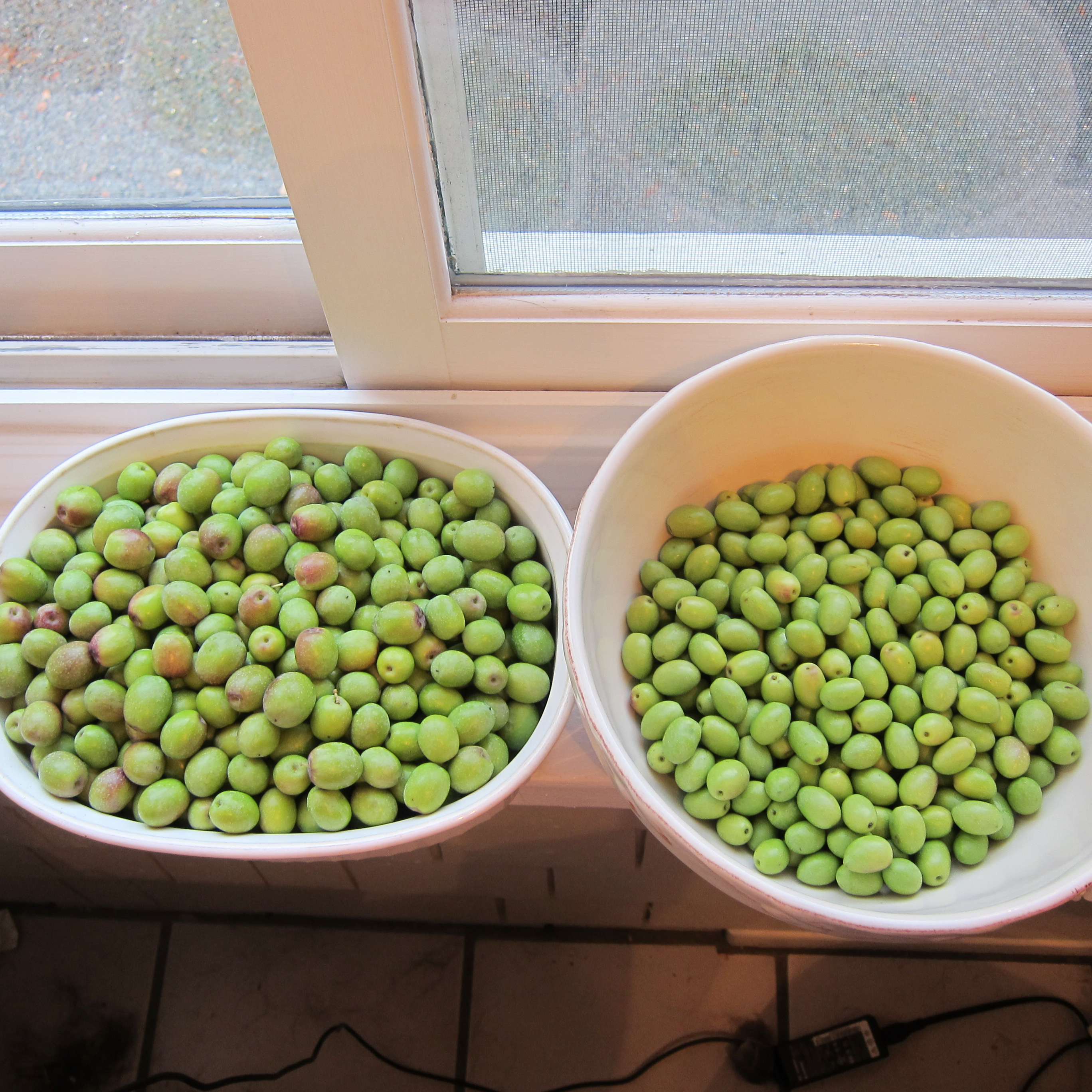
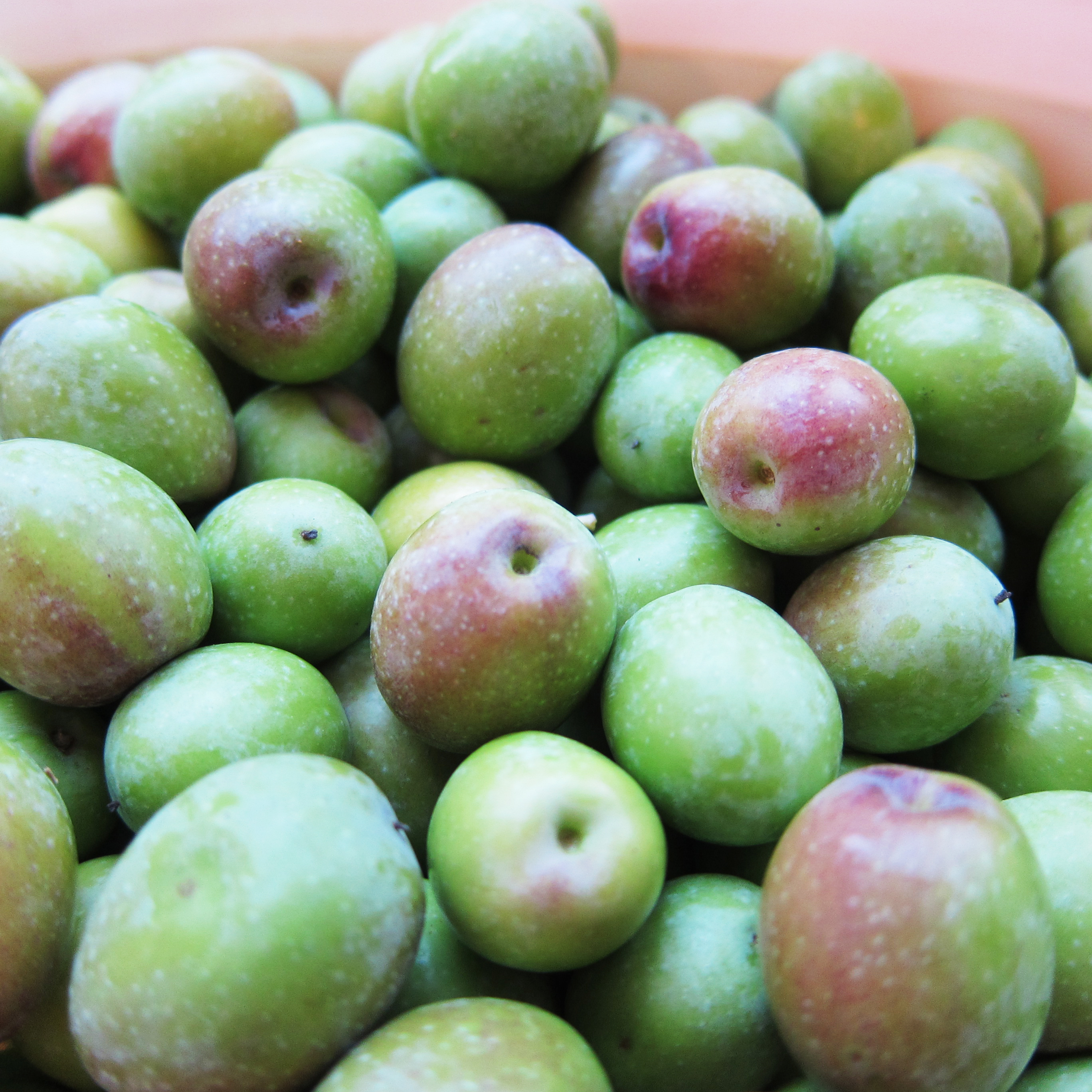
These are olives my friend Sharon and I foraged from someone’s yard.  Don’t worry – we asked permission and were granted it by the really nice ladies who lived there.  They even supplied us with a step ladder to get at some of the higher branches.  When we walked up their steps and rang their bell I thought they’d probably think we were trying to bring them some religion and worried they might be hostile.  Or maybe they’d think we were on to some make-up scam and be hostile.  I’m glad we took the chance and I’m equally glad that they were so agreeable.
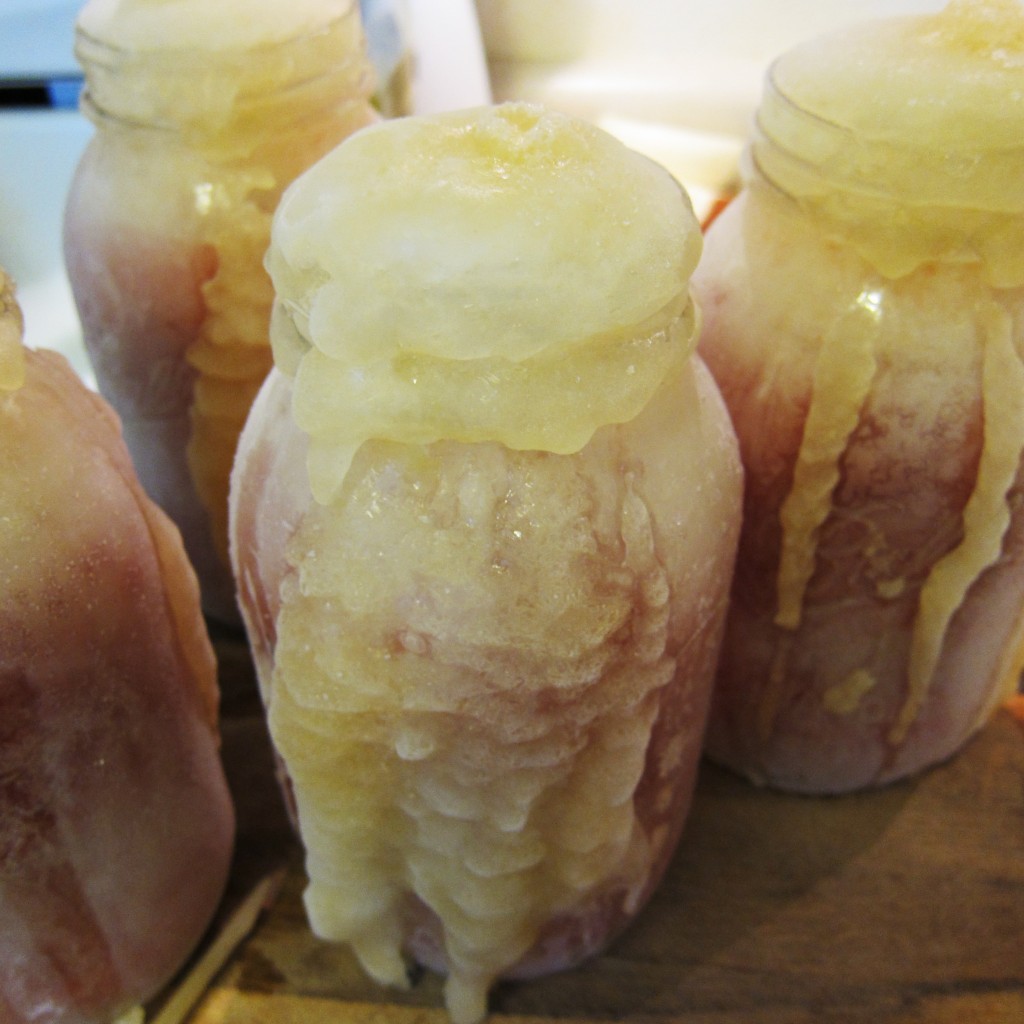
There are more olive pictures at the bottom of this post.  I’ve been meaning to share this disturbing picture with you: this is what happens when you think you’re being all thrifty and freeze “tomato water” for use in soups.  What I don’t want to know is why is the water part all yellowy?  Such a nasty surprise to find in my freezer.

I also wanted to chronicle how much you have to cook tomato sauce down to get a nice thick sauce.  This is the pre-cooked picture.  See how full that big pot is?  Do you know how much work it took to clean, score, core and blanch then peel, squeeze, and dice that big pot of tomatoes?  If you’ve done this before then you DO know.
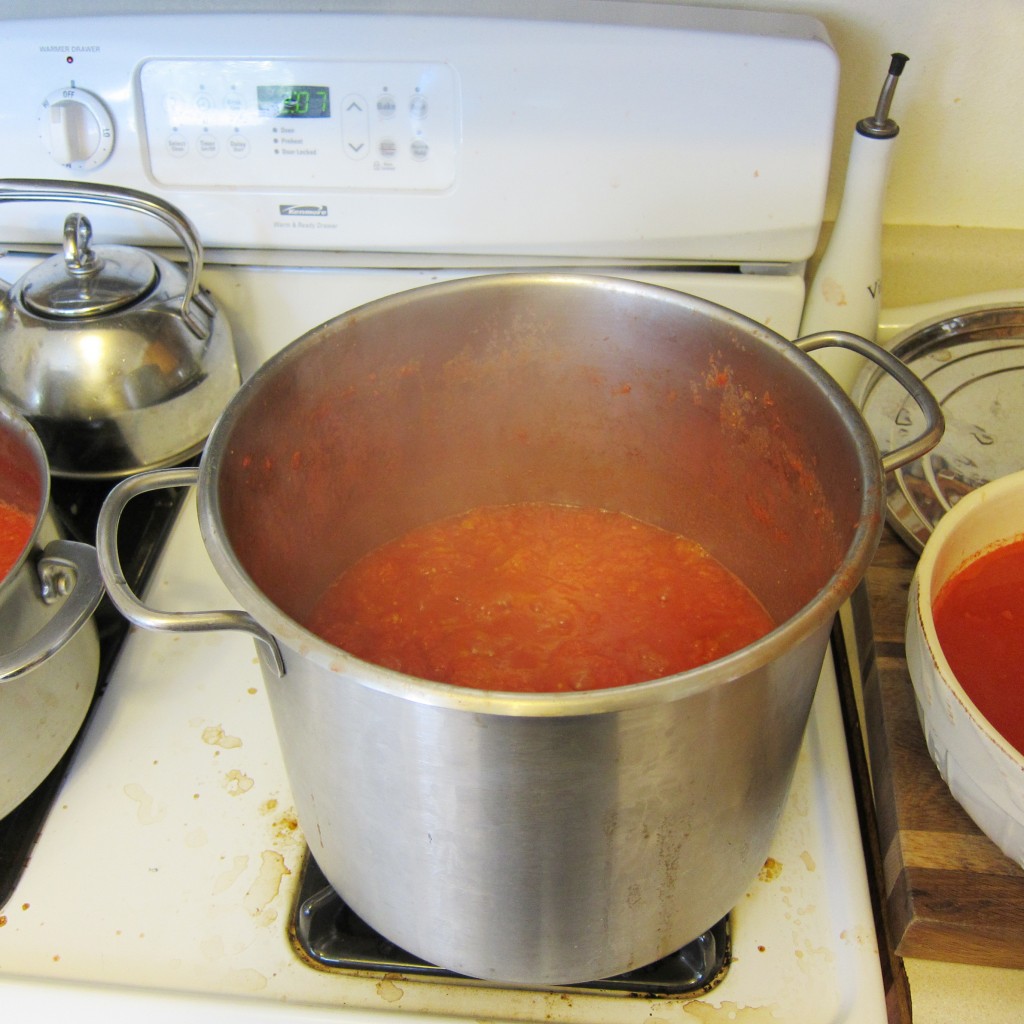
The steam didn’t cooperate with my camera but you can see through it that the tomato level has dropped dramatically.
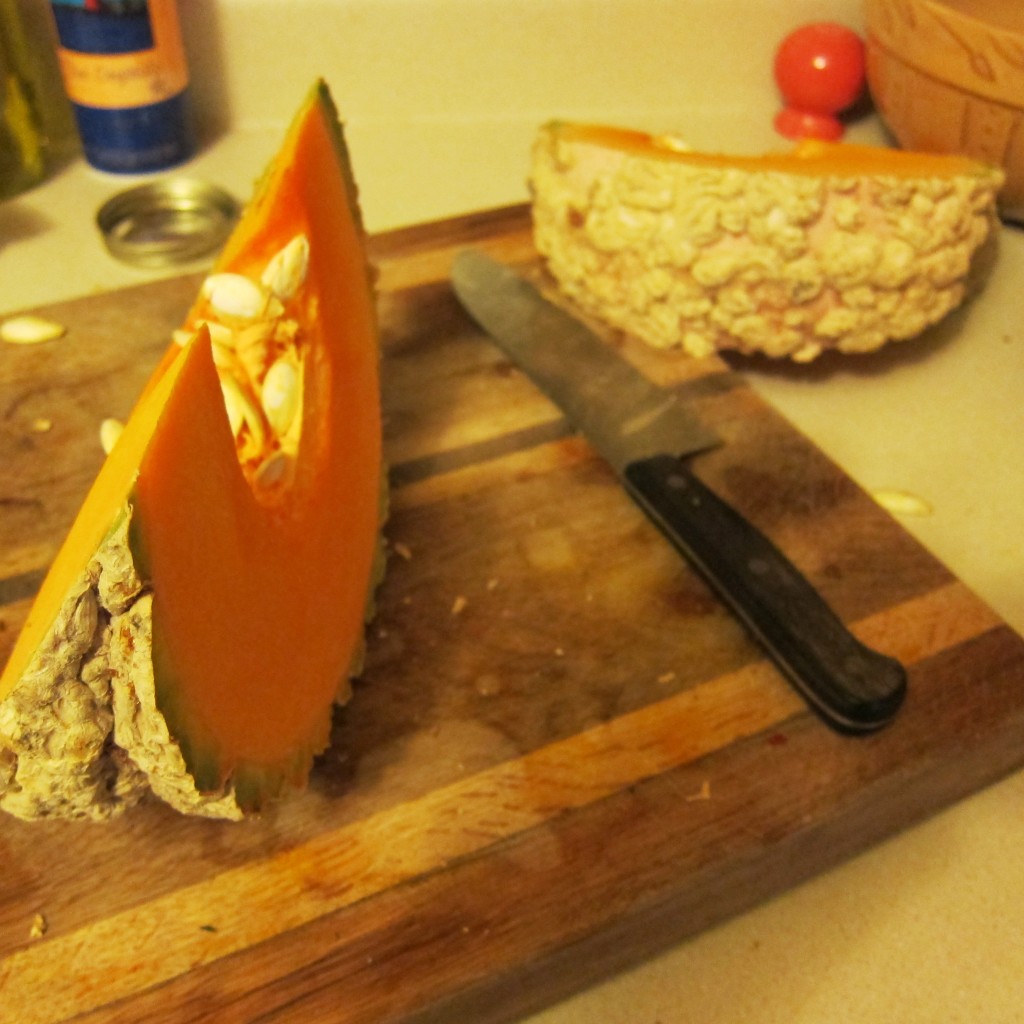
This is my 22 pound French heirloom squash that the produce stand people called “Peanut Squash” – it was difficult to find anything definitive on the subject but I’m completely sure that this squash is actually called Galeux d’Eysines.  It’s fairly pumpkin-like in flavor but is less watery than pumpkin.  This mean-ass squash caused me to cut myself.  When wrestling such enormous cucurbitas – I recommend being particularly aware of the location of all your fingers in relation to your knife.
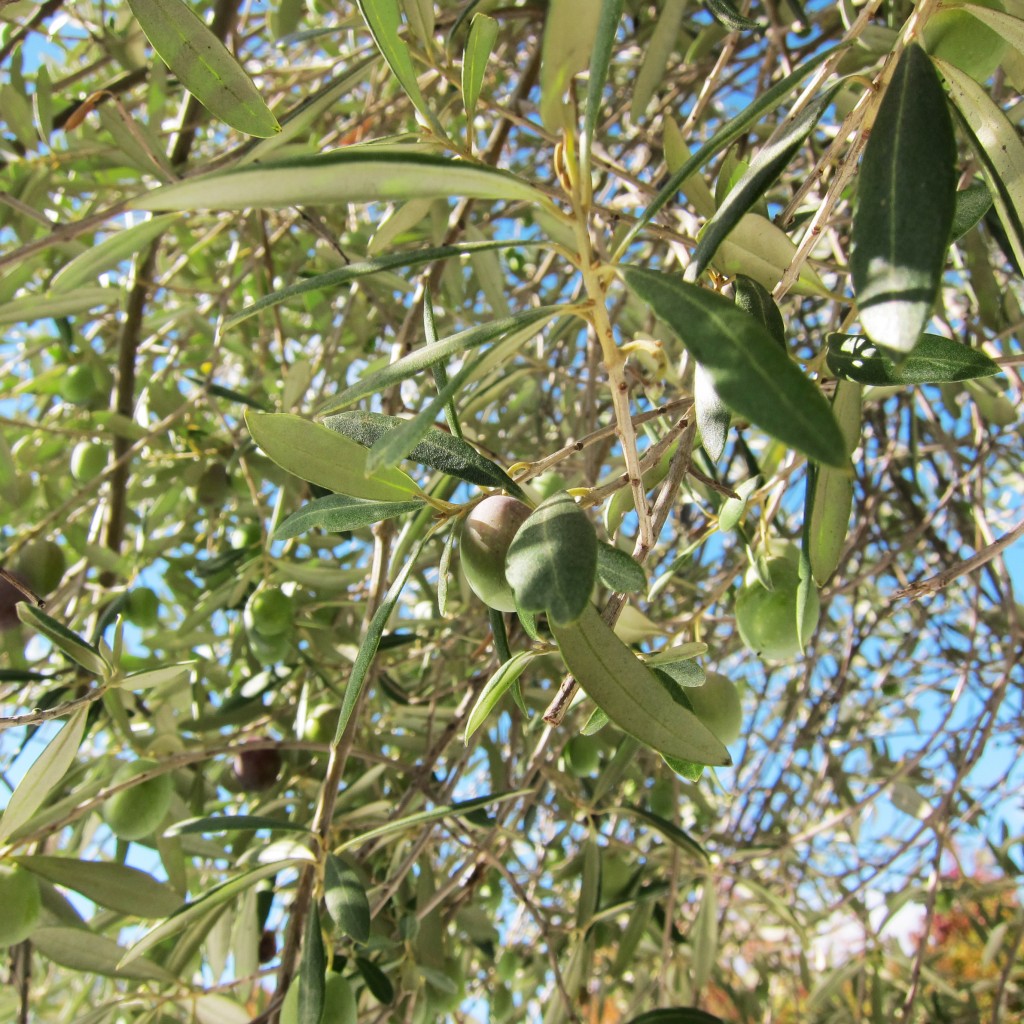
Olives are one of my favorite foods.  The only kind of olive I’m not fond of are the black canned Mission olives ubiquitous on pizzas from chain restaurants.  I don’t hate them but I would never voluntarily add them to food.  But give me any kind of green olive or black olive that is salty, or salty and vinegary, or salty and herby – yeah, big fan here.  Years ago I read a whole book about olives because my Grandfather was interested in them.  He told me stories about the olive orchard he bought in Italy when he was still a young-ish man.  It was supposedly one of the locations written about in Homer’s Odyssey.  My grandmother eventually forced him to sell the orchard and I got the feeling he still wasn’t over it in his 80’s.  Big clue as to how come they got divorced eventually.
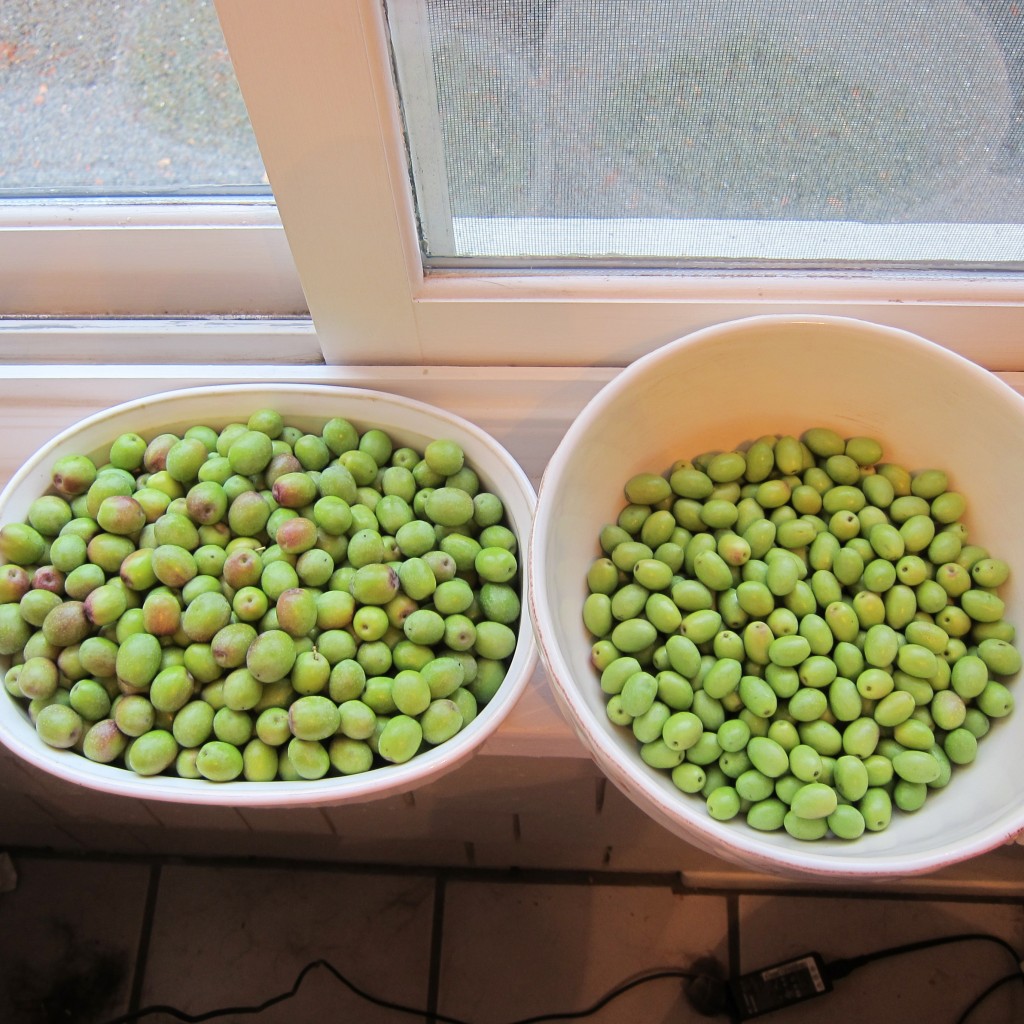
The book I read was “Olives” by Mort Rosenblum.  It was informative and whet my appetite for curing olives on my own.  It also irritated me – Mort is something of a pompous windbag – though he may not be like that in real life at all.  It’s just the tone of the book and honestly, I read it so long ago now I’m not sure I’d have the same opinion the second time around.  The point is that for over 12 years I’ve had the ambition to cure my own olives but back then it didn’t occur to me that I might be able to forage some and I certainly didn’t have any access to fresh olives for sale.

Since that time I have become a pretty good forager of walnuts, nettles, elderberries, blackberries, rose hips, and plantain – but until moving back to California there were no olives to forage for.  But now I am seeing them everywhere.  The biggest problem is that a lot of the ones I’m seeing are too small to bother with curing them.  Sharon and I definitely got enough to play with and in just a few minutes I’m going to introduce my haul to a lye bath*.

What I really want to do today is drive all over town looking for more olives to forage.

I am in full chipmunk mode now.  I’m taking the dog for a walk to see if the walnuts have started falling in the neighborhood.  Sometimes I wish I could forage and preserve food all the time – without other obligations like working or writing books (not really an obligation since I am unpublished and completely unknown – let’s just call it an obligation to myself) or running errands.  I want to spend all my time cooking and experimenting with food preserving.  And foraging.

I must go get dressed and made up – the olives are waiting for me and I need lipstick today.  I should also probably check on my fermenting pickles, shouldn’t I?  You might be curious how they’re doing about now.  I’m a little scared to look.  Drat – I also need to clean my work table.

And all I want to do is go collect nuts and fruits in my cheeks to store in my tree trunk.

*In case you’re curious – I’m using this recipe for curing olives with lye from Hank Shaw’s blog Hunter Angler Gardener Cook