
 Baking squash might seem too ridiculous to an experienced cook to explain but considering how many people I've met who've never baked their own pumpkin for pie, I think it's important to cover the basics. I like to think that if I died before teaching my son how to cook, he could come to my homesteading blog to learn how to do the basic things that mothers tend to teach their children in the kitchen before they ever set eyes on their first cookbook.
I would like to say, then, that there is no life instruction too ridiculous to teach a person who doesn't already know it.
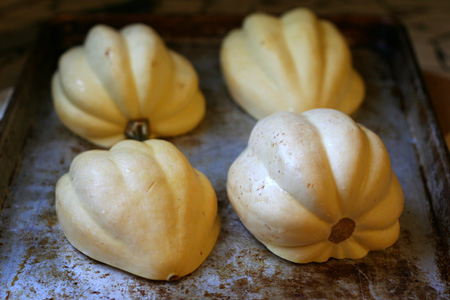
 Acorn squash are usually a dark green on the exterior (the ones in these pictures are mutants from a local farmer!) and medium to light yellow on the interior. Their flesh is somewhat stringy and a little on the watery side compared to sugar pumpkins or other large squash.
 1. Preheat your oven to 375 degrees.
2. Cut your acorn squash lengthwise. Try to cut it into two even halves. You can see that I didn't completely succeed with one of mine!
 3. Using a strong metal spoon scrape the seeds and the most fibrous part of the squash cavity out.
  4. Place face down on a sturdy baking sheet. Preferably not a non-stick.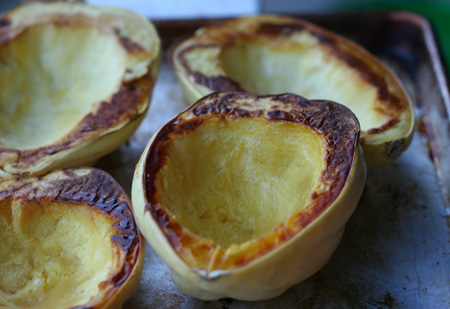
5. Bake until tender. How long this takes will vary depending on the size of the squash and the thickness of the flesh but it should take somewhere around 45 minutes. To test done-ness: you will be able to stick a knife into the skin with no resistance when it is done.
Things to consider:
Some people like to brush the undersides of the squash with olive oil. You may do this if you like but it is unnecessary.
Many people like to cover their squash with aluminum foil. This is also not necessary and I would recommend you don't do this to prevent waste in the kitchen. I've heard some people say that it helps cook the squash faster by holding heat in but at least with regards to acorn squash you get the same effect by cooking them face down in halves.
You can cook the squash at 350 degrees and just expect it to take a little longer. I cook all my squash at 375 degrees which I think lessens the over-all cooking time without overcooking it too fast which a higher temperature might do.
What now?
Stuff them: They're perfect for stuffing because a half a squash is a good single serving size. If you fill it with grains and beans you will have a complete protein and with some salad on the side you will have a very nutritious meal.
Dress them: While still hot add a tablespoon of butter, a sprinkling of salt (about five shakes from a shaker) and some grinds of fresh pepper (also about five), then eat it. Simple good food. You can do this right in the skin or if you prefer you can scoop the squash out of the skin and then add the butter, salt, and pepper.
Things to consider:
Some people like to brush the undersides of the squash with olive oil. You may do this if you like but it is unnecessary.
Many people like to cover their squash with aluminum foil. This is also not necessary and I would recommend you don't do this to prevent waste in the kitchen. I've heard some people say that it helps cook the squash faster by holding heat in but at least with regards to acorn squash you get the same effect by cooking them face down in halves.
You can cook the squash at 350 degrees and just expect it to take a little longer. I cook all my squash at 375 degrees which I think lessens the over-all cooking time without overcooking it too fast which a higher temperature might do.
What now?
Stuff them: They're perfect for stuffing because a half a squash is a good single serving size. If you fill it with grains and beans you will have a complete protein and with some salad on the side you will have a very nutritious meal.
Dress them: While still hot add a tablespoon of butter, a sprinkling of salt (about five shakes from a shaker) and some grinds of fresh pepper (also about five), then eat it. Simple good food. You can do this right in the skin or if you prefer you can scoop the squash out of the skin and then add the butter, salt, and pepper.

 What's the difference between polenta and cornmeal? Nothing. Polenta is boiled cornmeal. You can make polenta using a fine, medium, or course grind of cornmeal which will determine how long it takes to cook. The coarsely ground polenta will take at least 45 minutes to cook, sometimes longer. I personally prefer a medium to fine grind because it's silkier but a lot of my friends and family prefer the coarser grinds for the grainier texture.

Recent Comments