Author Archives: angelina

Ricotta Stuffed Tomatoes

ricotta stuffed toms 2.jpgThis is a very simple dish to make.  I always make my own ricotta but you can very satisfactorily use store bought which makes this dish also fast to put together.  If you have the time though, I highly recommend trying homemade ricotta as it has a sweeter fresher flavor than store bought.

I use this ricotta blend for stuffing other things as well, including lasagna.  The secret ingredient is nutmeg.  My mother, who lived in Rome for two years when she was a kid, taught me to put nutmeg in ricotta and though it seems strange- it is delicious!  If you hate nutmeg, leave it out.   

ricotta for stuffing 2.jpgRicotta Stuffed Tomatoes
serves 9

Ingredients:

9 medium summer tomatoes (firm)
15 ounces ricotta
1/4 cup grated Parmesan
1 egg
12 big basil leaves, julienned
3/4 tsp salt
3 shakes nutmeg
15 grinds fresh pepper

Method:

Preheat oven to 350 degrees.

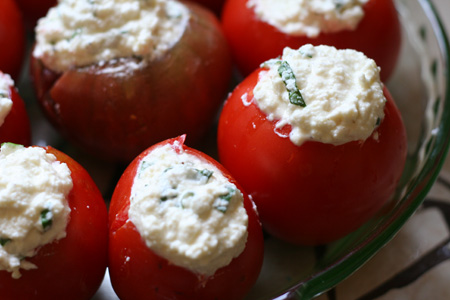
Cut the top of the tomatoes off and hollow them out being careful not to rip them up (you can see in the picture that I ripped a couple of mine).

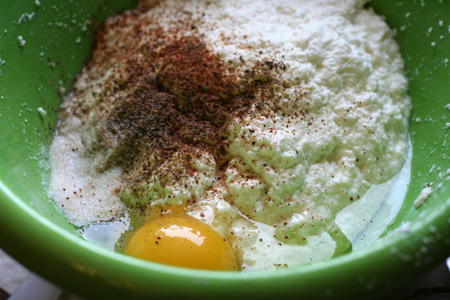
In a big bowl mix all the remaining ingredients using a fork so that the egg gets broken and mixed in well.

Place the tomatoes in a pie dish and fill each one up with the ricotta mixture making sure to heap it up at the top a little.

Bake in the oven for 30 minutes.  Then turn your oven broiler on and broil them until the tops turn golden (in my oven this is less than five minutes). 

ricotta stuffing 2.jpgThese make a great side dish or you can eat them as your main dish with a salad for a light dinner.  You can eat the leftovers for lunch.   

stuffed tomato with fork 2.jpg

Recipe notes:  Don’t use tomatoes that have already passed their peak and are soft because they’ll fall apart.  You can drizzle olive oil over the tomatoes before baking if you like.  I didn’t use it for myself because it really wasn’t necessary and I like that this dish is pretty light in the calorie department.  Olive oil would definitely add a bit more richness to the dish.   This recipe can easily be halved but I would still use one egg in the ricotta because it would be silly to waste a half and egg and though you can omit it all together, I like including an egg for extra protein and it lends more substance to the ricotta.
This recipe is Gluten Free

Enhanced by Zemanta

Preserving Notes: 9/5/10

pesto freeze 2.jpgI have 13 batches of pesto in the freezer.  That’s 13 up from last year.  There were many bone-damp cold winter evenings when I would have given a lot to defrost some pesto to put on hot pasta.  Something so green and fresh tasting never fails to bring warmth to the cold.  I never buy pre-made pesto any more.  It is always such a disappointment compared to my own.  I would like to get 9 more batches in the freezer before basil disappears from the market.

plum tomatoes 2.jpg

This is a terrible year for tomatoes in the Willamette Valley.  All the farmers are saying so.  I managed to pick (maybe) close to 80 lbs this weekend.  It was difficult finding that many ripe ones in the upick fields where I go.  The guy working at the farm stand yesterday said their tomatoes are 7.5 weeks behind from last year.  We don’t generally get hot enough weather to ripen tomatoes reaching into September.  So this is it.

I didn’t put up any tomatoes last year.  All winter I was bummed to have to buy canned tomatoes from the store.  I’ll have to do it again this year.  I have 5 precious quarts of tomato sauce I made yesterday which I will save for the darkest gloomiest days of winter.  I have 40 pounds still waiting for processing in the garage that I picked yesterday and haven’t yet processed and I’m having to ask myself what the best use for them is. 

I don’t buy fresh tomatoes once they disappear from the farmer’s markets.  Two things I’ve learned to make this year that call for fresh tomatoes but which I’ve had to use canned for are Mexican style rice and red enchilada sauce.  So my plan today is to make enchilada sauce and make the tomato/onion/pepper puree that goes into Mexican style rice, portion it out, and freeze them. 

To have one quart of tomatoes a week I would need to put up close to 300 pounds of tomatoes.  The most I’ve ever done were 36 quarts (200 pounds).  I didn’t buy a single fresh tomato or a single can of tomatoes from the store for an entire year.  But I was very careful how I used my tomatoes and realized that I use tomatoes so much in my cooking that I would have done better with a quart a week.

I put up 9 pints of marinated vegetables yesterday and have just as much ready to process today. 

I’ve got one box of peaches for which I must use half to make a peach chutney.  I’m not even sure I like chutney and since I don’t eat meat of any kind I’m unclear on the best use for it in my cooking- BUT – this is a labor of love for my mother who loves chutney.  The rest of the peaches will be jarred with a light sugar syrup.  If I’m lucky and there are some more peaches in at the farm stand next week I’ll put up another box in syrup. 

I also have about ten pounds of summer squash for making into relish and chutney.

There I should stop.  I don’t have time to do all the preserving I wish to do.  I’m squeezing all of this between work and parenting.  I haven’t worked on my book now for a month and I’m getting anxious about it.

I’m squeezing it in because last year I barely did any preserving and I regretted it all year.  Preserving food is generally fairly simple but terribly time consuming.  Why do it?  I love doing it.  I LOVE it.  The truly frantic preserving season is September for most people and this is the turning of the season as well. 

When I’m canning I feel as though my internal clock is being calibrated.  I become very present to the changes of weather which are influencing what’s available to preserve, I become connected to my own nourishment in such a primal way that I often find myself thinking about the history of humans as I peel blanched tomatoes, get sticky up to my elbows in sugar syrup, and think about the evolution of pickling as I fill jars with dill and spices for pickles. 

Whether you preserve your own food or buy commercially canned food this is still the only reason human beings can live in one place all year and get fat in winter instead of thin and feed more babies than you could feed if you still had to hunt and forage all year.  Agriculture and food preserving are the reason we can settle, fight wars, play golf, and mess ourselves up with junk food like Twinkies. 

I like to preserve as much of my own food as I can because it feels good.  It feels essential and keeps me from taking my food for granted.  The raisins I dried myself that I’m about to use in the peach chutney took time (though little effort) to make and came from a friend’s vines.  That’s a lot of interconnectedness with the local earth, friends, labor, and I’ve used very few of them because I didn’t have a lot to begin with and now it’s going to be used to nourish my own mother.

Preserving is a great labor of love. 

Preserving food is life-affirming. 

It makes my hands feel worthy of the life they’ve been given.

I’ve got a lot of work to do today and I couldn’t be happier.

I’ll be thinking of all the rest of you out there today putting up jams and sauces, fruits and vegetables.

Happy canning!

Enhanced by Zemanta

Shelling Pea Harvest: 2010

weighing peas 2.jpg

Nothing about my gardening tactics is ideal.  I frequently plant later than I’m supposed to (often in an effort not to plant too early which simply results in me losing track of when I’m actually supposed to plant), I have no drip system in (so everything is hand watered, or as is more often the case, I don’t water at all), and I never seem to make time for weed control which, since I don’t use herbicides to control them, means they grow taller than me.

The reason I’m bringing this up is that whenever I write down what yields I got for something, you can always remember that if I was a better gardener* those yields could be higher.  This should give hope to the less savvy people trying to grow their own food.

I was so sloppy this year that I’m not even certain which varieties of peas I planted.  I will need to dig through nefarious corners of my garden boxes and seed containers to see if I saved them.  I believe I used Alderman and Cascade, but I’ll have to double check.  Assuming I’ll remember to double check.

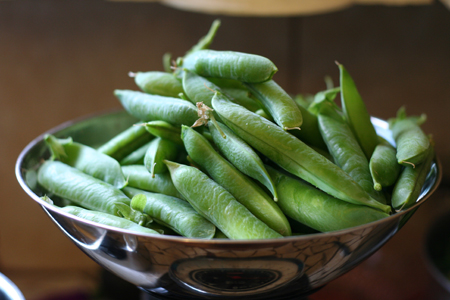
Total yield: 9 lbs 9 oz shelling peas

raised bed breakdown:
4×8 bed: 6 lbs 12 oz
1×3 bed: 2 lbs 13 oz

I never watered the peas.  They grew, bloomed, and fruited all during our prolific rainy season.  So that’s some good value.  I used two packets of peas which cost me a little more than $5. 

Doing some tricky math (because I’ve forgotten how to do it the easy way) I calculate that my homegrown peas cost me about .53 cents per pound.

I don’t know about where you live, but where I live you don’t find fresh shelling peas for that price. 

In case anyone is curious, I didn’t add any purchased fertilizer either.  We add straw with slightly aged chicken manure from our own hens.  BONUS.  So no money was spent for fertilization.  No effort besides planting the seeds was made by me.  No watering.  I got 9 lbs 9 oz fresh shelling peas for all that non-effort.  Who can complain about those economics?

What would have improved my yield:  weeding, planting earlier

*I’m actually an excellent gardener when I’m not working full time.  Or when I have the money to install things like drip irrigation.  In a previous life (when I lived in California) I had a much more productive garden and the weeds, though always plentiful, never reached full potential height.  But that was back when I was a housewife and stay at home mother.  That was when I realized that my passion, aside from writing, was urban homesteading.  Ah well, good memories!

Enhanced by Zemanta

Big Kitchen Fail: around the farmhouse 8/31/10

corn stack 2.jpgThe corn is good this year!  The corn is very very good and plentiful and not too expensive but I still choke at the thought of seven ears wasted!  However, the cobs, after giving up much of their flavor to a stock, made the chickens very happy.

As I mentioned in an earlier post, I’ve been working on a corn chowder recipe.  One version had too much heat and too much cilantro in it but was otherwise PERFECT.  (I know this because right before adding one too many jalapenos and the entire bunch of cilantro I tasted it and it was so incredible I almost stopped right there.)

roux 2.jpgMy basic roux always has a little dash of cayenne in it- but for this project, the corn chowder, it made it too hot! 

So yesterday was my remake day and I was really excited.  Not just to make a new better batch which I suspected would then be ready to share with you, but because I was simultaneously experimenting with an olive oil roux in hopes of making a superb vegan version for my vegan friends.  I had already made some corn stock (more about that when I write the recipe) and the roux worked beautifully, the sauteed vegetables were added and then, then was the moment of truth: adding the corn.

This is the moment where everything went wrong.

I had cut all my corn off the husks and had it ready in a bowl.  7 ears’ worth of it.  The only problem is that I’d had it prepped and ready to go for a day and a half.  All that time it was sitting on the counter.  I can’t tell you now why I didn’t put it into the fridge.  I have no explanation for my actions at all.  I smelled the corn (I have an excellent sense of smell) and it was sort of sour.  Not deeply sour.  But sour.  It wasn’t moldy, it hadn’t been hot (thank god!) and I had the most misguided thought in my entire cooking career: maybe it would be fine to use in the soup.  The cooking would kill anything dangerous and maybe the slight sourness would add a good flavor, the way soured cream does…people do intentionally rot fish in holes and call it a delicacy.  What’s a little fermented corn?

What’s a little fermented corn?!

Pretty unappetizing, as it turns out.  I followed through anyway.  Cooked it for about half an hour and in that time all the soured corn kernels turned brown in the soup and it didn’t smell delicious.  I gave up.  It makes me so angry when I achieve such incredible waste in my own kitchen.  What’s worse is that I didn’t even compost it which would have saved it from being complete waste.  I have a very active compost going on in my yard and I don’t throw much food in the garbage or down the garbage disposal. 

But sometimes I get overwhelmed by giant pots of soup that fail and I do weird things like panic about what to do with it and the thought of huge wet pots of soup getting slimy on the compost pile gives me palpitations.  So I tossed it in the rarely used garbage disposal. 

Today I’m feeling properly subdued about so much waste: 7 ears of corn, 4 home grown potatoes, two stalks of celery, some flour, a quart of home made stock, an onion, two jalapenos, and a can of evaporated milk (I was proceeding with the non-vegan version).

knock knock 2.jpgKnock knock?  Anyone home?  Can I come in?  Surely there’s a grub or two you need cleaned up?

When these kind of things happen you just have to let it go.  Now that I’ve shared my calamity with you and come clean about not composting, I am letting it go.

In other farmhouse news: the hens are LOVING their free-ranging in the early evenings.  The big girls have become much mellower and follow us around in the garden and up to the porch where they hope to be included in all family activities such as family movie night.  Sadly, they must be put to bed before the movies start. 

The adolescents have no problem finding their way back to the coop when the sun sinks but our big girls gather up on the porch railing instead and we have to put them away each night by carrying them to the coop.  They are already in their middle age and this is the first time in their lives they’ve been allowed to roam around outside their run a couple of hours a day so they don’t really know what to do.

They’ve been eating all the blackberries that I haven’t wanted from the garden (the too sour ones and the overripe ones).  It’s made for colorful messes on the patio.  While I am not loving all the messes, the benefit to my hens is obvious and I can tell that they are feeling much more fulfilled and happy.  Yes, you really can tell.  Birds may not be as smart as pigs but they are sentient beings and they do have some thoughts and emotions.  

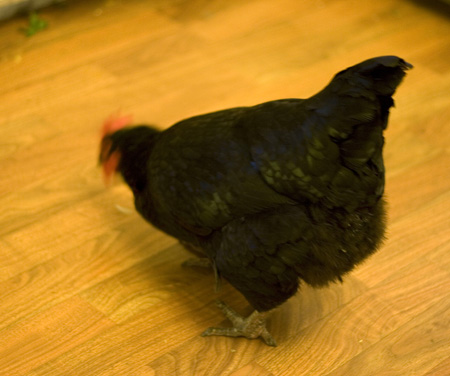
Dot arrives inside 2.jpgHey Dot, whatcha peckin’ at?  Thanks for dropping in the kitchen for a chat!

 
Dot even made it inside the kitchen once!  She didn’t care for the slick texture of the floor but was much interested in joining me in the cooking… lest you think I am a completely dirty scary person who lets her farm animals make a manger of the farmhouse… I audiosed the bossy gorgeous Dot almost at once.

Though I secretly really do wish my chickens could follow me everywhere. 

For all you germaphobes out there, I promise you this floor has since been mopped well.

saffron from Sharon 2.jpg

My long time close friend Mrs. E brought me this amazing gift when she visited me a couple of weeks ago: Spanish saffron!  Look how many packets!  It’s like gold!  I’ve never experimented with saffron because it’s always been just a little too precious for me.  This gift is so treasured- thank you Mrs. E!  I can’t wait to play with it!

Enjoying my hens running around has deepened my enjoyment of my old farmhouse and garden both of which have experienced serious neglect as we’ve  been struggling so hard to hold everything together.  As many of you know, we are going through a process with our bank that may take many months in order to try not to lose our house.  Not knowing if I’ll get to stay here is stressful and could easily overwhelm me and prevent me from enjoying it while I am still in it.

The truth is, there is a curious little circle going on where the more I emotionally let go of my farmhouse and accept that at any time in the next year we may end up having to rent an apartment and give up our birds and our garden and the peach trees which have just begun giving us fruit, the more
I find myself enjoying it in the moment, the more I enjoy it in the moment the more I realize I don’t want to let it go.

I’m amazed at how I’ve managed not to let that drag me into a horrible pit of anxiousness.  I just keep coming back around to letting it go and deciding to enjoy it while I have it.  As long as I keep coming back to that I can’t lose because even if I have to walk away in a few months, I’ll know that I didn’t waste all my time worrying about it and dreading it.

In an effort not to live in the past or the future I’m going to finally make winter curtains for this house and share the instructions for doing the same in your own if you need to make some for yourself.  In the past I wouldn’t have done it knowing that I might not even be in this house by winter time.  But what if I am?  This will be our third winter here in the farmhouse and if we don’t have to move it will be COLD because we don’t turn the heat up past 58 and may go a little lower this year.  Keeping an old house warm is a challenge and one of the very best ways to keep heat in is to have lined winter curtains on all of your windows. 

I’m also planning to do a tutorial on making coasters.  They don’t seem important until you can’t find any around the house and the few pieces of good furniture you have are getting damaged by drink rings.  I haven’t done sewing tutorials in a long time and that’s one that almost anyone can do.

So, though there have been some epic failures around here, there is a lot of good going on and I’m really taking the time to enjoy those good things.  Every day we go outside for a little while to walk around with the birds and feed them blackberries and kitchen scraps and talk to them, which they like.  I’ve been cooking really good food and have been enjoying the process of recipe development which sometimes ends in a mess but nearly always evolves into something really delicious worth sharing with you.

I hope all of you are taking the time to enjoy what’s good in your life right now too and with so many of my friends in such tough circumstances right now I just want to say that all of you are in my thoughts and when you navigate your own tough moments with grace I keep that with me as inspiration.

Fresh Tomato Salsa Recipe

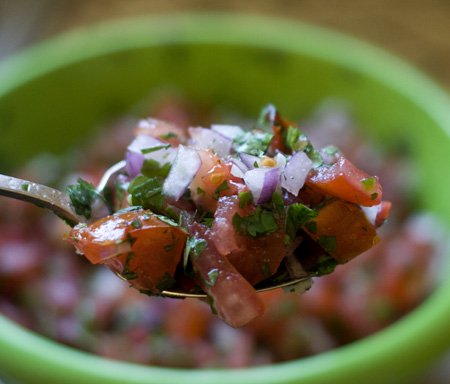
another macro salsa 2.jpgIf you don’t have fresh local tomatoes grown outside in the sunshine, don’t bother making this recipe.  I’m not being a tomato snob, I’m really not.  With recipes where you roast or cook tomatoes you can coax more flavor out of less than stellar fruits, but when making recipes with fresh tomatoes you need the very best. 

I learned to make this fresh tomato salsa from my friend Norman’s good friend Margie, about 19 years ago.   

Fresh Tomato Salsa

yields one big bowl of salsa

Ingredients:

6 ripe slicing tomatoes
1 small red onion
2 Serrano chilies
1 bunch cilantro, minced
1 lime
1/2 tsp salt

burnt skin 2.jpgMethod:

Cut the tomatoes width-wise, exposing the pockets of seeds, and over the sink or your compost squeeze the seeds out.  After removing the core, dice them into 1/2″ pieces, put in a large bowl. 

Dice the red onion fine, and add it to the bowl with the tomatoes.    

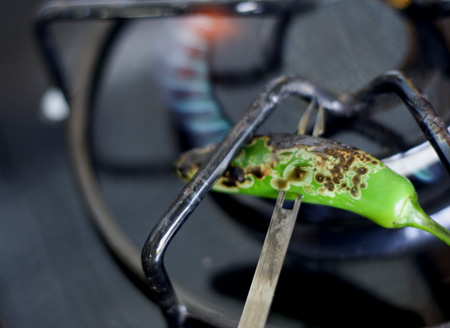
Roast the Serrano chilies by pushing onto a skewer (metal or wood, doesn’t matter) and hold over an open flame.  Turn the chilies around so all of the skin is charred.  Once the peppers are blackened and cooled enough not to give you a second degree burn from handling, rinse them in cold water, peeling the charred skin off.  Mince them into very fine bits and add them to the bowl.

Mince the cilantro very fine and add to the bowl with everything else.

Quarter the lime and squeeze it into the bowl.

Add the salt.

Now stir it up really well and eat it right away.

minced pepper 2.jpg

Recipe Notes:  I like it best eaten right away but Philip thinks it’s best after sitting for a few hours.  It will become watery at the  bottom of the bowl.  The heat of peppers varies, Serranos are generally a pretty hot pepper but I’ve bought some that were a lot more mild than I was expecting.  This is usually a pretty mild salsa.  If you would like more heat: add more peppers. 

Check out our other salsa recipe:
Pico de Gallo

This is a vegan recipe.
This is a gluten free recipe.
Enhanced by Zemanta

Eating Seasonally: summer 2010

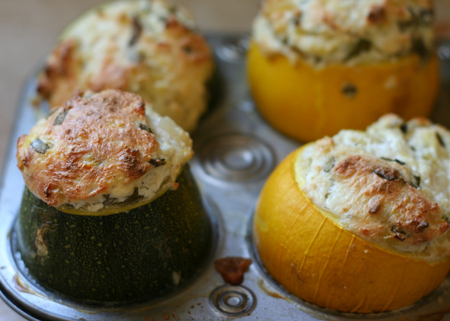
stuffed round zuchs 2.jpgThis is a recipe in the works.  The ricotta stuffing was excellent but the squash skin was kind of tough which was disappointing.  Hopefully I’ll be able to present this in the next week or so. 

We’ve been committed to eating mostly local produce for the last three years.  What “mostly” really means is that I buy almost all local produce all year but each week I allow myself to buy one or two produce items that aren’t grown locally.  Avocados are one of them.  I don’t believe I can live without avocados and I’m okay with that.  Because of buying avocados frequently I don’t buy oranges or tangerines (this winter I got three boxes full of them grown by a family friend which was an incredible treat) or bananas or pineapples or most other things that never grow in my climate.  If I decide I want any of those things then I make sure that I don’t buy avocados that week or I give up buying lemons or limes which I buy periodically for cooking.  It’s all about maintaining a high proportion of locally grown produce all year round. 

Nearly always if you’re eating locally you’re eating seasonally.  Eating seasonally has changed the way I think about produce for the better.  When you eat tomatoes all year long you not only support an unsustainable system of shipping produce worldwide but you commit to eating sub-standard quality food.  Wait, but that wasn’t what I was going to say- the best thing about not eating tomatoes until they’re in season is that they become infinitely more treasured.  I cheated this early summer and bought some locally grown organic tomatoes grown in a greenhouse, which, it turns out, weren’t that great anyway.  What can I say?  After ten months of buying NO “fresh”* tomatoes I was dying for my first taste and was disappointed.

This week the tomatoes are truly in season!  Here in my area they are beginning to show up at the farmer’s markets and they have flavor and I’m making a ridiculously poor sentence just because I’m so excited about it I can’t decide what to make with them first and I’m buying as many as I can at each market.  (That’s a lot of excitement.)

Right now the summer produce is at its peak and I’m finding that there are so many things I can only cook during the summer because this is the only time I can get the real deal: the ripe local flavorful food that epitomizes warm weather and prevents me from relocating to the North Pole during the heat.  Seasonal eating makes me savor food so much more than I did before.  I’m experiencing a little bit of sensory overload right now.

Here are some of the things I want to make with what’s available right now: 

Tomatoes: fresh salsa, pico de gallo, tomatoes on salad, stuffed tomatoes, slow oven roasted tomatoes, tomatoes in eggs, tomatoes in sandwiches, tomato gratin, pasta with tomatoes, a strange but unbelievably delicious casserole my mom makes with tofu feta and fresh tomatoes and cauliflower, tomato soup, Mexican rice, enchilada sauce, and Caprese salad.

Corn: corn chowder, corn on the cob, black bean chili with fresh corn, fresh in salad, corn in enchiladas, corn relish, creamed corn, and corn fritters.

Summer squash: squash gratin, stuffed squash, grilled on sandwiches, sauteed with fresh herbs and garlic, squash in summer soup, grilled as a side, zucchini bread, ratatouille, and in zucchini and feta fritters.

Eggplant:  grilled for sandwiches, grilled and cubed on pasta, baked, stuffed and baked, ratatouille, made into sauce for pasta with tomatoes and basil, baked with garlic and put on sandwiches, eggplant lasagna, and pickled!

Cucumbers: added to an assembled salad, sliced and dressed in mustard vinaigrette, in a raita sauce, tzatziki sauce to go over falafel, eaten plain, and dipped into ranch dressing.

 Those are just the main players.  Now I’m seeing beets- I love a salad with beets dressed in lemon and olive oil with kalamata olives and feta over a bed of lettuce.  Or roasted beets in couscous.  Or just roasted and eaten.  I love them pickled too.  Soon I’ll be seeing a little celery which is exciting because I gave it up for most of the year when I went seasonal.  I used to put it in almost everything I cooked.  I sometimes blanch and freeze it but if I don’t get around to it then I don’t eat celery for 11 months out of the year. 

What to make?  How to make everything I want to in such a short time?  The hardest part is that a lot of the time I’m truly happy just eating a cheese sandwich with fresh tomato, mayonnaise, spicy mustard, on wheat bread.  Just like that.  So simple.  It’s what I had for lunch today and it’s so good!  I’m one of those people who doesn’t think a sandwich is complete without tomato on it so I don’t eat sandwiches during most of the year either.  Except for grilled cheese with home made dill pickles

I stand in my kitchen the moment I have time to cook something and am paralyzed with choice.  Winter and spring cooking is about finding 100 great ways to use celery root and chard and carrots but summer cooking is about becoming drunk with the limitless possibilities for meals. 

Before I ate seasonally I didn’t appreciate what I was eating half so much or was nearly so conscious of the changes in my diet or of the seasons themselves in a broader sense; how when the air is hot and redolent of ripe blackberries it is also a time when I am most profoundly physically uncomfortable, my hens coo happily every late afternoon when the sun sinks and the heat eases and I toss them such succulent scraps as watermelon rinds or whole pieces of watermelon that Max has rejected, young squash trimmings, corn cobs full of corn scraps, and the low hanging blackberries in the garden.

Then there’s the way the air feels just as we turn the corner from the first two weeks of ripe tomatoes, when the nights start biting ever so slightly and underneath the lingering heat of summer is that queer smell we all recognize that tells us fall is coming; it’s time to preserve food madly, pick apples, clean up the summer garden if you’re normal and not lazy like me, and when the local giant cauliflowers start showing up downtown it means it’s time to pickle and it means that the last of the eggplants has drifted into the farm compost pile. 

Seasons still drive humans on a truly primal level but so many of us have allowed ourselves to operate outside them, to ignore the natural drives that tell us when to eat every rich vitamin-laden piece of produce we can get our hands on against the coming bleaker months, when to store things away for the co
ld months, when to pull out the blankets, hibernate, go inward, and when to come back outside to watch the first green fronds ignite the icy cold with bright hope…and it matters.  I feel more connected to myself and the earth when I eat seasonally. 

This makes sense since eating is such a basic need we are constantly trying to fulfill and without it, like light, we will die. 

So while I find it overwhelming to have so much lush produce at my disposal at a time when I am most inclined to eat salads and simple sandwiches, I also love this feeling of possibilities.  I just ate a salad with all organic locally grown (affordable) produce: lettuce, tomatoes (ripe!), raw corn, and cucmber, and it was soul satisfying. 

Tomorrow I hope to experiment with corn chowder.  I’m chasing a memory of a bowl of corn chowder I ate in San Francisco in a cafe that has been gone for over 15 years and who’s name I can’t even remember: a bowl of corn chowder that was so sublime I completely forgot who I was sitting with while I ate it and ever since then there has been no corn chowder to match it.  I keep trying.

Perhaps I’ll get it right this week and if I do I’ll share it with you.

Happy summer eating!!  


*I do buy canned tomato sauce and canned diced tomatoes and when I can I try to can my own.  The year before last I canned enough tomatoes myself that I didn’t even buy canned tomatoes for a year!  They tasted better and were actually cheaper than the factory canned tins.  If you don’t believe me you must read my article on the cost analysis between home canned and store bought canned tomatoes:

Is it cost effective to can your own tomatoes?

Baked Garlic Eggplant Recipe

baked garlic eggplant 2.jpg

Like so many people I know I didn’t love eggplant when I was growing up.  I didn’t hate it but it was last on my list of vegetables to cook for myself when I left home because my mom didn’t know how to turn the dry flesh into succulent eating.  I know how to do this now and the secret is simple.

FAT.

The first brilliant eggplant experience I had was when I was twenty five years old.  A friend came to Philip’s birthday party for which we were making spaghetti and her gift was an eggplant.  I’m afraid we weren’t particularly enthusiastic.  She took one look at our faces and decided that an eggplant in our hands might be a terrible thing so she marched into our little city kitchen and taught us how to make eggplant that no one could dislike.  There was butter and baking involved.  True to her word, we became fans of everything eggplant from that moment on.

I don’t cook with butter very often.  I prefer olive oil.  Either way, the very best eggplant is always cooked with fat.  That’s my opinion and no one will budge me from it.

This way of cooking eggplant will yield a very soft somewhat buttery flesh (even though it’s made with olive oil) and renders the skin tender.  The garlic bakes until it’s golden, rich, and has a mild nutty flavor.  If you like a firm eggplant treatment* you won’t like this.  I think it’s sublime put on a slice of good bread with stone-ground brown spicy mustard and a thin slice of mild nutty cheese (such as Fontina).  It can also be used to make a great eggplant spread or added to a pasta sauce.


Baked Garlic Eggplant Recipe

Ingredients:
4 small round eggplants (or 2 large ones)
1 whole head of garlic (two if the heads are very small)
1/2 cup olive oil
salt and pepper

Method:

Preheat the oven to 350 degrees.  Cut the tops off of all the eggplants and then cut them in half lengthwise.  Using a sharp knife cut slashes into the flesh diagonally- you want to cut down to about 1/2″ from the skin.  Don’t cut all the way through.  Then cut slashes diagonally in the opposite direction.  Put the halves onto a baking sheet.

Peel all the garlic cloves.  Leave small cloves whole but cut large ones in half lengthwise.  Divide them between all the eggplant halves evenly.  Stuff the garlic into the cuts in the eggplant. 

Drizzle the olive oil over the eggplant.  Use all of it.  Grind pepper onto the eggplant halves and sprinkle salt on them. 

Bake the eggplant for 40 minutes and then check it.  Baking times will depend on the size of your eggplants.  Even large ones should be done under an hour.  When the garlic and the top of the eggplants have turned golden and the flesh is soft when you press a fork into it, they’re done.

Recipe Notes:  You can cook eggplant faster in a hotter oven but you won’t get the melting quality of the flesh that way.  I love grilled eggplant but this recipe is about getting a succulence out of the eggplant that grilling (or roasting in a hotter oven) won’t achieve. 

*Really?  If anyone truly likes a firm eggplant treatment, may I suggest they hightail it to Aberfoyle to the local time-share restaurant on the hill where you can get a plate of salad with raw eggplant in it.  I happen to love the Scottish best of all people on earth but I have to say that they do not know the proper treatment of an eggplant.  What can you expect of a restaurant that thinks chicken soup is vegetarian?  But really, I love Abberfoyle.  Nothing could be more charming than the tiny farm store at the bottom of the hill with the surly people in it and the scary dog.  I’ve been twice and will go again!

First Week of August Around the Farmhouse

first artichokes 2.jpgThe first two artichokes!  They are so gorgeous.  I haven’t eaten them yet.  I plan to cook them today because I’m leaving for New York tonight. I’m so not freaking out.
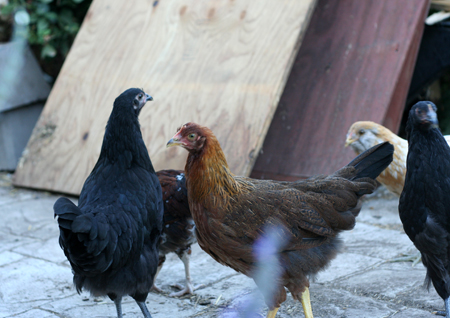
mo or curly sue 2.jpgIs this Curly-Sue or Mo?  They grew up to be the same size so I can’t tell!  The flock integration has worked out well.  There are enough of the young ones to huddle together for safety when Dot charges them.  Yes, Dot wants dominion.  Actually all of the older hens rush at the young ones but there has been no substantial bullying, no eyes have been pecked out, and the little ones are getting bigger every day so that soon I think there will be less rushing at them and a true pecking order will be established.
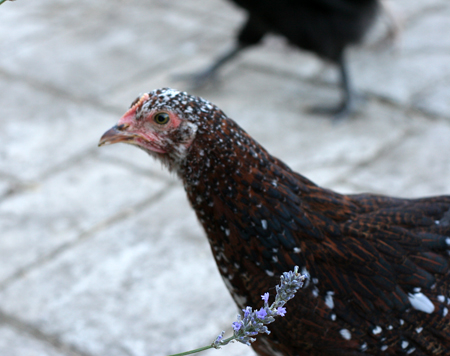
I love the way the Speckled Sussex hens look!  So pretty!

the pullet gang 2.jpgIt has been such a pleasure to see all the hens running around in the garden.  They’ve been plucking at the low growing blackberries.  That’s fine with me.  It will make their eggs richer and better.  But they probably won’t taste like blackberries.

most beautiful fruit 2.jpg

Here they are.  The fruit of my laziness.  I have been letting some brambles get out of control in the past two years and my reward are these plump, finely perfumed, sweet (though I like them with just a hint of sour still in them), summer berries.  I believe that blackberries are my all time favorite fruit.  They remind me of everything wild and scrappy.  They have been, for many years, the only thing I love about summer.*  In Oregon there are so many of them growing wild by the roadsides that when the heat rises the air smells like ripe blackberries.  It’s a heady experience to go whizzing down a country (or town, or city, or freeway…) road on my scooter and pass through a great cloud of warm rich blackberry scent.  It is the essence of summer.

It’s true that they are the scourge of the cultivated garden.  There are a few varieties that are fairly tame but I tend to doubt those ones taste as good as the ones that misbehave and sprawl all over the place like a bad boyfriend.  I can’t say if this is true elsewhere but here in Oregon if you have a blackberry popping up in your yard, or you see them by the roadside, they are most likely not truly wild blackberries but a variety first created by Luther Burbank called “Himalaya” which was so successful that it has taken over this whole state. 

I learned that fact from the Master Gardening program I took a few years ago.  I haven’t done any research to verify if it’s true but I like to think I have a little piece of Burbank in my garden that just arrived randomly to bring me these amazing free fruits.  I also happen to have a Santa Rosa plum tree, another of his finer works.

My house is in a state of mad chaos.  I’ve been working hard at my job, and doing my Kung Fu, and shopping the farmer’s market, cooking, and generally ignoring everything else.  I had meant to get the house really cleaned up before my departure but we’ve all been down with gastroenteritis this week so not much got done but what absolutely had to.  So I’m packing up and printing some Stitch and Boots business cards because I’m heading off the the Blogher convention.

When I return home I hope to get my house in better shape and to share several posts here that I’ve been sitting on while finishing the details (cooking times, photographing, etc.).  In the meantime I hope you are all stopping to smell the brambles in the air and taking the time to enjoy the amazing produce of summer!

*This is patently untrue as I have been known to say the same thing about home grown tomatoes.

Enhanced by Zemanta

Summer White Bean And Basil Salad Recipe

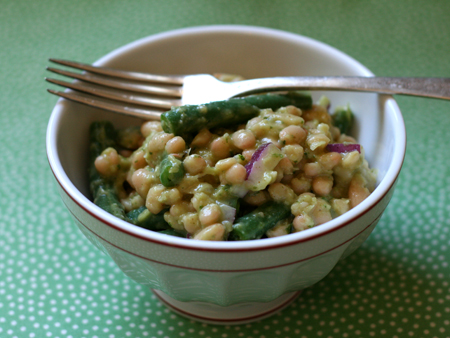
summer bean salad 2.jpgOne of my favorite beans is the navy bean.  I make a lot of bean salads with them because there is no vegetable and no herb that don’t pair well with them.  Unlike many other beans they have a mild presence which I find charming. 

I nearly always add feta to my bean salads but this one is so good just as it is, so tangy and flavorful, that I didn’t miss the cheese for a second.  Considering that I think life without cheese isn’t worth living, that’s saying a lot.

Summer White Bean and Basil Salad Recipe

Ingredients:

1 pound green beans
6 cups cooked navy beans
1/2 cup fresh basil dressing
1/2 red onion (sliced very thinly in 1″ long pieces)
 

basil bean salad 2.jpg

Method:

Trim the ends off the green beans and cut them in half.  Steam the beans just until tender (this usually takes 3-5 minutes). 

Put the navy beans into a medium sized bowl and pour the dressing into them,
mixing very well.  Stir in the steamed green beans and the onion. 

You can eat this right away but it’s best if you let it sit for at least an hour so that the beans can marinate in the dressing for a while.


Recipe Notes:  You can add other summery things to this salad such as cucumbers, tomatoes, or feta cheese.  If you add tomatoes to it I suggest you only add it to portions you are certain to eat the same day.  Tomatoes don’t fare well cut in salads and kept overnight in the fridge.  You can use great northern or cannellini beans in place of the navy beans. 

This recipe is gluten free: provided you use only gluten free vinegar in the dressing.
This recipe is vegan.

Enhanced by Zemanta

Fresh Basil Dressing Recipe

basil dressing.jpg

Something I’ve discovered in my picture taking learning curve is that in the final exam called “how to take a tantalizing picture of dressing” I have failed.  I would like to say in my defense that taking pictures of dressing seems to be a challenge for many people. 

I have been hearing the evil phrase “Too much basil!” being uttered by many silly gardeners and food bloggers.  This is a proclamation I have no patience with.  I have never had great luck in producing an “overabundance” of basil, no matter how hard I try.  What I wouldn’t give to have so much basil I could experience basil exhaustion.  The truth is, however, that there is no such thing for me.  Too much basil?  You will miss it like a lost limb in midwinter, so make a million batches of pesto to freeze!  Use it in salads, or ratatouille (also to freeze!), in pasta dishes, in ricotta for stuffing those ubiquitous zucchinis everyone also claims to get so sick of they could throw up at the sight of another one…

Basil is one of the single most versatile herbs I know of and though you can dry it, I have always felt that dried basil is a travesty of fresh.  Frozen basil is far superior to dried as well, provided you freeze it with oil to protect its lush greenness.

Most dressings I make I use dried herbs because I make large batches and sometimes the fresh herbs will brown before I get to using them.  However, I highly recommend making this fresh basil dressing, make it in a single batch and use it up within a week and you won’t regret it.  Regret it?  No, you’ll LOVE it!  I have already used it on a summer white bean salad (recipe coming soon) and as a dressing for pasta.  If you think pesto is too heavy or you want the fresh basil flavor but without cheese, you have got to try putting half a cup of this dressing on a pound of cooked pasta with roasted vegetables.

But obviously, this dressing will also shine on a simple fresh summer salad.


Fresh Basil Dressing


Ingredients:

1 cup olive oil
1/2 cup red wine vinegar
1 bunch basil (about 2 cups loosely packed)
2 garlic cloves
1 tbsp spicy brown mustard (or your own favorite mustard)
1/2 tsp salt
25 grinds of fresh black pepper

Method:

Put all the ingredients together into either a blender or into a container big and deep enough for an immersion blender to work well.  Blend it until all the basil is finely chopped and the dressing is creamy. 

Recipe notes:  If you don’t like mustard it’s still very good without it.  I like mustard so much I use a lot of it in most of my salad dressings.  It makes the dressing tangy which I love and this tanginess is surprisingly wonderful on pasta.  I also find that prepared mustard adds body to a dressing which I like.