Author Archives: angelina

Bring on the Bread!

I don’t know if anyone else has noticed but good quality bread* is getting more expensive every year.  Grain prices are going up so this isn’t surprising.  My own grocery budget is getting smaller so paying almost $4 a loaf and going through two loaves a week is $8 a week.  That’s $32 a month in bread.

We could, of course, give up bread.  There is a lot of noise out there from people evangelizing (or waxing rhapsodically at any rate) about the wonders of the Paleo diet.  Eschew all grains!  I’m all for everyone eating a diet that suits them, that makes them feel their best and if not eating grains makes you feel your best than I have no argument against it.  For you.  But I don’t view grains as evil or bad for my health.  So I continue to embrace them.

I’d forgotten how wonderful it is to bake my own bread.  My mom has decided that she wants to bake bread once a week to help us save money.  She used to bake bread in the hippie commune I was born into but that was over 36 years ago.  So she asked me to give her a refresher course.  I love the feel of bread dough, I love shaping it, punching it down, the smell of the yeast.  Then, at last, the smell of the bread in the oven is the most heavenly smell in the world.

If you haven’t baked bread before I suggest you get the book “Great Breads” by Martha Rose Shulman.  I learned to bake from that book and taught two friends to bake bread using that book.

I’m looking forward to more home baked bread!


*My definition of good quality means: whole grain, zero preservatives (big fat 0), made locally.  Or artisan bread for special occasions using white flour but zero preservatives and made locally.

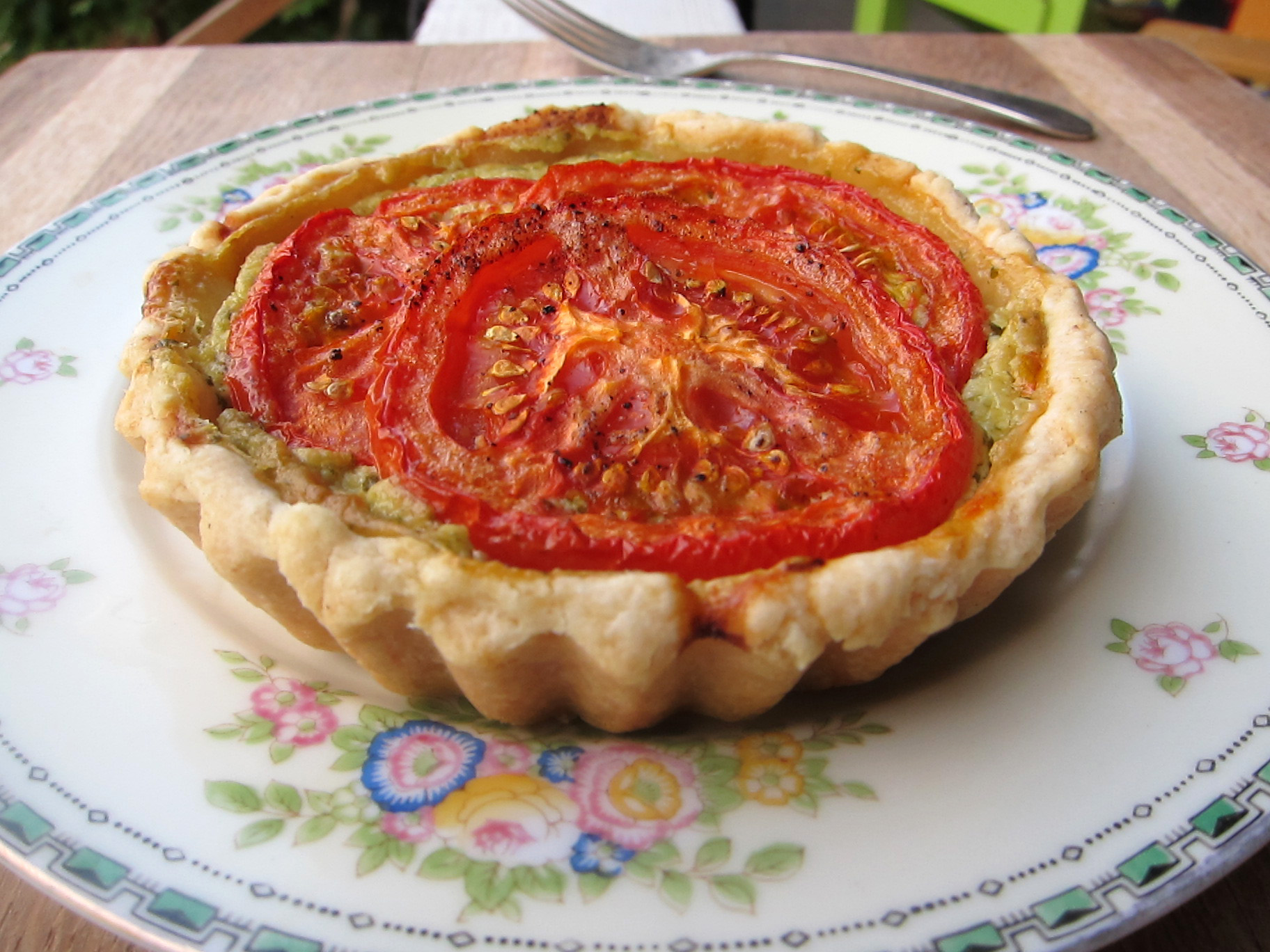
Tomato, Pesto, Ricotta Tart Recipe

Tomato season is over for us.  It’s been over for a couple of weeks.  I would be devastated but for the fact that I ate a couple hundred pounds of them while they were going strong and ended on a high note with my tomato tart experiments.  The last version, the one I’m going to share with you, I made for our friends who are moving out of state.  I needed to make something memorable enough that they’ll be inspired to come back and visit us.

It’s super easy unless you have to make your pesto from scratch, plus make your own ricotta (as I usually do), and then, of course, there’s the crust to make.  Wait!  Seriously, none of those things are difficult to make and if you’re not up to making them all yourself you can buy them pre-made.  If tomato season is already over for you too then you have two choices: bookmark this for next year or if you happen to have any sundried or oven roasted tomatoes in your freezer- you can top the tarts with those.  Whatever you do, don’t use hothouse tomatoes from the store.  Banish the thought!

Tomato, Pesto, Ricotta Tart Recipe

makes 6 individual tarts or one 9? tart

Tomato, Pesto, Ricotta Tart Recipe

Ingredients

Instructions

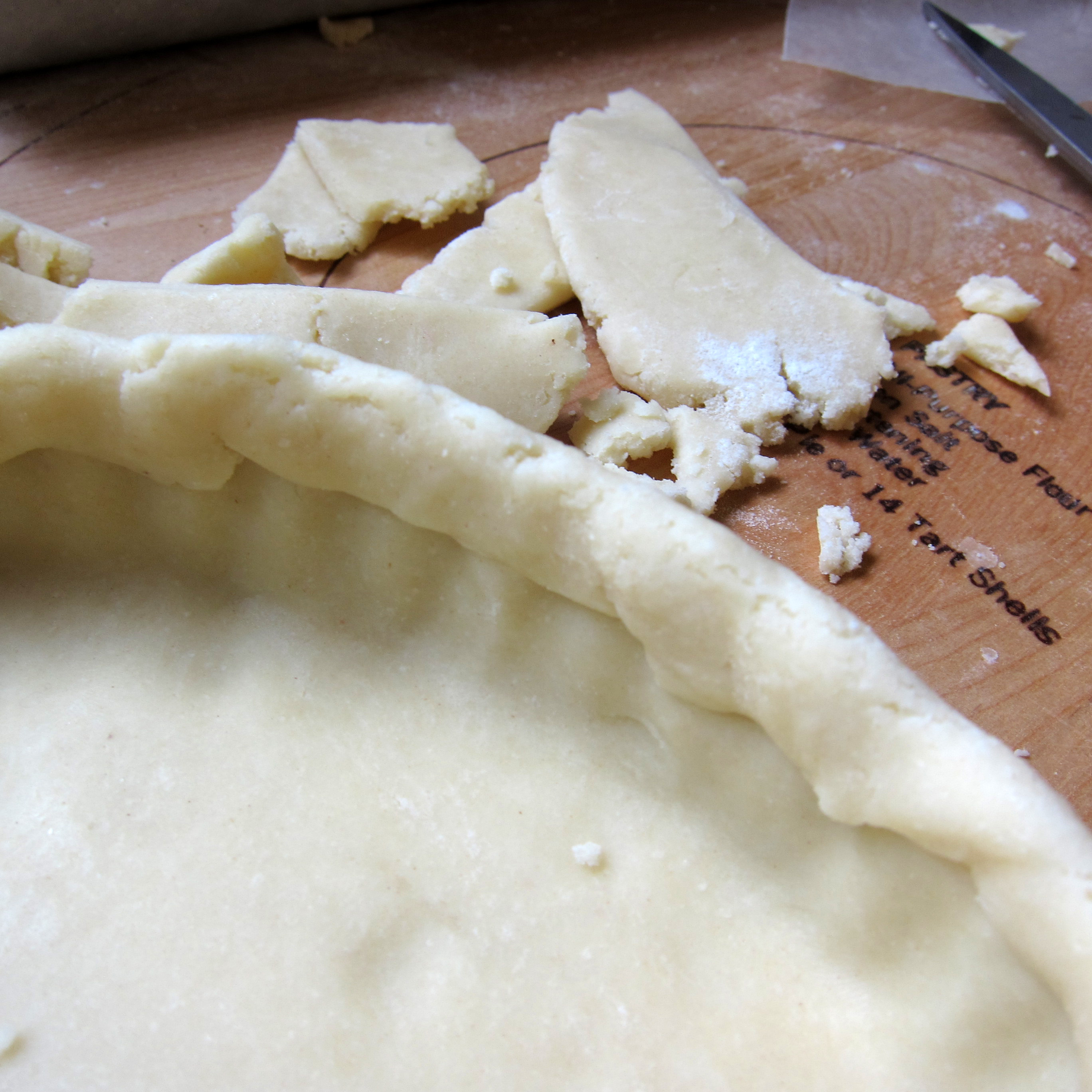
  1. Preheat the oven to 375°. Cut the pie dough into six equal sized pieces. Roll out and fit into the tart pans. Put all the filled tins into the freezer for 20 minutes.
  2. Blend the ricotta with the pesto until completely incorporated.
  3. Remove the tart tins from the freezer and fill each one with the ricotta, dividing it evenly between them all. Smooth the surface of the ricotta out in each tin. Arrange three slices of tomatoes on the top and brush with olive oil.
  4. Arrange on a baking sheet (to catch any spillage) and bake for one hour (or until the crust is golden).

Notes

If you’re using a 9? tart tin, arrange the tomatoes slightly overlapping each other starting with the outer edge and work your way to the center in a spiral. You may notice the lack of additional salt or pepper in this recipe- that’s because pesto is usually already salted and peppered and it is enough for the whole dish. I did salt and pepper the tomatoes in one version but I didn’t think it added anything to the tarts. I freeze the dough before baking because it keeps it from shrinking down in the oven while baking. If you never have this issue and prefer to refrigerate before filling, as most recipes suggest, go ahead and do that. Many ricotta recipes call for an egg to help set it up but I find this is usually unnecessary. Sometimes when I make my own ricotta I add a little bit of milk when stirring it up because it gets a bit dry after draining off the whey, so if your ricotta is homemade, make sure it’s not dry- it’s going to cook for an hour which will dry it out more.

https://stitchandboots.com/2011/11/02/tomato-pesto-ricotta-tart-recipe/


Here’s how I layered my tomatoes for a full sized tart.

If your tomatoes are huge you may only want to put one slice on top, as I’ve done here.

Getting Into Fall Around the House

My experiments with tomato tarts are over.  Tomatoes are officially finished for the year.  At the Saturday Market Denison Farm had a basket of mostly unripe pale ghosts of what I recognize as tomatoes.  It’s over.  As much as I love tomatoes I am not sad.  Everything has its season and I’m so happy that the temperatures have dropped.  My house got down to 55° this week.  My  mom usually can’t take such low temps in the house but she must be getting used to it because I offered to turn the heat on (we haven’t done so this season yet) and she said she was fine.  Keeping the heat down will be important in budgeting now that we’re back to paying our mortgage and hoping to keep the house.  I can’t even remember if I mentioned here that we got approved for a trial period with the HAMP loan.  People can be refused it even after paying their mortgage perfectly on time for the whole trial period, so nothing is certain.  But what’s new?  Nothing has been certain for a long time for us.

Big splurge in my house was buying a bunch more wire bail hermetically sealing glass storage jars for my pantry and cleaning my whole pantry out.  We had a major pest infestation and I had to throw a bunch of grains and old stuff out as well as wipe down all the shelves and clean out jars.  Doing this always feels so good!  We are buying more and more in bulk so it’s important to have a good way to store it all.  We do have food-grade plastic buckets for the huge quantities of legumes we have in the garage.  I hate using any plastic but I can’t see a better way yet for those.  But here in the cupboard the air-tight glass jars are the only way to go for us.  Because I can’t afford to have ALL things stored in them I do have a number of screw-top jars in use.

My Elephant Heart plum tree lost a huge branch.  we have yet to prune it and deal with it.  It makes me so sad.  However, I’m hoping that with a great pruning we can encourage it to survive this setback.

I finally finished canning.  I did.  I finished this past Tuesday with making quince “cheese”.  The project is a bit dubious, I have no idea if it turned out.  I have to wait a few weeks before opening my jars and trying it.  The recipe was actually British and called for using glycerin to coat the inside of the jars so that the quince can be removed more easily and sealing them with wax.  I am inexperienced in this and didn’t have paraffin on hand so I processed them in a canner which made coating in glycerin a waste.  If I like the taste of the quince cheese then I will go the traditional route next year and use wax and glycerin.

I was done with my canning.  I really was.  The grape syrup was a bust.  It gelled but not completely so I re-boiled it and it was ruined.  It lost all grape flavor and became boiled fruit flavor.  Not my favorite.  I tossed it.  Ah well, these things happen.  It’s part of the preserving learning curve.  The apple sauce, at least, was simple and I canned quite a few pints of it.  I don’t even eat much of it but I do love it on savory pancakes with sour cream (latkes or zucchini fritters) so it’s nice to have some on hand.

I was done with preserving and cooking in serious bulk until yesterday when my friend Andre had a bag of tomatilloes he couldn’t do anything with and gave them to me.  Suddenly I have tomatillo salsa to make.  I’m not crying.  Not really.  I love tomatillo salsa.  So I’ll be making that this week.

Food budgeting is beginning.  My first trick is to not shop during the week.  Unless it’s something specifically for Max.  I will not indulge in the habit I have of suddenly wanting to make something I don’t have the ingredients for and running out to buy them.  I am shopping on Saturday for the week and will simply have to make food with what I buy.  No spontaneous purchases.  Next I will work at limiting some of the expensive things I buy like cheese.  Coffee too.  If we run out mid week, no buying another bag.  I’ve got lots of tea to drink in it’s place.  I’m not depressed this time (the year before last was super hard and really depressing).  We have plenty to eat.  Max’s food is the biggest concern because of his picky eating, but cooking on a budget for the adults is not going to be difficult if I get creative.  We have tons of bulk and after this very busy preserving season I have stuffed the shelves with jars of home canned goods and the freezer with good things.  We are already very fortunate and rich with good things to eat.

I also have a great huge stash of walnuts from a dear friend of mine and this makes me feel secure like a squirrel with a full tree trunk.  I look forward to cracking them.  My OCD makes this kind of work extremely satisfying and then I’ll freeze the nuts so that no bugs or bug eggs can survive.  Sounds distressing, I know.  However, I know from experience that these things linger in all real food and sometimes freezing is the best way to deal with them.  I’m going to have so many walnuts to use!

Today I’m going to make chocolate zucchini bread from Clotilde Dusoulier’s book of the same name.  I’ve never tried it before but I’m hoping the kid might enjoy it.  (It’s actually “cake” but has less sugar in it than most zucchini bread recipes do).  To that end I must dash off and get dressed and clean the kitchen.  What could be better than baking on a rainy stormy day?

I hope you are all enjoying your Sunday and keeping warm inside.

Pantry Shelves: how to clean, store, and organize your kitchen shelves

Basic Pie and Tart Dough Recipe

I learned to make pie dough first from my mother using barley flour and for years used the one she published in her cookbook “Honey and Spice”.  The next pie dough influence was Deborah Madison‘s recipe in “Vegetarian for Everyone”.  Some of her tips proved useful in increasing my success with making a really good dough.  The last influence was Martha Stewart.  I find her instructions aren’t as good as my mom’s and Madison’s, but I like using her proportions of ingredients.

I make a really good pie dough.  This is one of my few baking talents.  Some people use slightly different butter to flour ratios for tart doughs but I use the same dough for both pies and tarts.  One way in which I disagree with almost everyone is that I don’t believe it matters whether you use salted or unsalted butter.  I dislike unsalted butter on my toast so I use what I keep on hand.  I still add salt to the flour.  Trust me, this dough is not too salty.

I also never add sugar to my crusts regardless of whether I’m making a savory or sweet pie.  Most recipes say you can add an optional teaspoon of sugar and I see no reason for it.  There are even sweeter versions of pie dough (pâte sucrée) but I never make this kind of crust because I don’t have a great sweet tooth and if my crust is full of something sugary I don’t need the crust itself to also be sugary.

Some people are intimidated by pie crusts and I don’t understand why.  As long as you have a food processor it’s both fast and easy.

Basic Pie and Tart Dough Recipe

Basic Pie and Tart Dough Recipe

Ingredients

  • 2 1/2 cups all purpose flour
  • 2 sticks of cold butter
  • 1 tsp salt
  • 1/4 to 1/3 cup ice water

Instructions

  1. Measure the flour and salt into your food processor bowl and pulse a few times to mix. Cut the sticks of butter into cubes and arrange evenly around the flour as shown below:
  2. Pulse the butter until the butter pieces are well broken up (many say “the size of peas” but the pieces will be uneven so I don’t find this useful). The photo below shows about how your flour butter mixture should look right before adding water:
  3. With the processor running add the water one tablespoon at a time in a trickle. After about 3 tablespoonfuls check the moisture of the dough to see if it’s ready or if it needs a little more water.
  4. Check the dough by taking out a small handful like this:
  5. Then squeeze it in your hand. If it retains the shape you squeezed it into when you touch it, the dough is ready to be rolled out. If it breaks apart easily then it needs a little more water, only just a little at a time. See how it looks when it’s ready in the image below:
  6. Now dump the dough onto a pastry board or clean counter top. It will be very crumbly. As quickly as you can, gather it all in a heap and press it into a ball. Do not knead it.
  7. Now you can divide it in two and roll it out.
  8. I shape each half into a flat disk, put it between two layers of wax paper and roll it out until it’s large enough to fit a 9? pie pan, I lay it over the pan, gently press the dough into it and then flute the edges. Or, I may divide the dough into different sizes to use for individual pies or tarts, but I still make flat discs of them. If you aren’t going to use the dough immediately, store in the fridge between the wax paper in a plastic bag (the plastic bag will prevent the dough from drying out).
  9. Here are some tips I follow that I find very useful in making successful pie and tart crusts:
  10. I roll out my dough into their pans right after forming the dough, I don’t wait for it to chill in the fridge. When the dough is rolled out in the pie pan and the edges are crimped I put it in the freezer for at least 20 minutes before filling and baking. I do this step even if I’m planning to pre-bake the shell. Freezing it first prevents shrinkage of the dough. I also find it helps prevent the bottom of the crusts from getting soggy if you don’t pre-bake.
  11. For pre-baking I usually use kidney beans as pie weights. I keep a jar of them for this purpose. Once you’ve used the beans for pre-baking I don’t think they’re good to cook, but you can use them over and over again.
  12. Many people like to trim their tart crusts level with the top of the pan. I don’t like to do this. I prefer to build the crust up a bit higher than the tart pan. This is a rustic approach. It also prevents shrinkage of the crust and a spilling of the contents over the top. I do sometimes trim the uneven or excess dough off with scissors to get a more consistent crust thickness.
  13. If you only need enough for one pie crust you can, of course, halve the recipe. But why do that? You can wrap the extra dough tightly (or vacuum seal it) and freeze it for later.
https://stitchandboots.com/2011/10/27/basic-pie-and-tart-dough-recip/

Tomato, Pesto, Ricotta Tart Recipe


This Week’s Garden Harvest

This is what I harvested from the garden this week: some cayenne peppers (many more are almost ripe, but not quite there yet), rose hips from my French wild rose, and a handful of snow peas.

I halved the hips and gutted them.  They are now drying.  I tried getting all the hairy bits off but with no success.  That stuff can, apparently, irritate your throat if ingested.  I guess I just have to make sure to use muslin bags for making tea with them.

I haven’t had a lot of time to play in the kitchen and I still have those same pesky preserving projects hanging over my head.  I would truly like to get them finished this weekend.  I need to move on with my writing.  I’m also going to have to clean my house pretty seriously because in a month there are going to be a lot of people in it.  I’m feeling pretty overwhelmed.

Preserving left to do:

sugar up the grape juice to make syrup, and can it

Apple sauce, can it

Quince in vanilla sugar syrup, canned

Shred all the giant zucchinis and freeze them

I have heard from some of my friends that they’re winding their own preserving projects up but are having trouble, like me, getting it all done between work and other responsibilities.  We do it because it’s important but there’s no question that doing a lot of preserving takes time.  What I’m tired of is having jars everywhere, on every surface, and all my equipment out.  I’m ready to put it all away.  But it would be silly to do it before I’m done.

I’m going to go get dressed, go to the Saturday farmer’s market, and then I’m going to get some of this done.  Plus cook a farewell dinner for really good friends who are moving back to Utah.  Boooooo!  We are devastated.  We must feed them so well they will immediately plan they’re first vacation to visit us.

What are you all working on this weekend?  Is your canner finally back on the shelf?  Are you wrapping things up or still in the thick of it?

Preserving Notes for Fall 2011

I would like to say that canning season is truly done for me as of today.  Instead, I can say with confidence that canning season is kind of winding down but who knows when it will truly end because I still have quince on my tree and a friend has said her concords are in.  I dearly want to make concord grape soda and/or grape syrup for Italian grape sodas.  Or even just juice.  It’s the only home canned thing my son enjoys that I make.  It’s the only thing he asks for.  Here are my notes from this year’s canning adventures so far.

Jam:

My jams almost always taste fantastic.  It’s hard to go wrong with jam flavor so I can’t claim it’s because of my great mastery or kitchen brilliance.  Jam consistency is a whole different story.  Most years I have more trouble getting my jam to set than making them set too hard.  What I find frustrating and weird is that the only jam I used pectin in didn’t set well at all, but the other two jams which I made without pectin set more firmly than I wanted.  Again and again.  I made three batches of blackberry jam.  I adjusted the boiling time to shorter and shorter periods with each batch until the last one I did I was absolutely SURE it would end up being too soft.  It was not.  It was just as firm as all the other batches.

I made two batches of Damson jam.  (Incidentally, I did jell testes for every single jam batch, in case anyone cares to know).  Each batch is more stiff than I’d like it to be.  For me the perfect jam consistency is sticky and thick but soft enough to spoon onto a scone without having to violently shake it from the spoon.  I think I know the trick now at last.  The jell test instructions say to put a teaspoon of jam onto a little chilled plate then put in the freezer for one minute.  This is not enough time to really tell.  That’s my opinion.  I think next year I will bring my jams to a boil for just a few short minutes and then take it off the burner, do the jell test, and let it cool at room temperature for a half an hour or so.  The little plate I did my jell test on last night that indicated my damson jam was not yet ready sat on the counter over night and this morning it was the perfect consistency.  But I boiled it longer last night because it didn’t seem set enough.  So what I learned is that to do it properly, I must take my time with the test.  Why should I be in a hurry anyway?

Rose Hip Syrup:

Gross.  I hate the flavor I got.  I have had dried rose hips in tea many times in my life and very much enjoyed the flavor and the slight tartness of them.  I thought the flavor of rose hip syrup would be similar.  Not so.  It was sweet, kind of soft and floral, and though that may sound good to some people it was awful to me.  So that was a total waste of time.  I can’t give up on rose hips, though, because they are so nutritious and full of vitamin C.  My plan is to do the tedious and cut them, gut them, and dry them.

Asian* Plum Sauce:

I tried a recipe from the book “Preserved” by Johnny Acton and Nick Sandler. This is not at all what I want in a plum sauce.  I didn’t use the spices they used because I dislike cinnamon in most savory food (except some North African dishes) and I really dislike star anise.  They have you cook the sauce for two hours (to let the spices I didn’t use infuse the sauce) and I did cook it down for quite some time because after adding so much vinegar, water, and soy sauce it was much too thin.  The sauce I ended up with has a very muddled dark taste.  Maybe the soy sauce had something to do with that.  Maybe just cooking it for so long.  I’ll tell you what, though, the spices that were called for would not have improved it one bit.

What I wanted is  the kind of plum sauce you get when you order Mushu vegetables in a Chinese restaurant.  The authors of this book claim that that’s what this is supposed to be like.  It’s not.  It’s been a while since I’ve had plum sauce in a Chinese restaurant but I haven’t forgotten that taste.  What I loved about that sauce was its bright, tangy, and very plummy flavor.  I’ll do better to make up my own version next time.  The plum sauce I made last year using yellow plums, ginger, garlic, sugar, and jalapeno was fantastic for dipping spring rolls into.  That’s more like what I want, except with dark plums.   What a waste of Damsons that turned out to be.

Dill Pickles:

There weren’t many pickling cucumbers to be had and the ones we got were too big and had much too developed seeds inside which means they will be mushier than usual on the interior.  I gutted many of them that were seriously sub-par and I have no idea how those will turn out.  The idea is that I will chop those up for potato and egg salads.  The seeds were enormous and gelatinous because they were too mature.  We were a little desperate, so we made do.

There are several quarts of mixed vegetable pickles (with green beans from the garden included) and I think those will be very nice.  They look super pretty as well.

Peach Chutney:

Second year making it.  Last year I cooked it a little too long and it got very dark.  We liked it, it was good.  The adjustments we made this year were to lower the sugar (it was too sweet) and to lower the amount of raisins.  I may have not cooked it quite long enough this time.  The color is prettier (lighter orange) but it may be softer than intended.  I think over all it will be an improvement.

Jalapeno peppers:

They’re very good.  Really wish they were more evenly sized (my mom is untame-able in this way) but they taste great and I’m happy we have so many of them.

Lots of freezing:

Lots of pesto.  That always turns out great.  I did some in jars (my preference) but since the freezer is actually running out of space this year I had to revert back to using plastic vacuum seal bags.  Also have 6 quarts of corn chowder in there, 3 quarts of pinto bean chili, at least 10 quarts of plain blanched corn, 3 pints of sauteed onion with hot peppers and corn.  A couple bags of slow roasted tomatoes which I don’t think turned out well but I can’t say how something that’s so simple and which I’ve made well so many times before could be unsatisfactory- yet it’s so.  I have several jars of strawberry syrup and ginger syrup in there as well.

Drying:

My mom has been doing a lot of this work.  Several quarts of dried nettles and a quart of dried kale.  Varying amounts of: thyme, stevia, calendula, cayenne peppers (there are still quite a few ripening), and arnica.  I’m considering drying a giant zucchini to experiment with how it is reconstituted in winter soups.  Anyone else tried this and have an opinion?

Theoretically I’ll be done with fall preserving when I’ve gotten and processed the concords and picked and processed the quince (Philip has requested quince jelly).  So where are all of you in your food processing – are you done?  Almost done?  Or just getting started?

*The original recipe was called “Oriental Plum Sauce”.  When referring to people or things from the Asian continent it is considered (according to my Asian friends and my personal opinion combined) to be better form to use the word “Asian” instead of the word “Oriental”.

People Are What They Grow

I’ve been living in McMinnville for five and a half years now and when I first arrived I marveled at the obvious love this town had for: lawns, tiny stands of shrubs and/or perennials dwarfed by expanse of lawn, Japanese maple trees (the mini kind with red leaves), and the sameness.  All the mind numbing sameness from house to house, yard to yard.  I had just moved up from a northern California neighborhood filled with a wonderful diversity of garden styles so the sameness here struck me as being stark, sterile, and depressing.

Naturally I’m painting a broad picture.  I’m telling what my impressions as a newcomer were.  It is to be understood that all this time there have been a sprinkling of gardens that have not fit this standard mold, that have stood out with their more interesting styles.  But I promise that those gardens were (and still are) in the minority.

I have come to understand that the garden style here represents the people here very well.  This is a conservative town that likes things to be neat and tidy, likes the diversity of flowers to be corraled in liver shaped segregated (easily maintained) beds.  This is how it deals with people as well.  People are superficially friendly here but any outsider will tell you that it goes air deep.  People aren’t actually that friendly here.  They are not eager to let new people into their inner circles.  There is a hierarchy that, while it exists in all places where humans gather to live, is more strictly observed than it ever was in the city I moved here from.  This orderliness, this silent segregation of people into groups and cliques, this tight containment of plants reflects the people who grow them.

My own garden “style” very much reflects me as well, both my good qualities and my bad.  I rarely weed.  I put my mess of fruit and vegetables where people can see them.  I let my roses run riot.  I let my trees reach out too far.  I eschew order and encourage my plants to live together in a chaos of tangles.  Every once in a while I trim some things, weed a little, pretend to make order.  My garden reflects my mind, which is not an orderly place at all but constantly full of thoughts, of ideas, of questions, of anxiety, and of reflections – all of it in an untidy mess.  What you see is what you get.

I’ve been noticing gardens changing slowly over the last few years.  I’ve seen some lawns ripped out and vegetable beds put in in their place.  I’ve seen more gardens leaning towards permaculture ideals, and more daring combinations of perennials, some of them even edible.  Blueberries as shrubs in the front yard!  I’ve been seeing more herbs, more flowers, more fruit trees being planted.  I’ve seen those liver shaped beds expand, shrinking the obsessively clipped lawns surrounding them.  I’ve seen more lawns go brown in the summer.

Best of all of this is that I’m seeing more and more vegetable gardens being put in front yards.  I am seeing sidewalk strips turn into corn patches.  I am seeing squash plants spilling out toward curbs.  I am seeing more and more food being grown right there in front where all the neighbors can see.  I suppose in some ways this is a sad reflection of our deep recession.  Food prices constantly going upwards is forcing people to see the merit of growing their own food.  Letting lawns go brown in summer is a reflection of thinner pocketbooks creaking under the weight of water bills.  I’m not sad about this.  I hate that people are getting more and more strapped, myself included.  I hate that so many of my friends are enduring hard times, scrabbling for enough money to pay mortgages, some going on food stamps.  I’m not happy for the stress that financial distress is bringing to people but if this is what it takes for people to understand the value of growing food instead of lawns, I can’t do anything but cheer for the transformation.

The apartment building in these pictures is around the corner from my house.  For years it has favored institutionally low maintenance landscaping.  The people who live in it are mostly middle aged to old, no kids, and truthfully they seem a dour motley crowd that rarely smiles back at me.  When I saw these squash plants pop up in early summer I was taken completely off my guard.  I was absolutely charmed.  It gave me a glimmer of hope for all of mankind to see them plant tomatoes against the chain link.  Many tomato plants in the place of azaleas and useless stinky Pieris.  I ride my bicycle past this little patch often and every single time it makes me happy.  It reflects change in a stolid community.

I wonder if eventually most lawns will disappear and give way to a diversity of garden styles and garden plants.  I wonder if McMinnville will ever lose its crazy love for utilitarian shrubs in favor of more daphne, herbs, flowering quince (or even fruiting!), and free range wild flowers?  I doubt it, but a girl can hope.

Cherry Tomato Gratin Recipe

Cherry tomatoes are often the first ones to ripen in the garden and the last to give up to dropping fall temperatures.  Most people who grow them eventually get to a point where they need to figure out something else to do with them besides using them in salads or eating them right off the vine.  This is what you do with them.  It’s simple, it’s fast to prepare, and it makes a fantastic side dish.

This recipe is based on one from “The Vegetarian Table: France” by Georgeanne Brennan, one of my favorite cookbooks.

Cherry Tomato Gratin Recipe

serves 4

Cherry Tomato Gratin Recipe

Ingredients

  • 1 1/2 lbs cherry tomatoes
  • 2 Tbsp olive oil
  • 8 oz ricotta cheese
  • 1/4 cup basil, julienned
  • 2 cloves garlic, finely minced or pressed
  • 1 tsp salt
  • fresh ground pepper
  • 2 Tbsp grated Parmesan cheese

Instructions

  1. Preheat oven to 425°. Divide the tomatoes into four 8oz ramekins. Drizzle half a tablespoon of olive oil over each dish of tomatoes.
  2. In a bowl, mix the ricotta with most of the basil (set aside just a little for the top of each gratin), the garlic, salt, and pepper.
  3. Divide the ricotta between the four ramekins – top each dish with it, sprinkle with Parmesan, and add the rest of the basil.
  4. Place the ramekins on a baking sheet and bake for 15 minutes, then finish by broiling just until slightly browned (only a couple of minutes). Let it cool down before eating because those tomatoes retain heat well!
  5. Gluten free recipe. (I don’t know if any store bought ricotta has gluten in it but I used my homemade and it is definitely gluten free)

Notes

If you want to make your own ricotta - it's easy! How To Make Homemade Ricotta

https://stitchandboots.com/2011/09/24/cherry-tomato-gratin-recipe/


Cautiously Hopeful: The Bank Called

After 15 months of no answer from the bank (12 of which they were just completely ignoring us*) we have been approved for a trial period with the HAMP loan.  This, it turns out, is a little anticlimactic because the reason we applied for the loan was to lower our mortgage because we couldn’t afford it.  It’s only been lowered about $50 a month.  It feels a little like going back to square one.  There is a significant change in our loan, however, which I need to be thankful for, which is that the terms of it now include a lower cap on how much our variable rate can go up which is important because the way it was  before we knew that even if we could somehow keep scraping by paying our mortgage, in three years it was going to balloon up to an amount there was no way we could pay.

I want to rejoice that we’re one step closer to keeping our home but I feel dispirited.  An acquaintance got approved for the trial period too and at the end of making all her payments on time she was refused the loan in the end.  So we are by no means in the clear.  However, that was over a year and a half ago and I can’t see any reason why, at this point with the market absolutely flooded with foreclosures, why our bank would refuse to give us this loan if we make our payments on time and in full.  They have nothing to gain by putting this house into foreclosure.  They won’t recoup their money.  They’re better off keeping us here, making payments on a loan that isn’t much different from the one they originally made with us.

Who can say what will happen?  We start paying our new mortgage starting in November.  What this means for us is that we’re going back to being seriously cash poor.  No traveling for me, possibly ever again.  Serious grocery budgeting.  Back to rarely going out to dinner (we’ve been going out once a week as a family treat for the last year).  It means dropping some Kung Fu.  (I’m hoping to keep my forms class but until we start paying the new mortgage I can’t tell if this is realistic or not)  It definitely means no beer on a regular basis which is great for the waistline but not so great for stress relief.  We will not be able to buy books anymore (we don’t spend tons of money on them or anything but it was nice to be able to buy some great books for Max this year after being able to buy so few before).  It will be hard to take care of things like my teeth which need serious work, Max’s therapy, fixing my scooter (which seems to be having transmission problems), and buying pet flea care ($$$)**, any other crap that crops up that needs to be dealt with.

Do I sound pessimistic?  I’m worried.  I haven’t forgotten the hell year we had of barely scraping up enough for groceries some months.  One other difference, though, is that my  mom is here now.  She is pretty poor herself, depending on social security for her income.  (Incidentally, for those of you who want to abolish this institution – you wait until you’re old and in poor health and can’t work enough to pay to stay alive and depend on your poor relations to somehow scrape by enough to keep you alive- this is no joke.  I am so thankful my mom has something coming in after years of hard work!)  Anyway, my mom’s income is mostly going towards bills that cannot be excused just because she retired.  But she is going to try to budget too so she can contribute to the mortgage.  She really wants to help and that’s what she’ll do if she can.  So truly, things may not be as bleak as they were before.

It’s been a couple of days since we found out and as it sinks in that the bank is not, so far, planning to boot us out of the house, I am slowly succumbing to some optimism.  Allowing myself to think about planting my elderberry and rose from my friend Riana.  I am cautiously allowing myself to believe we might actually get to stay here.  We love this place.  None of us want to move.  As my mom has  been working hard all summer on our garden and produced for us a great crop of beans and tomatoes and other good things we have been dreaming of the things we’ll plant next year, the beds we’ll add, the changes we’ll make so our property feeds us ever more food.  From one barrel we have a bumper crop of cayenne peppers, we have dried enough thyme to supply us for a year, we’ve dried stevia too, and kale.  There’s so much more to do, so much more we can grow.  And with our financial situation being so tight, staying here means that it’s never been more important to grow food and herbs.

This is the first year my quince has produced anything worth talking about.  The immature fuzz has faded and I have several quince coming closer to harvest time.  I have been watching that ancient fruit forming, clinging to the tree surrounded by a thicket of roses gone a bit wild, and it’s seemed to me a representation of everything I hope for.  I want to see that tree mature.  I want to see crops of quince so large I throw up my hands and say “What shall I do with so much quince?!”.  I wasn’t even sure, months ago, that I would be here to see it fruit this summer.  Now it looks like I’ll at least get to harvest the fruits it made and I can start thinking about what I’ll make with them.

It’s tough for so many people out there.  It just keeps getting tougher.  There are so many people out there having an even harder time than we are.  We’re employed and that is saying a lot right now.  So while I’m feeling cautiously hopeful about being able to stay in this house, I am also taking some time to be grateful for the things we have and the good things that have come our way.


*They don’t even look at HAMP applications while you have an open bankruptcy file.  But they failed to inform us of this.  That was 12 months of needless paperwork Philip put together every single month.  Would have been nice to know this.

**I do intend to start using diatomaceous earth in the carpets and on the pets to help control fleas as my friend Ann suggested and maybe eventually that will be all we need (and that’s pretty cheap stuff).  At the moment they are recovering from a bad infestation and they need the big bad chemical treatment.

Around the Farmhouse: A Not So Leisurely Sunday

I have my mother to thank for all these tomatoes.  She has been making sure they get water frequently resulting in the best tomato crop my garden has had in years.  It’s so exciting.  In the area it’s been known to be a mild/cool summer with heat spells only showing up the late in August and I know some people are not having great tomato harvests like we are – so I think they must be in a great spot and I also think my mother has some magic.  We grew about 12 plants.  I think I should go count them to be sure and for the record next year.  The varieties we’re growing whose names I know are: Black Krim, Striped German, Sungold (2), Jaune Flamme (2), Yellow Brandywine, and a few others whose names I can’t remember and will be revealed when we rip out the plants and gather the plastic plant tags.  I think there is a Pineapple variety and possibly a Japanese Trifele.

My mom also planted some snow peas around our flimsy garden fence and we’ve been getting quite a good crop of them.   We have some lush lettuce and some beets that look like they might be getting big.  We harvested and dried some kale and have been getting a slow but steady stream of cucumbers and zucchinis.  Again- why does everyone have a “problem” with prolific zucchinis and I just have a trickle?

One of my favorite things to eat this summer has been a simple Greek-inspired salad.  Just cucumbers, tomatoes, thinly sliced red onion, feta cheese and vinaigrette.  The Sungold tomatoes are unbelievably good in this and I could eat this for every meal.  I would do it except for the fact that there’s a lot of other produce to use up too.

45 quarts of dill pickles.  About 17 half pint jars of blackberry jam.  15 half pints of strawberry jam.  11 quarts of marinara sauce.  22 quarts of diced tomatoes.  4 pints of tomatillo salsa (my mom did that one on her own).  5 half pints of peach chutney.  5 pints of peaches in light syrup.  That’s what’s been going on in my kitchen this past few weeks.  I’m hoping to pick up some damson plums tomorrow to make jam with.  A close friend has some Italian prune plums and I’m wondering what I could make with those.  She has a lot of them.  I do like prunes and I’d be interested in drying a few but what else are they good for?

Any ideas?  Please share.  Would they make a good savory plum sauce?  Do they make a good jam?  How about pickled plums?  (I’ve never had those).

Today we got our first fall rain.  It’s lovely.  It means I need to go pick as many of the tomatoes that might be ripe out in the garden that I can because they’ll start splitting.  Today I will be slow roasting a bunch of tomatoes and then freeze them.  I also got 10 ears of corn for $3 at Harvest Fresh and will be making a spicy corn chowder with them.  If the corn is good I will go and get more corn and make some chowder to freeze.

I also have pesto to make.  As I’m writing this all out I suddenly feel serious pressure to finish my paid job so I can jump into the kitchen and get cracking on all those food projects.  Food has a habit of going bad when left around.  I wasn’t even going to make pesto but my friend Laurie and my mom talked me into it.  I still have 10 batches in the freezer.  Still, in case you didn’t know it- people love pesto and that makes pesto a great bribe or a much appreciated thank you to friends and family.  Pesto in winter is one of life’s greatest indulgences.  Mine, which my close friend Chelsea and I perfected together, is one of the best recipes out there.  (According to Laurie and my mom) (I like it a lot too)  So I bought supplies to make more and there are four beautiful bunches of fresh basic waiting for me to process them.  I’m tired.  Is it beer-O-clock yet?

You can make corn chowder too-here’s my recipe.

If you don’t know how to slow roast tomatoes and you want to try it you can follow my instructions for making slow oven roasted tomatoes.

This pesto recipe is fantastic.  Making it always reminds me of Chelsea.