Author Archives: angelina

Pickled Jalapeno Recipe

This recipe is based on the one in Joy of Pickling by Linda Ziedrich but I’ve changed the spices to match my own tastes.  I wanted pickled peppers like the ones I buy in jars in the Mexican section of the grocery store and these absolutely hit the spot. The main difference is that canning them at home gives you a softer finished pickle which some people might not like as much.  The ones in the store can be almost crunchy at times.  I don’t personally like them crunchy so these are perfect for me.  If you want a crunchier pickle you can add pickling lime but I’m not going to advise on how to do that since my one experience using pickling lime disgusted me beyond belief.  The taste of these peppers is tangy, hot, with just a little garlic flavor.  I suggest eating large quantities of them with huge blocks of cheese.

Pickled Jalapeno Recipe

Serving Size: yields about 4 pint jars

Pickled Jalapeno Recipe

Ingredients

  • 2 lbs jalapenos (whole or sliced in rounds)
  • 4 garlic cloves
  • 2 tsp mustard seeds
  • 1/2 tsp black peppercorns
  • 4 cups distilled white vinegar (5% acidity)
  • 4 cups water
  • 3 Tbsp canning salt (or pure sea salt with zero additives)
  • 4 Tbsp olive oil

Instructions

  1. In a nonreactive sauce pan mix the vinegar, water, and salt and bring to a boil. At the same time put your jars in the water canner to boil until you need them.
  2. Wash the peppers and trim the stems to about 1/4" or cut all the peppers into rounds discarding the stem ends. If using whole peppers slit them twice lengthwise.
  3. Divide the spices between the jars evenly and fill each jar with as many peppers as you can fit without cramming them.
  4. Fill each jar with brine. Shake the jars a little and tap (gently) on counter top to bring air bubbles to the surface. Top up with more brine if needed leaving 1/2" headspace.
  5. Pour 1 Tbsp olive oil into each jar. Wipe the rims carefully with a clean damp cloth. Fit the jars with two piece lids.
  6. Process in the boiling water bath for 10 minutes.*
  7. Let the peppers cure for 3 weeks in a cool, dry, dark place before opening.

Notes

*I have not included the basic steps for boiling water bath canning here. I assume you already know them. If you are new to canning then please check out this link for how to can foods using the boiling water bath method here: Intro To Canning

How much brine you need is going to depend on the size of your peppers and whether you leave them whole or slice them. You may have some left over and that's fine.

If you are working with a large amount of peppers it may be more useful to follow this guideline: add to each jar 1 garlic clove, 1/2 tsp mustard seeds, 1/8 tsp peppercorns, and 1 Tbsp olive oil.

At the time of this writing I canned 12 lbs of jalapenos and ended up with 28 pints of pickles. I did a mix of whole and sliced peppers. I mention this to illustrate that yields can only be given in approximations here.

https://stitchandboots.com/2011/09/08/pickled-jalapeno-recipe/

Couscous T’Faya Recipe: saffron couscous with caramelized onions

This is a traditional North African wedding banquet dish.  I know this because it says so in the book from which I adapted it called “The North African Vegetarian Table” by Kitty Morse.  I made this dish many years ago without the saffron because I don’t generally buy saffron.  Not because it isn’t grown locally (though theoretically, if I was more of a madwoman than I am, I could grow it myself) but because it’s expensive.  In a funny circular way I came to know this dish more personally through my friend Sharon who gave me an enormous package of envelopes of powdered saffron.  I thought she had gotten it from her own travels.  I didn’t use any of it until now because I’m not used to having 50 envelopes of powdered saffron at my disposal.  It seems so precious a gift and I have enjoyed seeing that exotic treasure every time I open my spice cabinet for the last year and every single time I see it I say to myself “I need to make a saffron dish soon because I have so much of it!”  And then I would manage, somehow, not to make any saffron dishes.

It finally occurred to me that while spices are known to last for quite some time it is also known that they lose their integrity with each year in storage and while it is certainly lovely to open my spice cabinet and see my exotic precious gift of saffron sitting there, it would be embarrassing to never use it and have wasted it all.  So I finally returned to this dish that I made years ago without saffron and this time I got to experience it how it’s supposed to be.  It was so good I knew I would immediately write my version of it here, to share with all of you.  But therein lay a problem: there are all kinds of powdered saffron grades and often they are mixed with things like turmeric and if I’m to give you a recipe then I need to help you find what I used or come up with equivalents.  This turned into two hours of fruitless and increasingly frustrating research.  I translated every word on the packaging into English and nowhere was there a word for saffron or even turmeric listed.  The only ingredient listed was corn starch and a mysterious secret formula which makes up 14% of the ingredients.  Formula E-102.  I found out only one thing which is that this product I used is made in Novelda, Espana which really is a saffron producing region.  The company that made mine is nowhere to be found online.  So I put in a desperate call to my friend Sharon to get more information on where she got this strangely unlisted gold.

She told me that her ex-sister-in-law (a Moroccan woman) had made her some fantastic food using this saffron and so Sharon asked her if she could bring her back some of the same stuff she uses the  next time she traveled back home.  Sharon imagined that B would bring her a few small envelopes but as it turned out she brought her three big packages of it, each containing about 50 envelopes of saffron.  This is the stuff she uses in her own cooking.  Sharon shared the gift with me knowing I would appreciate it.  However, she doesn’t know any more about this particular brand of saffron than I could find out.

The funny thing is that when I told Sharon about the dish I was writing the recipe for she said she had had that same dish at her brother’s wedding in Morocco and that she’s wanted to know how to make it for a long time.  It’s funny how the first recipe I use this saffron for is one she’s had in its country of origin and that it was her gift that made it possible for me to make it.  The version Sharon had was different from the one in the book that I followed (and then changed for personal taste).  The thing that seems key is the saffron, cinnamon, caramelized onion, and raisins.  The version in my book includes almonds and hard boiled eggs.  The version Sharon had at her brother’s wedding banquet sounds more like my adaptation without those ingredients.  Try it and see what you think.  I include the amount of saffron in threads as it appears in the original recipe and then if you have powdered you can do as I did and use an envelop of it.  I’m not generally a fan of sweet in my savory and cinnamon is for me, as it is for many Americans, a spice for sweet food.  It is used in a lot of savory dishes in North African food and in this context I find I actually enjoy it.


Couscous T’Faya: saffron couscous with caramelized onions

serves 6

Couscous T’Faya: saffron couscous with caramelized onions

Ingredients

  • 4 Tbsp olive oil
  • 4 onions, quartered then sliced very thinly
  • 1 1/2 cups couscous
  • 3 cups of hot water (with the saffron dissolved in it)
  • 6 Spanish saffron threads, crushed and added to the water*
  • 1/2 cup raisins
  • 1/2 tsp cinnamon
  • 1/2 tsp salt
  • freshly ground pepper

Instructions

  1. In a large saute pan heat 3 Tbsp of the olive oil on med/high heat, then add the onions. Saute until they begin to brown, turn down the heat to med/low and keep cooking until they caramelize, stirring frequently to prevent burning.
  2. Add the remaining Tbsp of oil to another large saute pan on med/high heat and stir in the dry couscous until coated. Stir frequently until the couscous is very slightly toasted, then add the water, cinnamon, salt, and pepper. As soon as the water is simmering, turn off the heat completely, cover with a lid and let sit for ten minutes.
  3. Fluff the couscous with a fork and add the onions and raisins. Serve.

Notes

* or 1 envelope of powdered saffron.

I served this with zucchini sauteed with vinegar, honey, and oil which was really nice. I will put that recipe up soon. What I wanted to serve it with was carrots sauteed with honey, oil, and mustard and garnished with either parsley or cilantro but I didn’t have any carrots that day. This is a great accompaniment to hearty stews and spicy stir-fries or tagines.

https://stitchandboots.com/2011/08/30/couscous-tfaya-saffron-couscous-with-caramelized-onions/


A Garden Surprise and a New Garden Hero

I was waiting for these currants to turn red, the way you do when you’re growing red currants.  They have stayed this pretty blush color for a long time.  Now some of the berries are shriveling up like raisins.  This was a clue to me that these fruits were not going to turn red.  I had this flash of memory back to the time I was agonizing (in the most enjoyable way) over which currant varieties to buy.  I couldn’t help but be attracted to the champagne currants for their ethereal paleness.  I was completely blinded by the romance of them.  In the end I decided that they probably wouldn’t taste as good as the red ones.  I tend not to like pale versions of food.  Except for cauliflower.  I don’t like white eggplants, white asparagus, or wax beans (pale yellow).  So I ordered the red ones.  I ordered three plants.  One died.  I finally planted the two surviving ones and this year (the first time in three years) it produced a few clusters.

So here we are today with two champagne currants.  Isn’t it strange how sometimes what we want comes to us even when we decide we really don’t want it?  I’m going to cut these today and see if they taste good.  They may not because they’re quite old at this point.  Still, I’m not sorry that the universe handed me my fanciful plant wishes – just look how the blushed berries are illuminated by the sun?

If we get to keep the house then I’ll plant a couple of red currants as well.

I have a link to share that I saw on my friend Ann’s blog Thoughtherder which you should check out just to read about her adventures in not using shampoo.  She posted this video of Ruth Stout and I am so charmed by this lady!  You really must watch this film of a wonderful gardener named Ruth Stout.

Thank you for sharing that, Ann!

I have another link to share with you.  If you do any foraging for wild food you will be amused and you will feel yourself in excellent company: Stalking Boletus Edulis – Or How Mushrooms Caused Me to Engage in All Seven Deadly Sins

I still haven’t foraged for any mushrooms but this only serves to wet my appetite for hunting mushrooms.

We got our first real harvest of tomatoes yesterday and they are so good!  Especially the Black Krim which is one of my very favorite tomatoes of all time.  This weekend I canned dilled beans/carrots/zucchini.  7 quarts.  Yesterday I canned 11 jars of blackberry jam and have a discussion I want to start about reaching gelling points with other canners.  Next up, hopefully this weekend, my mom and I will try to get a box or two of pickling cucumbers from Sauvie Island to make my garlic dill pickles.  We’re out and it’s devastating!

What’s going on in your kitchens and gardens this week?

Summer Squash and Tomato Pasta Recipe

Every summer I see recipes crop up whose sole purpose is to perpetrate the old zucchini joke.  “Got more zucchini than you know what to do with?  Here’s one way to use it up!”  I hate that old gag.  If people felt burdened by having abundant zucchini every year they’d stop growing it.  I may hate that joke because for some reason my zucchini plants never do go rogue on me and I’d love it if they did.  I’d love to have “too much” summer squash.  If you have that much of it you can shred it and freeze it in two cup portions for making zucchini bread all winter.

So I’m not offering up this recipe as a way to “use up” your annoying abundance.  I’m offering this one up for sheer love of summer squash as a delicacy I only eat fresh for a few months of the year and look forward to more than Christmas.  If you love summer squash as much as I do then you need to make this dish, or make up your own variation of it.  It’s simple, it’s aromatic, and nothing in the dish hides behind anything else.

Summer Squash and Tomato Pasta Recipe

serves 4 to 6

Summer Squash and Tomato Pasta Recipe

Ingredients

  • 1/4 cup olive oil
  • 1 large onion, quartered and then sliced thinly
  • 2 zucchinis or 4 crooknecks or 6 patty pans, diced on the thin side
  • 3 cloves garlic, pressed or minced
  • 5 large tomatoes, cored and diced chunky
  • 1/2 bunch basil, julienned
  • 1 tsp salt
  • fresh ground pepper
  • 1 lb angel hair pasta

Instructions

  1. Heat the olive oil in a large saute pan on med/high heat and then add the onion. Stir the onions frequently to prevent burning. When they begin to brown a little add the squash. Saute until the squash is tender and lightly browned.
  2. Set a big pot of salted water on to boil.
  3. Add the garlic to the onions and squash and saute for about two minutes then add the tomatoes.
  4. Boil your pasta now and it should be ready just about the same time as your sauce.
  5. Stir the sauce frequently to keep the tomatoes from sticking. they should be breaking down nicely but you should still have some chunks left when you’re done (depending on the type of tomatoes used). Right before you’re ready to drain the pasta add the basil, salt, and pepper to the sauce and cook and stir for about two minutes and then turn the heat off. Add the pasta and toss it well.
  6. Eat. I added about a bucket of Parmesan to mine because I love Parmesan and I look for any excuse to eat it. It’s a hard habit to break but I did eat a couple of bites of this pasta without any and it was excellent. Next time I might just eat a bare bowlful.

Notes

If I’d had any Kalamata olives I would have added some. I have noted produce size because with homegrown especially there is such a wide range of sizes and that can affect the amount of sauce you have for the pasta. For this one I actually used 1/2 of an enormous yellow zucchini but I am very good at estimating equivalents and two medium sized ones would be the same. You can mess with recipes like this a lot and still make it fantastic. So don’t be afraid to play. You could use twice the onion and really caramelize them before adding anything else and that would have made a sweeter sauce.

https://stitchandboots.com/2011/08/20/summer-squash-and-tomato-pasta-recipe/

Food for the Poorest Bird

My lace-cap hydrangea, lilacs, and Japanese Snowball have become tangled with over-eager brambles that reach for bare feet, crawl across our porch, and spread out into our lawn.  It became this Medusa mess through neglect.  While the pages of my novel grew, so did the strength and ambition of the brambles encircling my house that I didn’t have time to uproot or even cut back.  I will admit that the branch-thick canes are mean to step on and I do sometimes worry I might wake up one morning unable to leave my own house like some sucker in a fairy tale.

Then the canes clothe themselves in blossoms, the shower of petals in late spring is like a bridal explosion, and just when I remember that I’m supposed to be cutting them back or digging them up the sprays of green berries swell and hang heavily with clean pure food and I am reduced to a quiet humility.  After all, I invade and take over everywhere I go too but I don’t feed birds and insects and bears and people as I sprawl.  All the scratches and the encroachments are forgiven as I pick fat black berries and eat them warm and lazy.

When I came home from my trip the berries which were (I thought) still hard and green when I left had become luscious and sweet and there were so many of them ripened already that I could dream up a dozen possibilities of what to make with them all while I ate them by the cupful.  I decided to make some jam and my mother requested a dessert be made with some because she doesn’t love jam.  I started picking them yesterday and every year it’s almost the same meditation – the abundance all around us and the abundance we kill off with round up and mowers.  I know we all need some space not over-run with blackberry hedges and in no way blame people for wanting to tame them better than I do, but to name such a generous plant as a noxious weed seems like awfully rich behavior coming from such a poor nation.

I am not rich in money and I’m not, according to all the tarot readings I’ve ever gotten, likely to ever be rich with silver or gold or even the things that stand in for them.  I might lose my home soon.  Like so many people, we’re hanging on.  I was able to take my trip for which I’m deeply grateful.  But not more than I’m grateful to the blackberries choking my porch.  I’ve got six jars of jam, I’ve eaten at least a quart all on my own fresh, and tonight we had blackberry buckle.  All of this food was free to me.  I spent no money watering them or buying them or fertilizing them.  They ask for nothing and give me pounds of organic free fruit.  I know it’s not like having a heifer to butcher up.  I know it’s not like winning the grocery store sweepstakes.  I know it isn’t the same as having a field of wheat or rice.

I don’t care.  It’s my secret joy to see blackberries taking over factory yards, neglected fields, rising up on the banks of rivers, and edging so many miles of blacktop.  I feel connected to blackberries in a way I am connected with no other fruit or food.  They’re scrappy, surviving in a hard-scrabble world; thriving in nutrient starved hard ground producing from this barrenness a rich sweet juicy tempting fruit with the most delicate fragile perfume.

While I picked the fruit of my neglect I thought about hunger and starvation.  I thought about people ripping out brambles to plant more lawns.  I thought about the kind of values that are reflected in our tendency to loath the messiness of food in a landscape.  I thought about all those people in the J.C. neighborhood in Santa Rosa who complained about the horrible messes the walnuts made on the streets.  I collected them every year.  The whole time I lived there I never bought a single walnut in the store.  So many people in our neighborhood bought walnuts when they were literally dropping from the sky into our hands.  They weren’t just any walnuts- they were high quality large walnuts with a truly fine flavor.  Before foraging for those nuts I was ambivalent about walnuts.  I didn’t hate them but I didn’t especially love them either.  The squirrels, birds, Sharon, and I looked forward to gathering those nuts every year.  Food falling from the sky.  Free food showering the streets and all anyone can say is “They make a damn big mess.  I hate ’em!”

I’ve never lived on the streets.  I’ve never gone long enough without food to be truly deeply desperately hungry but I’ve been hungry.  I’ve had nothing but butter in my fridge on more than one occasion.  I’ve lived on potatoes and butter at times.  I know what it is to not have an abundance of food.  I don’t think you have to half starve to death to appreciate having food but why do so many people not collect the walnuts and blackberries?  Why are they called a nuisance?  I know so many people who plant “ornamental” pears and apples.  I know they’re pretty but there’s so much hunger in the world, if you’re going to plant a tree that could potentially feed you or your community – why choose a sterile empty one?

Is food such a mess that we have come to reject it if it means we have to exert ourselves at all to collect it?  There is such malnutrition and hunger in the world and yet even poor people aren’t collecting blackberries from the miles of thriving fruiting fragrant bushes.  Even poor people don’t seem to value free food unless it’s picked for them and handed to them in a bag.

While I picked 9 cups of berries from my choked porch I felt lucky.  I felt rich.  I thought that even if I lost my home, even if I became literally homeless, in Oregon I would not starve to death in August because of this generous noxious impolite weed.  There is enough here for the insects, the birds, the small rodents, the big bears, and me.  In some way I felt myself break down a little.  It happens every year when I’m picking food and realize all over again how small I am on the big map of the universe.  I am nothing.  My insignificance is colossal.

When we spend so much of our time building ourselves up, trying to become more than we started out, striving so hard to achieve things we dreamt up on quiet buzzing summer afternoons when we were children looking at the world of possibilities like it was one enormous frosted cake and all we had to do was point at the slice we wanted and it would be so.  When we spend all this time reaching and growing it’s easy to forget how unimportant each of us is as an individual.  Our legacy as a collective is so much bigger than each of us separately.  It is good to be humbled.  To become small.  It isn’t at all the same as being humiliated or being made to be invisible or not count.  Being brought to a place of humility is about embracing everything outside yourself.  It’s about acknowledging that every bite of food we get is a grace in our life.  It’s about your body being nothing more than a corporeal bookmark of who you are in this world.  You can’t take your body with you.  It doesn’t matter if you believe in heaven and hell, reincarnation, or neither- your body is a reflection of who you are but it isn’t going to go with you when you’re gone.  So you have now.  You have this minute and when you’re in a state of humility you are no more important than the bees and the frogs but you matter just as much as they do.  Everything belongs.  Everyone belongs.

My spirit is a field of blackberries growing in bankrupt soil producing from nothing a rich harvest of food for the poorest bird.


Cooking Ambitions: Dishes I Want to Master

I just got back from Southern California a few days ago and my head is full of food intentions.  I went down there for the Blogher ‘ll conference and then stayed on (and hopped a train) to visit with my sister in Los Angeles.  I had a food plan going down there which was to eat nothing but: Mexican, Chinese, Middle Eastern, Greek, and Indian food.  Here in McMinnville these ethnic foods are not done well when they are done at all.  I should say that they aren’t done according to what I’m used to and what I’m used to is the best Mexicali food in the world from the Mission District in San Francisco.  I say “Mexicali” because there are more and more people who feel the need to interject that what we know as “Mexican” food in the states is a bastardization of the real thing south of the border.  I accept this distinction.  Rick Bayless has accomplished what he set out to accomplish.

What ended up happening is that I ate a fair number of American-style breakfasts, a veggie burger here and there, some classic hippie food (it was so fantastic to reconnect with my tofu roots!), a extraordinarily bad Greek salad, some decent Mexican food which was good but didn’t compare to any of the Mexican food of the Mission District, some very good Japanese food, excellent Thai food (though it made me burp quite a bit so I’m thinking Pad Thai doesn’t quite agree with me), amazing high end Mediterranean style food (from Croce’s), and some really good wood fired pizza.  Having an eating plan was fun and I’m glad for the focus but some things left me still wanting.

When you have food cravings that have gone long unsated it is necessary to take matters into your own kitchen.  I didn’t get any Chinese food at all so my craving for garlic eggplant, vegetarian spring rolls, and vegetable chow mein has only grown more intense.  There is a long list of cooking ambitions I have and I’m going to list them here.  If any of you have recipes for the following dishes that you swear by-please share!  (Bearing in mind that if your recipe requires meat or meat juices to make it good- it’s not for me).

  • Vegetable Chow Mein
  • Garlic Eggplant (don’t know the actual name of the dish- it’s got chilis and garlic and is sweet and sour and the eggplant melts in your mouth- skin and all)
  • Falafels
  • Palak Paneer
  • Aloo Gobi (there are many recipes out there for this but I want the classic kind you find in Indian restaurants)
  • Tamales – I was inspired by the green corn tamales I had at El Cholo in Santa Monica though those were WAY TOO SWEET, so my thought is to combine masa harina with fresh corn to keep the sweetness down but have the wonderful flavor of fresh corn.
  • Red Enchilada sauce – I have tried several and have yet to find one that really satisfies me.  I want one like you get in restaurants but a lot of the recipes I’ve seen are kind of creepy.
  • Red Thai curry paste – but without shrimp paste or fish sauce
  • Green Thai curry paste – but without shrimp paste or fish sauce
  • Indian spice mix – I want to put together an all purpose Indian spice blend that I can just pour out and toast up on the spot.  I have a book with different blends so I’m going to try that out.
  • Greek style salad dressing – we used a basamic vinaigrette last night and that was good but the classic dressing used on Greek salads usually has some pretty sharp herbs in it and is lemony.

I’m going to be very busy in the next month juggling work (we’re going through some big changes that require everyone to really pitch in), food preserving, querying agents for my book, and through all of this I want to eat well and get some things in my repertoire that I can lean on.  I plan to eat a lot of Greek salad while tomatoes and cucumbers are prolific.  I need to make dressings in bulk to keep ready for use in the fridge.  I’d like to make lots of enchilada sauce when peppers and tomatoes are flooding the farmer’s market.  I’d like to have shortcuts in my freezer to Thai curries.  Sometimes when I get really busy I start leaning too heavily on simple and fattening things like grilled cheese sandwiches.  My plan is to truly get the most I can out of the summer produce while it’s still abundant.

In our own garden we’re starting to see tomatoes ripen and beans have been prolific while I’ve been gone and are already winding down (my mom steamed an enormous batch and I used half of them in a Greek-style salad last night), I have one artichoke ready to harvest, lettuce, kale, our first cucumber, some zucchini, and the blackberries are luscious and there are tons of them.  Biggest score in the world is that my non-produce-eating child ate a handful of them yesterday.  I plan to make some cobbler (my mom’s request), some jam, and if we have enough- some wine.

Time to get dressed and prepare the kitchen for canning!

August 2011 Garden Update


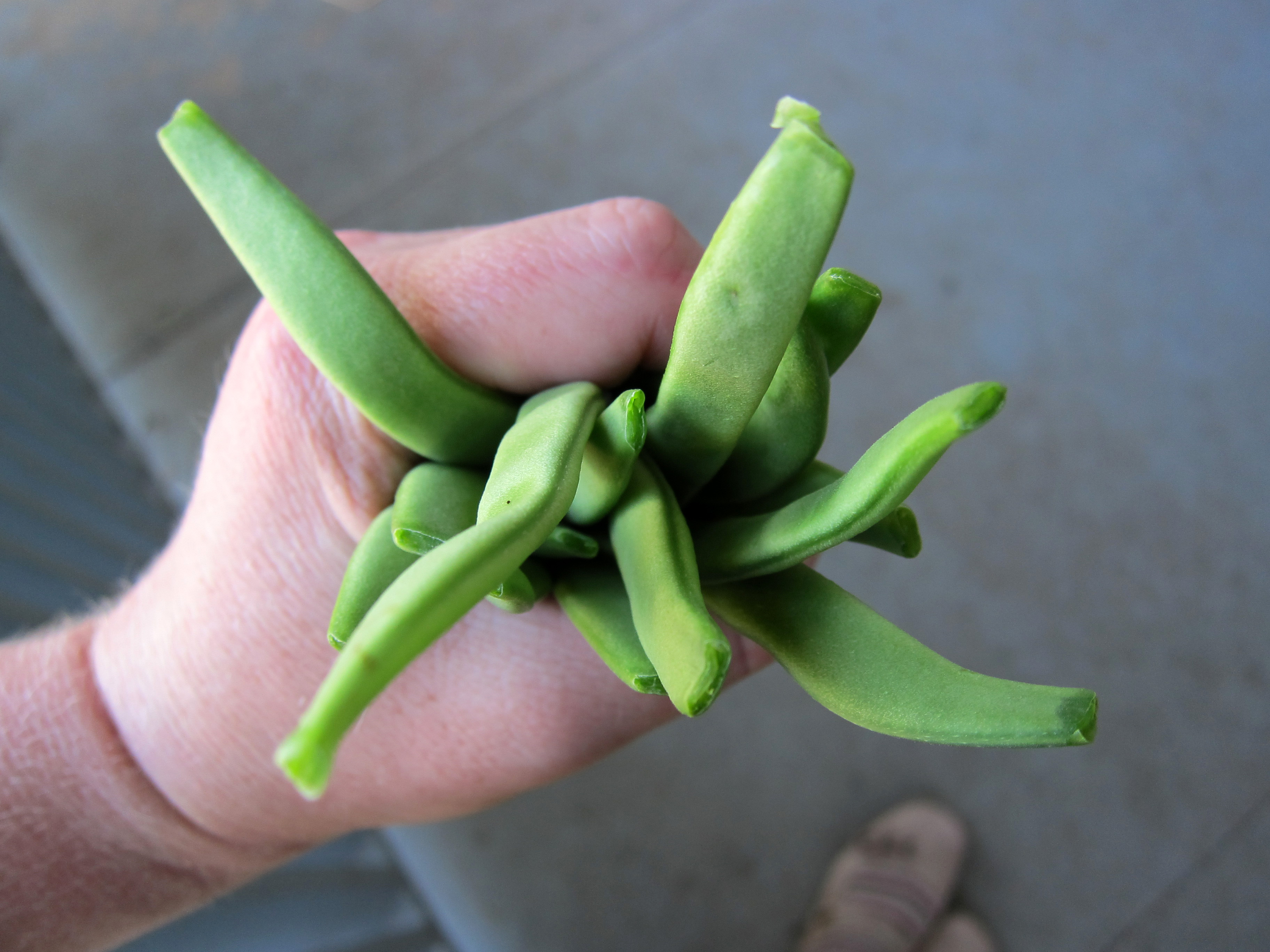
Thanks to my mother our garden is doing great.  She’s the one who’s been watering every other day (manually) and mulching and planting.  While I’ve been working and writing and preparing for my trip she’s been out there working hard.  These are Romano beans (Helda) and they’ve become my favorite now.  They can get quite big and still not be tough or develop beans inside too fast and they taste wonderful.  I’m done growing Blue Lake or Kentucky Wonder, both of which have performed poorly for me in the last few years.

I actually know a few people who don’t like tomatoes.  I’d be devastated if I became allergic to them.  I look forward to them every year with the same fervor some teens look forward to seeing Justin Bieber in concert.  (I know all about Justin Bieber because my ten year old son mocks him at every opportunity)  Everyone in my area keeps saying this summer is even colder than last summer but I don’t believe it.  I have lots of tomatoes and there’s plenty of time still for them to ripen.

Bee balm.  It’s such an outlandish flower.  We already had quite a lot of flowers to attract beneficial insects but my mom has added a lot more.

I don’t care what Oregon says*, Buddleia is gorgeous and definitely brings the butterflies and hummingbirds around.  I didn’t buy my  buddleia, I got it as a volunteer from the neighbors.  I will concede that it’s a bit pesty the way I keep finding more sprouts which get woody and dug in really fast if I don’t rip them up at first sight.

Squash!  Everyone jokes about it but for us it isn’t growing so valiantly that we must share it with anyone at this point.  The two crookneck squash plants died.  One of our zucchini plants is a little yellow and small and that leaves just one trooper that is giving us some promise but the delivery has been nothing to brag about yet.

Thank you mom!

*Buddleia is considered a noxious weed in Oregon and it is illegal to buy it.  One of those ridiculous laws that defy sense since nurseries are allowed to sell it.  Maybe the law is that you’re not allowed to grow it.  You can buy it but not grow it?  In the Master gardening program I asked some very keen questions about it but naturally the answers just went in circles.

8 Benefits of Eating Locally

I think it’s funny that this is a conversation people need to have.  (And we do need to have it)  In all of human history people ate mostly locally because that’s what was available to them.  With some things reaching them from far-flung exotic places, like spices and other dried goods, there was certainly some access to imported goods but this wasn’t something people indulged in on a daily basis.  Of course, in the earliest days we were more nomadic and sometimes traveled to our food rather than it traveling to us.  Even so, we burned our own fat doing it, we built muscles hunting for our food and relocating on foot.  If we had to do that now there would be no obesity.

Here we are now.  We have become so used to everything in the world coming to our home town without the least inconvenience we actually have to work hard to figure out what is being grown and produced in our own regions.  I think it’s fantastic that people are rediscovering their local industries and economies but it’s surreal that those who do so are sometimes considered extreme or hoity toity for wanting to only eat apples grown locally.  I’ve heard the local eating movement spoken of derisively as though it’s some precious elitist activism and to me that’s really twisted.

There are a lot of reasons to eat what you want when you want it wherever it comes from.  It often costs less, it’s right in front of your face – so why not?  You want what you want and all your life there’s been no shame in eating tomatoes in the winter so why are people getting up in your face about it now?

What’s less apparent to people are the reasons why they should go out of their way to seek only locally produced foods.  If it’s more expensive and they actually have to work to find stuff and also not eat things that aren’t grown in their region what possible motive could they have for doing it?

  • The colossal use (and waste) of fossil fuels in the transportation of food across the world.

It’s a big reason to reduce the miles between you and your source of food.  A huge reason.  A reason with layers.  First of all, our unrelenting use of fossil fuels is polluting the planet.  Plain and simple.  I know some people still don’t believe in global warming or environmental pollution (I can only assume they’re being intentionally blind to smog and landfills and the plumes of exhaust being released in the air even from well regulated trucks on the road) but the fact of the matter is that our use of gasoline to ship produce and packaged goods creates a lot of pollution.  The more we truck food across the globe the more packaging we require and most of that packaging is either made from petroleum or uses a lot of it to fuel the factories that produce the packaging (factories that produce paper products usually run on fossil fuel).

Our incredible hunger for convenience, packaged goods, tomatoes in winter, and treats from around the world is so great that we are burning through crude oil as though we will never run out.  But whether we do it in our lifetime or the next doesn’t matter in the debate.  We will run out.  When we do, without much expense or effort going into alternative sources of safe power- where are you or your children or their children going to get your food when that happens?  Every time you buy apples that came from New Zealand you keep it from the pockets of local growers.  If enough local growers stop growing because they can’t compete in the global food economy, who’s going to feed you when the global food economy crashes and you have to eat what you can find around you?  It’s big, it’s important, and I know a lot of people sleep well at night believing it’s never going to happen in their lifetime.  But we don’t actually know when it will happen.  Only that it will.  So a really important reason to reduce the miles between yourself and as much of the food you eat as possible is because we need to reduce the rate at which we consume crude oil as a nation and we need to make sure that we build very strong food security close to where we live so that if a day comes when getting olive oil from Italy is no longer possible, we’ll know where to get fats to saute our food in.

  • Strengthening your local food security.

If your community is ever cut off from shipments of food from other places, what are you going to be left with?  Does your community have a good source of potable water?  Does anyone in your region grow grains?  Can you even get your hands on them or are they all being exported to other communities?  Oregon produces a tremendous quantity of beet sugar but we export most of it.  This means it’s actually more likely  that you can buy sugar that was produced in Oregon on the East Coast and in Russia.  Does your community have a grain mill?  Do you have a solid quantity of farmers growing a decent variety of produce?  And if so- how well supported are they by their own community?  Are YOU supporting them?  A strong community is one that is self supporting.  The basics of being self supporting (in any context) is being able to provide yourself with your basic needs for survival.  Food, water, shelter, and coffee*.

  • It tastes better!!

When it comes to produce this is unequivocally true.  When you stop eating non-local produce you will almost automatically be eating more seasonally.  You won’t be eating apples from New Zealand in spring and summer.  You won’t, most likely, be eating apples after winter because even good (local) storage apples begin to decline sharply in quality by spring.  Just ask my son who is an extreme picky eater- texture is hugely important to him and there’s not an apple that can last until spring and still be good quality.  Eating seasonally means you’re going to taste produce at it’s peak.  This sounds like a smug little sentiment.  It reeks of cozy cliches but I promise it’s true.  Not only does food eaten in season taste better, a lot of farmers who are growing for their local community don’t have to grow varieties specifically best for shipping long distances which means there is a resurgence of produce amongst farmers that is grown specifically for taste.  If you’re eating local produce it also doesn’t have to be picked early – if you’re buying from farmer’s markets and the produce is actually grown on a local farm it has often been picked that same day you bought it.

  • You get more in touch with the seasons.

So eating more seasonally will also get you in sync with your seasons in a way you may never have experienced before.  If you don’t eat fresh tomatoes that aren’t local, you’ll only be eating them as long as your local farmers (or you!) have them available in the fields.  Fall is marked by the end of the tomatoes, and for some of us it is marked by the frantic canning of as many of them as we can get our hands on.  There will be no more for months.  At first this seems like a  huge deprivation.  No tomatoes on salads for nine months.  No tomatoes on sandwiches for nine months.  Sometimes longer.  That’s hard if you love tomatoes like I do.  The first year it seems like a sacrifice.  However, when the next tomato season rolls around you will look forward to and appreciate those fresh tomatoes in a way you have never done so before.  Your late summers will be more poignant for what you’ve been looking forward to eating and have missed.  All your seasons will be punctuated by different foods.  No longer will you eat all the same foods all year.  Every season will bring special delights.  Late spring brings asparagus and the season is very short.  You will notice the blessings of each season more and you will have more to look forward to with each season.  It may seem, if you haven’t experienced this for yourself, such a small matter that there’s no way it can really change your life.  But it will.  For the better.

  • It will make you a better and more resourceful cook.

The average person shops on whim.  If they want sauteed summer squash they put it on the grocery list and buy it.  Doesn’t matter if it’s mid-winter.  If they see a recipe in a cookbook and they want to try it right now, they go and buy what they need and make it.  If you’re eating locally then you’re eating more seasonally and you’re not going to be able to make whatever recipe you see in your cookbooks until those things become available locally.  So you have to learn to cook with what’s in season.  In some ways this brings things more into balance in your diet.  Foods that grow together go together.  You know what I’ll never see on a plate together in my house?  Asparagus and fresh tomatoes.  Which is fine because when I’m eating fresh asparagus I don’t crave tomatoes anyway.  Different regions will have some big differences in what comes into season when so in the south you might be getting your first tomatoes in at the same time you get local asparagus (if your region even grows asparagus).  I don’t live in the south so they’ll never appear on the same plate in my house.  Maybe this sounds limiting but being limited can spark a lot of creativity.  The produce I eat in the winter is definitely much more limited in variety than what I eat in the summer but I don’t feel limited.  I get more creative with what I’ve got on hand.  If you’re not used to cooking seasonally then you may want to check out some seasonal cookbooks from the library for some guidance.  More and more seasonally arranged cookbooks are being published.

  • Supporting your local economy.

I mentioned this earlier but I can’t mention it enough.  This is vitally important.  For a community to be viable it needs to be producing commodities, it needs to provide jobs for the people who live in it.  Even though it may seem like commuting to other communities for work is a great idea, it won’t be as gasoline becomes increasingly more expensive (which it will) as it becomes increasingly scarce.  You want to be buying milk from the local dairy rather than the one that’s 600 miles away because the money that goes into that dairy’s coffers will then go back into your community via paychecks for jobs in the dairy, and local taxes from their business that help pay for things the community needs, and it will flow back through local restaurants and other businesses the people running the dairy will use.  Every dollar you send out of the community stays out of the community.

  • A stronger connection to your community.

The more you know about who is growing and making your food the more connections you’ll be making to your community.  It happens slowly and it’s subtle but it’s absolute.  To eat mostly locally you will have to do some sleuthing, box checking, talk to people, and you will get to know the people who grow your food.  You will go to the farmer’s markets and you will talk to your grocers, you will probably spend more time shopping at smaller markets that buy more predominantly from local producers.  This will connect you to people.  You will get to know more people and feel more connected to what’s going on in your own community.  You will care more because you will become more dependent on the welfare of local producers and artisans.  The more you support your local producers and economy the more you will also be a value to your community.  People notice.  People care.  Nothing has made me more connected to my community than doing my ten month local eating challenge which turned into a lot of permanent changes so that I remain a strong supporter of local dairies, farmers, and craftsmen.  While I was already a firm supporter of buying from the local farmer’s market, I now put a much larger proportion of my food budget into my own community and also into my own state.

  • The more a community supports it’s local food producers the more accountable they will be to their community in their practices.

If you get to know your local food producers you can raise concerns with them, let them know what’s important to you as a consumer.  You can visit their farms and their facilities to see how clean they are or if they’re being honest about pesticide use.  When both the consumer and the producer know each other, business becomes more personal.  It’s much harder to be an anonymous irresponsible business when you’re being supported by your community.  Food producers should not be able to hide behind corporate shields from responsibility.  I personally know most of the people who grow the produce I eat.  I can raise complaints and questions and make requests and I am more likely to be heard by them than I will ever be heard or considered by a corporate farm two states or a country away from me.  Local producers will feel consumer pressure and respond to it much more quickly than international ones will.  This gives the consumer more control over the food  being produced and the practices used to produce it.  But it also gives the producers more power to create a business that’s supported and revered by the people it serves.


Eating locally isn’t a fancy food trend to amuse ourselves with.  Eating locally is a fundamentally important way to strengthen our communities and our connection with the earth that we depend on to keep us alive and healthy.  I think the habit of wild and wanton global eating was the fancy trend that’s made us forget the importance of nurturing what’s right under our own two feet.

*Haha.  That’s what I need for survival anyway.  I don’t even need much caffeine in it.  This is one of those imported goods I don’t ever want to live without.

Eat Local Challenge: setting your perimeters and goals

How strict should you be for your eating local challenge?  This is a completely personal decision.  When I did my 100 mile eating local challenge I planned to do it for a year.  I ended up only doing it for 10 months.  Since I knew I was going to be doing it for many months I tried to design it so that I would really be stretching myself but NOT so that it was impossible to do.  The things I excluded from the challenge were all things that people have been trading for and purchasing from long distances for hundreds of years: spices, oils, tea, coffee, sugar, etc.

I thought about the philosophy behind this challenge and the spirit behind it.  We have learned to eat apples imported from New Zealand because their seasons are reversed from ours which means that just as we should not be eating apples again for six months- voila!  We can have apples that are in season in New Zealand.  Those are apples that have traveled about 6,800 miles to get to you.  Most produce that has to be shipped any fair distance has to be refrigerated.  When you’re trying to reduce the amount of fossil fuel that goes into the food you eat (with the idea that you will become less dependent on it to survive) not eating produce imported from other countries is a huge step in the right direction.

Doing a local eating challenge will inspire you to grow more of your own food and to preserve what’s in season while you can get your hands on it.


I’m going to share what perimeters I set for myself with this challenge and then make some suggestions for how you can set your own.

  • Time Frame: one year.  (Though I only did it for 10 months, I went through the toughest two seasons- spring and winter)
  • List of exceptions: coffee (but not tea), spices, sugar, vinegar, baking powder, selected grains (wheat flour, barley, corn meal), Parmesan cheese, oil.

Max’s food is also excepted due to his extreme picky eating, I wasn’t willing to refuse to let him eat an out of season apple since he eats very little produce to begin with.   (Though I did work hard to feed him local too.)

  • Definition of local: 100 miles
  • Foods subject to challenge: dairy, fruits, vegetables, nuts, beans, pasta, everything that is not on the exceptions list.
  • We do not expect family or friends to cook only local foods for us nor do we worry about restaurants which we don’t eat at often anyway.
  • The Goal: To eat as seasonally and locally as we can for one year. We are not choosing to be extreme in our approach and are allowing some of the basics that we find indispensable and that people have been trading for for hundreds of years, such as spices. What we want is to learn what grows in our own region and when, to learn how to cook according to what is available fairly close by and reduce the over-all miles between us and our food. We seek an edible education.

If you are going to do your own local eating challenge I would decide how extreme to be according to how long you plan to do it for.  If you’re writing a book about it then obviously you need to be very extreme to impress people.  That will mean no non-local salt, among a million other things.  But if you’re like me and you’re simply trying to eat more locally and aiming to push yourself to an uncomfortable enough place to actually learn something then I would make sure you allow yourself to have coffee.  The shorter your challenge period, the more extreme your challenge should be.  If you’re only doing it for a few weeks, and if it’s going to be in the high produce season (summer) I would suggest going even more extreme than I did.  Your pantry is likely already full of things you can lean on.  So force yourself to do without some non-local things you don’t already have on hand that you use a lot of.  This will either teach you to find substitutes or to do without.

For 10 months I didn’t eat any pasta I didn’t make from scratch.  While I allowed myself flours, I did not allow myself any non-local packaged pasta.  As a matter of fact, there are some places that make local pasta so you don’t have to go without.  Portland has several makers of pasta.  I don’t get to Portland often and so I just made my own.  It was pretty amazing actually.  I’ve never had better pasta than what I’ve made myself.  I also didn’t eat tofu that entire ten months.  No soy (except soy sauce).  As it turns out, a friend let me know that there is at least one tofu maker in Portland, so I could have been eating it.

What about ingredients in packaged things?  If you buy corn chips made by a local manufacturer (Don Pancho for us Portland area people), does it count as local if they use cornmeal imported from another state?  That’s for you to decide.  That’s for you to define.  For my challenge I did try to avoid packaged foods for me and Philip as much as possible.  Partly to counter balance the fact that our picky eating son eats mostly food in cracker form.  So I decided that when it comes to packaged foods like corn or potato chips (which we rarely eat anyway) they had to be made by a local company but I wasn’t about to source out all their ingredients.  But I do admire those who have the fortitude to do that level of research and to uphold such stringent rules.  I did not allow myself to buy salsa made locally in the winter – the kind that is in those fresh tubs (not jarred) because part of my local challenge was also eating seasonally.  Tomatoes, unless they’re canned, are never in season in winter.  Ever.  Not unless you live in Mexico.  Or Chile.  Or Australia.

If you’re doing a long term challenge covering multiple seasons, I would give yourself a little more slack because it gets a lot harder to eat seasonally and locally in the middle of the winter if you don’t live in California.

Remember that this is a challenge meant to help you reduce the miles between you and your food, to reduce your own dependence on imported food.  It isn’t about being better than anyone else or feeling the pain of deprivation but about stretching your knowledge of what your own region grows, making yourself get more in touch with what’s seasonal, and will hopefully inspire you to make some permanent changes that support greater local food security and put more money into your own local economy.  Don’t break your back and remember to have fun and take notes to share later.

Strawberry Jammy Sauce or Saucy Jam?

For the first time in my gardening life I had enough fruit from my own yard to make jam.  For anyone who has dreams of living off the fruit of the land, this is a beautiful and triumphant moment.  Although, I suppose it’s a little less triumphant when I report that the bed of everbearing strawberries, from which this incredible bounty grew from, did not produce consistently good tasting berries the way my June bearing patches did.  We couldn’t stop eating the ones that came from the June bearing patch but these ones… eh.  So making jam was less about using up the crazy excesses of my bountiful yard as it was about finding a way to make them taste better.

I will take this moment to dispel an insidious myth that everything you grow yourself tastes better.  Not true.  This deserves an entire post on it’s own.  I’ve grown carrots that were, indeed, better than any carrot I’ve ever bought.  I’ve also grown carrots that were woody, bitter, and stupid.  In that order.  There are so many factors that go into what makes a vegetable good: variety planted, soil quality, frequency of watering, heat available to plant, etc.  It’s really annoying when everyone out there claims that everything home grown is better.  It annoys me, but apparently not everyone else.  It also may indicate that they have magic soil and mine is just ordinary.

Back to the jammy strawberry sauce.  Or saucy strawberry jam.  Whatever.

You are always going to get the best preserves from using the freshest and best tasting fruit.  Truly.  But the magical thing about jam is that if you have a somewhat watery flavored fruit, cooking it down a little with a lot of sugar can result in a more intensified flavor so that a mediocre strawberry will make a good flavored jam (and an ambrosial flavored strawberry will make something you want to describe in some stupid poetical way that will make everyone around you want to hit you).   I chose to use a recipe from Hilaire Walden’s book “Perfect Preserves” which is full of dreamy recipes for what promise, right on the cover, to be perfect preserves.

I think if you’re not me making perfect strawberry jam might be a cinch.  But I AM me.  I am an excellent food preserver.  My pickles are renowned (and not just limited to my close small family circle either, at least two friends have raved as well!), my blackberry jam has given much pleasure, my pickled cauliflower is shiny, my canned peaches coveted.  I’m not bragging, I’ve just practiced a lot.  Except with pectin.  Pectin and I have yet to come to an understanding.

I’ve used several varieties and several recipes and sometimes it works out well and I can’t understand how come people make such a big fuss about it (mostly me), and then other times I follow the exact same instructions and it doesn’t set.  I used timers and everything.  I am not a sloppy preserver.  You already know the end to this story because I gave it away in the title of this post.

My strawberry “jam” didn’t set much.  It’s definitely thicker than sauce, but likewise it’s thinner than what I like to experience in a jam.  It’s not Hilaire’s fault.  I know the fault must lie in my own methods, or in the natural pectin levels of the fruit I was using being perhaps unusually absent.

It doesn’t actually matter because it tastes SO good!  No watery flavor at all, nice and rich and exactly what my idea of perfect strawberry jam tastes like.  There is a quality some strawberry jams can get that’s almost – I’m not even sure if this would be the right word- metallic.  This doesn’t have that unhappy quality.  It’s sweet without shriveling your teeth up.

So I’m happy.

Which I better be because I took 6 1/2 pounds of berries and turned it into 15 half pint jars of strawberry jam.  I’m not done with pectin yet.  I think we’re going to come to an understanding soon.