Author Archives: angelina

Food Philosophy: Eating Local

I have agreed to give a talk about doing the 100 mile diet at my local library.  I did the 100 mile diet for 10 months a couple of years ago.  It changed how I eat irrevocably.  I didn’t stick to the 100 mile diet but I did stick with a strong dedication to eating mostly local produce and a determination to seek out as many pantry staples that are produced locally as I can.    Before I write up my notes on how I ate during my 100 mile diet challenge, I want to chronicle, for clarity, how I eat now.  What does eating local mean for me?

First of all, eating local is NOT a contest.  It’s not a “trend” to follow and then abandon just because too many other people are doing it and it’s stopped being cool (that’s a particular species of personality I disrespect in general).    Eating local is something all people need to re-learn to do for the sake of regional food supply security.  Eating locally means eating seasonally which means that your food will taste better and be texturally more appealing (think of out of season mealy apples).  Eating locally supports your local economy and naturally ends up supporting smaller local farms.  Eating locally will connect you to your own community in new (and good) ways.

The best reason to eat local is because it brings greater pleasure to the table.

I am not a zealot about eating locally.  I try not to be a jerk about it.  There are people so serious and dedicated to eating locally that they would definitely not think I’m doing enough.  That’s okay with me because to me this isn’t a contest to see who can eat the most locally.  My rules for eating are not severe, not difficult, yet so many people I know think I’ve taken a vow of food chastity just because I won’t buy most produce out of season.

I am going to try to break it down into lists of how I eat NOW, this is NOT the 100 mile diet:

Imported foods I buy:

coffee, tea, oil, sugar, spices, limes, dry pasta, rice, some dried legumes, condiments, sometimes tofu, sometimes wine (I can’t afford local wines though we have lots of them), some nuts and seeds, food for Max, Parmesan cheese, avocados, fresh ginger, garlic (when the local farms don’t have any), flour, polenta, olives, some juices, chocolate (we consumer very little chocolate), canned tomatoes (when I run out of home canned), canned coconut milk.

I don’t consume a lot of rice, tofu, or wine.  Even though I don’t buy lemons (only on very rare occasions) I do keep limes on my constantly exempt list because I use it for seasoning in cooking a lot and there’s no good alternative.  I don’t buy any other citrus regularly.  Max food is one big exemption I’m okay making so my kid won’t starve to death.*  The list looks long and I assure you it was much shorter when I did the 100  mile diet.

Produce I never buy out of season (and buy strictly locally):

green beans, tomatoes, asparagus, all fruit (except apples for Max), eggplant, summer squash, winter squash, favas, tomatilloes, hot peppers (I don’t even eat sweet ones because they don’t agree with me), fennel, cabbage, celery, cauliflower, broccoli, cucumbers, sweet potatoes, lettuce**, corn, peas (fresh, though I will eat dried split peas).

Produce I will buy out of season but only from local sources (root vegetables can be eaten all year due to excellent storage quality):

beets, potatoes, carrots, onions, rutabagas.

After doing the 100 mile diet for 10 months I decided to lighten up a little on the rules so that they would be more livable for me.  Every week I go shopping I allow myself a small portion of imported produce.  On my list of exceptions I included avocados and limes.  Here’s how it works: if I want to buy bananas, I can, but I can’ t buy bananas AND avocados.  I basically have two spots available on my grocery list to buy something that doesn’t ever grow here.  The following list is of produce I rarely buy and when I do I can’t also buy avocados and/or limes the same week.  Truth is, I haven’t bought most of those items since doing my 100 mile diet challenge.  I love avocados so much it takes a strong urge for tropical fruit or imported vegetables to oust them from my weekly indulgence list.

Produce I buy only very rarely:

pineapples, kiwis, bananas, tamarind, jicima, most melons, oranges, tangerines, dates, coconuts, pomegranates.

Things I ONLY buy locally:

honey, seasonal produce, walnuts, bread, milk, butter, eggs, most cheeses, fresh herbs (I grow most of my own) and dried herbs, beer, vodka, canned corn (there is a company within 100 miles that cans local corn, I rarely buy canned corn anyway but when I do I only buy from this company whose name I will get and record for those who want to know), fruit***.

I want to note here that I do quite a lot of food preserving so I don’t buy much commercially frozen or canned produce.  I make an exception sometimes for canned tomatoes when I run out of home canned, but I really don’t do that often.  Most years I just stop making anything tomato-y until the season starts again.  I freeze a lot of eggplant and fruit.  So it’s all local even though I’ll eat those out of season from my pantry- I never buy them out of season.

I think that sums of the bulk of my food buying habits.  Enough for now.  Next I want to do a post covering what those lists looked like while I was doing the 100 mile diet.

*He is an extreme picky eater largely because of tactile issues connected to his OCD and ADD, we don’t punish him for it.  I concentrate on keeping his food free of HFCS and preservatives and making his diet as organic as I can.

**This year is the first one I’ve cheated and bought out of season non-local lettuce.  I am determined to knock that off.  It really is worth waiting for it to come back in season.

***My policy has always been to buy Max whatever produce he’s willing to eat whether it’s in season or not, local or not, because he eats so little produce and I’m desperate to get him to eat any at all.  The funny thing is that he’s been learning (without my help) that the red grapes our friend Laurie grows and shares with us are a hundred times better than the ones I have bought him from the store which he now refuses to eat.  He’s discovered that apples out of season aren’t so good either.  This year he refused the out of season carrots, cucumbers, grapes, watermelon, and apples.  That’s all the produce he ever eats.  So this winter and spring he didn’t eat any produce.  Just tater tots.  So frozen potato products was the only “produce” he ate.  On the one hand this is very stressful to me, on the other, it’s proof that once you’ve gotten used to eating truly ripe seasonal produce there’s no going back.

First Days of Summer

The Apothecary’s Rose is supposed to have a strong scent.  For me it has never had more than a mild sweet scent.  Even so, I am completely taken with it’s history as one of the earliest cultivated roses and its well known medicinal uses.  When it comes to getting the best medicine from roses you want to get as close to wild roses as you can.  The absolute best rose variety for use in medicine is the dog rose (Rosa Canina) (but good luck finding a nursery that carries this one and if you do, for god’s sake- tell me where you found it!) but this rose is the next  best thing to species roses.  I am not generally a fan of the single roses but this is one of the exceptions.

Borage is charming.  It has uses.  It’s edible.  It’s medicinal.  I confess I like it because it has starry spikey blue flowers that look like they were designed by a ten year old into science fiction.  I haven’t had any in my garden for a long time.  So many things blooming right now are old friends.

You are dying to ask me if my hands are freakishly small, aren’t you?  (What would you say if I said YES?!)  These strawberry leaves were normal sized when I planted them last year.  My secret fear is that someone (poison-man from next door) dumped some toxic waste on my garden and now these plants have superpowers.  Do other people have such enormous strawberry leaves lurking in your garden?  Please share, cause I’m a little freaked out.

In contrast to the leaves, the berries are normal sized.  There are lots of them!  In a couple of days we’ll be able to pick our first bowlful.  One of the things I love about living in Oregon are all the berries.  I realize that California has them too.  But they’re not as good.  I kid you not.  Especially if you like to grow them yourself.  I could never get any strawberries to thrive in my California garden.  I couldn’t keep the ground moist enough to get anything but tiny little berries.  Here, all I have to do is plant them and wait.  They ripen just as the summer sun comes out (there’s little spring sunshine here) and so I don’t even have to water them to get fruit.  The blueberries here are phenomenal and prolific as well.  So are the blackberries and the –

Speaking of berries coloring up- the red currents are turning too!  I’ll have enough of them to make about a quarter cup of sauce.  Maybe.  I’m so excited about them, even if I just had one bunch to eat raw, I couldn’t be more pleased.  I love tart food!

This is my most beautiful kitchen utensil.  Mitch made it from black walnut wood.  From a walnut tree that grew here in my county.  I never knew a spoon could make me so happy.

Philip has submitted our HAMP loan papers, this time to actually be looked at by an underwriter with the bank.  We should know in a month if we get to stay here.  If we do, we’re going to be really broke again.  I think it will be worth getting to stay right here.  Looking down from my eyrie of an office on my monastery garden full of California poppies, lupines, calendula, columbines, nasturtiums, vegetables, and feverfew.

There is such a chaos of beautiful, edible, and healing things planted all around me here.  I want to be here.

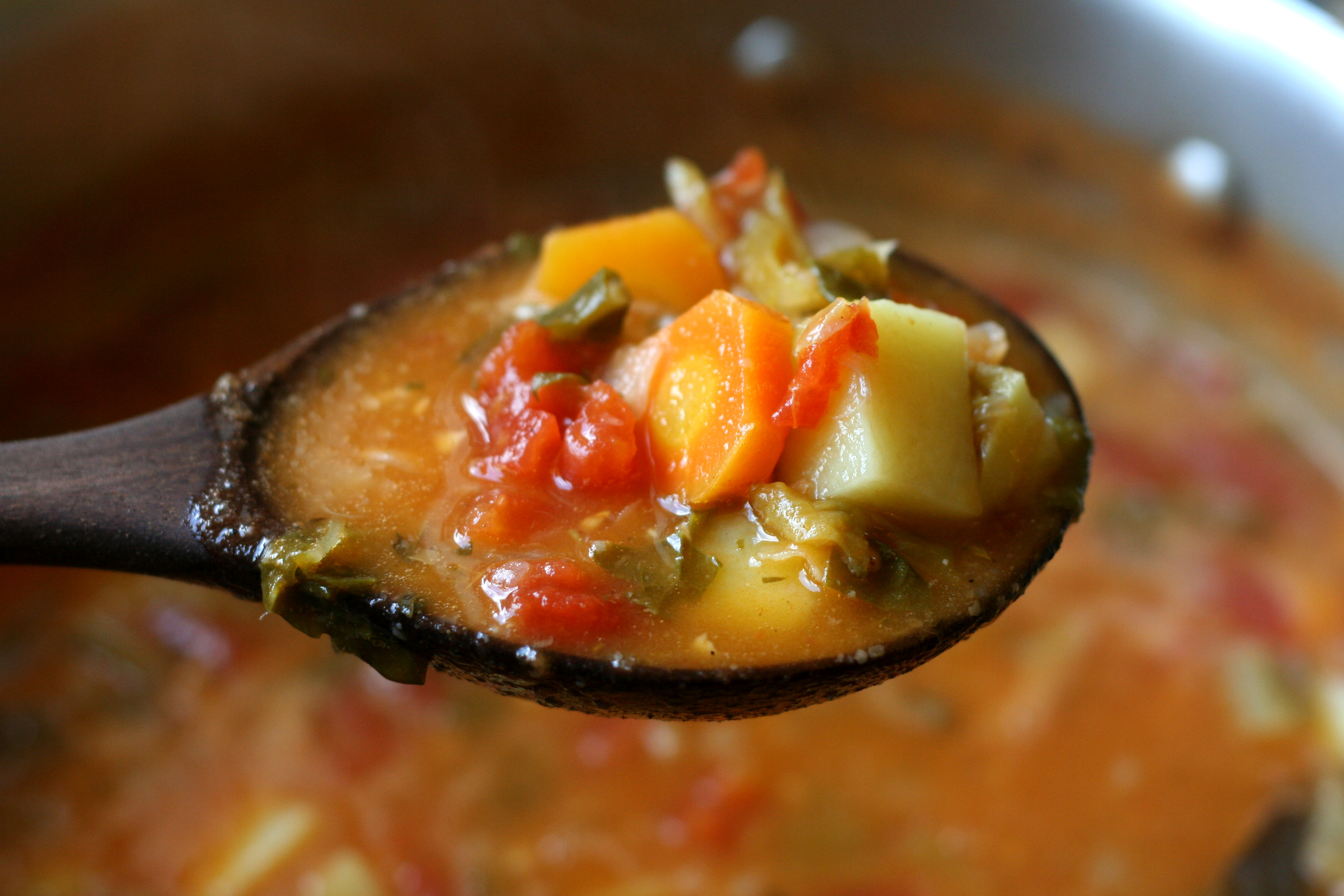
Cabbage Garlic Soup Recipe for a Summer Cold

Getting summer colds is the pits.  Just when you think you’re out of the woods you get smacked in the head with congestion, headaches, a sore throat, and low energy.  As everyone knows, you can’t cure a cold.  The strategy should always be to lessen the symptoms and the duration of the cold as much as possible.  So when I woke up at 4am three nights ago with all the symptoms of a cold coming on suddenly, I immediately took a bunch of nasty-huge multi vitamins meant to boost the immune system (the ones I use are “Wellvitamins” and I only use them when coming down with something because they’re very expensive) and I drink lots of elderberry syrup, water, and sometimes I make up some ginger and honey tea or sage and honey tea.

That’s all well and good, but if you feed yourself crap while doing all the other good things you should be doing, it’s like shooting yourself in the foot.  First thing you should do when you feel like you’re coming down with any kind of cold or flu is make soup.  I believe that all soups have healing powers, even the cheesy ones, but if you’re getting sick I’d like to recommend making a vegetable soup full of vitamin C, garlic, and cayenne pepper.  Like this cabbage and garlic soup I’m sharing here.

Cabbage is full of vitamin A, C, calcium, and potassium.  Tomatoes are full of vitamin A (!!!), vitamin C, and (you guessed it) potassium.  Potatoes are full of vitamin C and more Potassium than cabbage and tomatoes combined.  Carrots don’t have much vitamin C to speak of but as everyone knows they are crammed with vitamin A and what many people may not know is that they are also quite rich in potassium.  All the ingredients in this soup will fill you with vitamins and minerals.  The navy beans are rich in calcium, phosphorous, and more potassium than any body could need.

The garlic (there’s a lot of it in this soup) is great for boosting the immune system and cayenne pepper is great for purifying your blood and helping it circulate better.  In addition to that, the cayenne will help loosen phlegm which will help clear your sinuses.

Cabbage Garlic Soup Recipe for a Summer Cold

10 servings

Cabbage Garlic Soup Recipe for a Summer Cold

Ingredients

  • 1/4 cup olive oil
  • 1 large onion, diced
  • 2 bay leaves
  • 4 quarts of water (more if needed)
  • 1 cup navy beans, uncooked
  • 2 tsp salt
  • 4 carrots, chopped med
  • 1/2 head cabbage, chopped
  • 3 med. potatoes, diced med
  • 28 oz can of diced tomatoes (or 1 quart of home canned)
  • 12 cloves garlic, pressed or minced fine
  • 1/8 tsp cayenne
  • 1 1/2 tsp oregano

Instructions

  1. Heat the oil in a large soup pot on med/high heat and add the onion and bay leaves. Saute until the onions lightly brown.
  2. Add the water, beans, and salt. Bring to a boil and then turn heat down to med/low and cook until beans are tender. The time may vary, for me it was about one hour. Be sure to check on them and stir them while cooking.
  3. Add everything else into the pot and turn heat back up to med/high. At this point it should be soupy but the amount of water you need may vary depending on how much of it cooked off while cooking the beans. All the vegetables should be completely covered with broth.
  4. Bring the soup back to a boil and then turn the heat down a little and let it cook until all the vegetables are tender. Probably about 30 minutes.

Notes

This soup makes 10 servings. I don’t make small batches of soup because we eat it for leftovers and sometimes freeze it. You can easily halve this recipe. I used 12 cloves of garlic but you can use more. Do it! The next time I make this soup I plan to increase the garlic up to an entire head. Once the soup is cooked through it doesn’t seem very garlicky.

Play with the amount of cayenne. A very little can be really hot so go cautiously. It should be hot enough to make you sweat a little and make your nose run after you eat it. It should not be so hot that it’s painful to eat and burns a hole in your eye socket. Unless you like pain like that, I won’t judge.

If you are inexperienced making soups I suggest you read my soup philosophy post- it will help you understand soups better and give you the confidence to play with them.

https://stitchandboots.com/2011/06/18/cabbage-garlic-soup-recipe-for-a-summer-cold-2/


Beautiful June

June in my garden means all of my roses are either blooming or are just about to bloom.  While I was working on the novel the other day my mom surprised me with this vase full of gorgeous “Cottage Rose” roses, a David Austin variety.  I don’t know how this rose behaves in anyone else’s garden but in mine it is towering and reaching and wants to be a climber.  The roses are prolific and gorgeous.  The scent is light but definite.  Roses in my garden either have to have a scent or they have to perform some other purpose (rose hips, for example).

Here’s “Cottage Rose” in its natural environment, the jungle of my yard.

This is my bean bed which is coming along nicely.  I need to buy another bean packet to fill in some holes where beans didn’t pop up or where they were eaten to the ground.  I planted all I had in this bed.

I’ve grown bush beans and they’re good but my favorite is always the pole bean.  I am growing Scarlet podded, Helda, and Lazy Housewife.

I have some wild purple lupines from a wild seed packet but this one my mom bought at the nursery and I can see it from my eyrie of an office.  I’ve been enjoying the almost coral color mixed with the orange calendula and California poppies it shares a bed with.

I have been wanting to grow red currants forever.  I have made several failed attempts.  For the first time I’m getting berries and they’re so pretty!  Gooseberries are another ambition I have and now I’m encouraged to try for them next year.

This week we finally heard from the bank about our house.  Through a gross miscommunication we have been applying for the HAMP loan for a year and the bank was ignoring us because our bankruptcy file never officially closed.  You can read about it on my other blog if you like “If My Bank Was My Boyfriend”.   The upshot is that they aren’t ignoring us anymore and we should find out whether or not we get to keep our home within the next month.  Now I’m looking around feeling both dread and excitement at the same time.  I find myself saying (constantly) “If we get to keep the house we’ll replace those dying diseased peach trees with more “Frost” peaches…” or “If we get to keep the house I’m going to plant a gooseberry…” or “If we get to keep the house we’ll get a tub we can actually soak in…”

The reality is that if we get to keep our house we’ll be so broke we’ll just have to sit tight and buckle down with budgets and make do with what we have and there will be no real improvements for the foreseeable future.  I can live with that.  For the chance to see my sour cherry tree mature and put out a full crop?  For the chance to harvest our first Spitzenberg apple?  Worth the poverty.  Not having to move, not having to leave this house we love, not having to uproot ourselves to God knows where and in what hovel… completely worth being broke as dirt.  All my fingers and toes are crossed.  We think the numbers are in our favor and the bank says the only thing they care about is the numbers.

Whatever the outcome, I’m enjoying my roses and seeing my fruits and vegetables growing and maturing.  June is a lovely month in Oregon.

Asparagus and Fresh Fava Couscous Recipe

I am seeing fresh favas show up at more and more markets both in my own area and across food blogs.  This is a happy circumstance and if you haven’t found them at your local farmer’s market start pummeling your local farmers to grow them.  I dislike dried favas a great deal but eaten fresh they are nutty and a little sweet (much like peas) and versatile.

I can’t get enough of them which is why I usually grow at least one bed of them in my own garden.  I missed out this year which is really cramping my style because their season is super short and once you see them at the farmer’s market you may only have two weeks to take advantage of them.  They don’t keep well in storage.  (Take note when buying them and putting them in the fridge:  you have a maximum of two days to get those suckers shucked and blanched before they will go off).

I usually try to get people to try favas in my grilled polenta recipe but right now, I want you to try this recipe and play with it while you have the chance.  There are so many ways you could alter what I offer here to suit your personal tastes and to expand it.  This is simple and pretty fast to make.

Asparagus and Fresh Fava Couscous

serves 8

Ingredients:

1 1/2 cups couscous

1 Tbsp olive oil

3 cups water

1/3 cup olive oil

1 bunch of asparagus, trimmed and cut into 1″-2″ pieces

1 cup fresh shelled favas (a good sized produce bag of unshelled), skin removed

6 garlic cloves, sliced thinly

1/2 bunch basil, julienned

8 oz feta, crumbled

2/3 cup mustard vinaigrette to dress it with

Method:

Make the couscous according the directions HERE.

In a large saute pan heat 1/3 cup olive oil on med/high heat.  Add the asparagus and the shelled beans.  Do not walk away.  You need to stir this frequently or the beans will stick to the bottom of the pan.  When the asparagus and beans start to brown, add the garlic and saute just until they start to brown.  Turn the heat off and add the basil.

Add the couscous to the vegetables and toss really well.  Add the feta and the dressing and toss really well again.  Eat.

Recipe Notes: About trimming the asparagus- I cut a good 2 to 3 inches off the bottoms and that’s not always enough.  I cut the stems into 1″ pieces and then left the tops a little longer.  About preparing favas- yeah, they’re a little work but they’re worth it.  Be sure to blanch the beans and then remove the outer skin.  I failed to weigh the unshelled bag of favas I bought but did measure the shelled beans.  I don’t think you need to get your knickers in a twist over this one.  Just get a good sized bag of favas and it will be perfect.

I added no salt or pepper to this recipe because I used a vinaigrette to dress it which already has seasonings in it.  If you don’t like vinaigrette I suggest you use plain olive oil instead but use only 1/3 cup of it and then salt and pepper the dish.  Be careful though, because the feta adds quite a bit of salt on its own.

If you are vegan I would ditch the feta and use one cup of green olives very rougly chopped if they’re large, or left whole if they’re small.  You could use kalamatas instead but I really think green here would be the best.  While this dish will still be good without either feta or olives, I think it makes the dish much more exciting.

This makes a lot.  I don’t cook in small amounts.  If you want to halve the recipe it’s not at all difficult.  Halve everything and make only 3/4 cup couscous to 1 1/2 cups water.

I had to give you one more picture.  To convince you to try this dish.

The McMinnville Saturday Market

The Saturday Market in McMinnville runs all year long, unlike our week day farmer’s market that only runs from June through October.  This has been fantastic for me because I try to eat mostly local and mostly organic food and the winter, before this market, was especially tough for me to stick to my preferred way of eating.

There are only two farms that kept up stalls all winter long.  Denison Farms is a really huge farm in Corvallis that does several different farmer’s markets and this is the smallest one they do.  This means that they will only keep coming if it is profitable enough.  I promised myself to shop their stall every single weekend during the winter.  I only missed a couple.

They have had a surprisingly good diversity of vegetables throughout the winter.  They make use of greenhouses for certain, but this doesn’t bother me at all.  If I had a big enough property I’d have a big greenhouse myself.  They’re organic which is great.  Their prices aren’t cheap, but it’s been a long time since I have made food choices based solely on price.  We have made the choice to spend less money in other areas of our life so that we can buy good quality food.


We have eaten well all winter on the most lush dark greens and on their fennel, turnips, carrots (sometimes), leeks, potatoes (until they ran out of last year’s crop), and radishes.


I’m not a big fan of radishes but I’m learning to enjoy having them in salads.  Just don’t ask me to eat them whole dipped in salt and butter.  (Excuse me while I retch that thought out of my head.)  In spite of not loving to eat radishes, I have to admit that I think they’re beautiful and I never get tired of seeing them stacked up.

Growing Wild Farm is also organic.  It’s a small family owned farm here in McMinnville.  They had some good offerings for most of the winter but when it got slim at last, they brought out the cutting boards they make from fallen oak trees on their property.  They are also one of the few farms that offers fresh herbs.  I find it curious that so few farms here do that.  Basil is about the best you can find around here.  Growing Wild offers lovage, sage, rosemary, mint, and sometimes dill.

I’m not a big fan of rapini.  I want to be.  Just like with the radishes.  I don’t hate it.  There are honestly few vegetables that I hate.  But I never choose rapini if I can choose something else.  Still, it’s popular and it’s pretty.  See that cutting board?  Next picture shows more of them.  I bought two of them this year and I LOVE them!

I am notoriously hard on everything I use.  I have never waxed a cutting board in my life until I bought these handmade ones.  They’re gorgeous and sturdy and I’m trying to take good care of mine.  Next time you need a cutting board you should come and check these out.  Sometimes if you have a specific cutting board size you need and it’s not there Andre will make one to the size you need.  Always be sure to ask.

Ruby Cakes is new this year.  My friend Dominique started this business baking allergen free cupcakes and other baked goods.  She now has a partner whose name I have shamefully forgotten.  (I only met her once!)  The business has been doing very well and even my picky son likes the cupcakes.

Every weekend it seems they have some new treat for everyone to try.  I can’t keep up with everything these treats are free of but here’s what I know for sure: gluten free, dairy free, and soy free.  They also offer some sugar free treats.

Red Fox Bakery is also at the Saturday Market.  They have a counter inside where you can buy breads and pastries and the best macaroons in the entire world.  Outside they make pizzas in a cob oven which are also very good.

This miniature horse is a new attraction at the Saturday Market for the kids.  I’m a sucker for animals and can’t get over how small this horse is.  Maybe it’s really a pony?  I don’t know, but he’s cute.

Another recent addition to the Saturday Market is a stall full of handmade wooden spoons, bowls, and terrariums.  The day I took these pictures there were no terrariums so feast your eyes on the spoons!  This stall is run by Mitch and Ari (Mitch does the woodworking and Ari does the terrariums).  I have been in need of wooden spoons recently.  I lost the two I’ve been using for years.

I’m not sure a kitchen can have too many spoons.  I bought two cheap ones from the kitchen store downtown but that was before I saw these ones.  They aren’t cheap but they’re gorgeous and worth every penny.  Wooden spoons can last forever.  No lie.  There is no comparison between the ones Mitch makes and the cheap factory made ones.  Each spoon is different, he uses a variety of woods, so you have to test each one out to see how it feels in your hand, does the depth of the bowl please or do you want something shallower?  Is the handle the right thickness, does it taper where you want a handle to taper?  You don’t actually have to ask these questions like a dork.  You just pick up different spoons until you’re holding one that makes you want to rush home and start a pot of soup.  I bought a long handled spoon for soup but plan to buy a shorter handled one with a deeper bowl as soon as the budget allows.

These little walnut buttons completely charmed me.  For my book I was wondering what my character Cricket would do if she couldn’t get hold of containers for lip balm and I thought of walnuts with little hinges on them, sanded out inside, filled with balm, and closed with some twine.  When I saw these I was amazed to see that someone else had thought of something to do with walnut shells- I hadn’t considered that they could be used as buttons!

Other things you can get at the Saturday market: jewelry, soaps (sometimes), wild mushrooms, duck eggs, other baked goods, crafts, chocolates, knitted hats and scarves, and nursery plants and bulbs.  Not all of these things are there all the time but if you haven’t visited the Saturday Market and you live in McMinnville, you must come and see it!

I think every community needs a market like this year round.

Eggplant Spinach Pasta with Kalamata Olives

This pasta was made mostly from things in my pantry.  I have given directions and ingredients as though you have a fresh eggplant and celery because you can make this dish in the summer when these ingredients are in season.  However, I grill and freeze eggplant and if you do too this is a great recipe to use them in.  I also blanch and freeze celery when I can get it in season locally and I don’t buy it any other time of year.  If you’re using frozen eggplant and celery, as I did here, you skip sauteeing the eggplant and just saute the onions until translucent and lightly browned and add the celery and eggplant at the same time as the tomato sauce.  I defrost the eggplant ahead of time because it’s safer to dice them once thawed, but I don’t defrost the celery, I just add it to the sauce and let it defrost as it cooks.  I used my home canned tomatoes and if you have them use 1 quart of diced tomatoes (and their juice) and 1 pint of tomato sauce.  I like to serve this with Parmesan but feta is very good with it too.  Happily, if you don’t eat cheese, it’s wonderful without!

When I’m impatient for summer produce this is the dish I make.

Ingredients:

serves 6

1/4 cup olive oil

1 onion, diced

1 large eggplant, diced into 1/2″ cubes

3 stalks celery, chopped

28 oz can diced tomatoes in their juice

15 oz can tomato sauce

8 oz spinach, roughly chopped

3 garlic cloves, finely minced (or you can press them)

1/2 cup red wine

6 oz bottle of Kalamata olives, drained

1 lb pasta (rotelli or penne would be good choices)

Method:

Heat the olive oil in a large skillet on med/high heat and saute the onions and the eggplant until the eggplant is lightly browned.  Add the celery, diced tomatoes, and tomato sauce and stir well together.  When the sauce begins to bubble, add the spinach, garlic, and wine.  Turn the heat down to med/low, add the olives and let cook, stirring to keep from sticking, while you cook the pasta.

Bring a big pot of salted water to a boil and cook the pasta in it until it’s done.  Drain the pasta and add it to the sauce.  Take it off the heat and serve.

This dish is Vegan

This dish is Gluten Free IF you use gluten free pasta

Flowering and Fruiting in the May Garden

Lilacs are something I didn’t see that many of when I lived in California but here in Oregon the landscape is covered with them and May is when they flower.  I have several in my garden but since I didn’t plant them myself I don’t know what kinds they are.  I have two white ones and this is the first time this one has put off more than a couple of blossom clusters since I’ve lived here.  I love it.  Philip isn’t crazy for the scent of lilacs in the house, he thinks they’re overwhelmingly soapy.  I love it.  The scent on this one isn’t particularly strong, a disappointment to me, but at least it’s beautiful.

This is the first time my red currants have produced any berries.  The plants (I have two) spend an awful long time in their pots so it’s not surprising.  Now that they have a good deep spot of soil to reach into they are much happier and I’ve got several clusters of berries on them.  Not enough to do much with but it makes me happy anyway.

Borage is an amazing plant to have in the garden.  Bees love it so it helps the pollination of everything else to have it growing near all your fruiting plants.  This one’s very small but they do get enormous and they’ll seed freely.  Some people think this is a nuisance but I don’t.

This is my bed of tomatoes and calendula.  I’ve got: 3 Siletz, 2 Jaune Flamme, and a Sungold.  I need to have black tomato varieties too.  So I’d better get another bed cleared of quack grass.  Yeah, no problem.  I’ll get right on that.

I’ve never done square foot gardening but my mom is giving it a try in this bed.  She’s got it marked up and soon will plant it out with seeds.

It’s good to mulch your strawberry beds.  My mom covered ours with straw and with the sunshine we’ve been getting (not a lot, but enough) and the slightly warmer temperatures have given them an enormous boost of growth and though you can’t see it well in this picture, they are blossoming.  This is a bed of ever-bearing which means it doesn’t produce quite as large a berry or as large a June crop but will continue to produce for a few months.  Last year I was getting berries through October.  Just a few here and there.  If you want to make jam or pies with your strawberries you’re better off planting June-bearing varieties that tend to produce large amounts in a single crop and often the berries are of larger size.

Not pictured is my 8×4 bed of pole beans- the first few bean sprouts have emerged.  I love green beans and I don’t think you can have “too many” because if I can’t keep up with fresh eating I love to marinate and can them.

What’s going on in your own garden right now?

Poison Oak Remedy: Green Clay

I have a very low sensitivity to poison oak which means that I can stand in the middle of a big patch of it and not get a rash.  I know this because I have stood, accidentally, in the middle of a big patch of it and didn’t get a rash. I have had a lot of exposure to it in my life and when my mom and brother would come down with horrible allergic reactions, I (who had been in the same places as them) would be spared.  This luck means that I have gone my whole life not having to worry about remedies for poison oak or seek relief for the itching it causes.

That has changed over time as my son got his first poison oak rash when he was three and though that time wasn’t too bad, every time he gets it he has a much worse allergic reaction than the last time.  I did some research the first time he got it and read as much as I could about it and discovered that there are some myths about poison oak that have been busted by science but which are difficult to bust in the minds of many who suffer from it.

The biggest myth is that once you get poison oak your rash is contagious and you can give it to others.  This is NOT true.  What gives people the rash is an oil produced in poison oak, called urushiol, which bonds with the proteins in your skin within the first 10 to 15 minutes of contact and once it has bonded the urushiol is absorbed into your skin and cannot be transferred to anyone else.

I have assembled a number of sources of information about poison oak which explain well that you can’t spread your own poison oak rash by scratching, the oozing that sometimes occurs can’t spread your rash either.  If you suffer from a sensitivity to poison oak and you don’t already know these things, please read up!  It will help you manage your rash exposure to know how you can get reintroduced to the oils through clothes and pet fur and will ease your mind to understand that you aren’t contagious once you’ve gotten the rash.

Once you have it, there’s nothing you can do to get rid of it.  For those who have severe reactions (my mother has been hospitalized from allergic reactions to poison oak) you may need to go to the hospital and get a steroid shot, but this is only done in very severe cases.  For everyone else the only thing you can do is control the itching and promote the healing of your rash by drying the sores and blisters out.

We have used a medicated steroid creme to help control the itching of my son’s poison oak rashes in the past and while it did help, it was not as efficacious as we could have hoped.  We have also resorted to using Itch-x from the pharmacy which does work well to control the itching for short periods of time but fails to help heal the rash itself which needs to be dried out, not kept moist with ointment.  During his most recent rash, which was worse than any of the previous ones he’s gotten, he was itching so much that he was raising big welts on his arms and body and causing his rash to bleed.  We listened to some suggestions from other people (there are soaps meant to help with poison oak) and then my mom asked why we didn’t use Calamine lotion.

I really didn’t know why I hadn’t tried it before.  I remembered that I had some green clay I’d gotten from an herbal shop and decided we’d try that.  Isn’t Calamine lotion mostly clay-like?  Maybe not, but I went home and mixed up some of my green clay and my kid was completely game (desperate) to try it so I covered all his rashes with the clay.  He was really happy with the results.  He told me it helped with the itching better than the ointments and felt more comforting.  We continued to use it for a week, applying it liberally every single night before bed.  Here’s what I used:

Ingredients:

1/3 cup green clay (Montmorillonite)

2 tbsp water

Method:

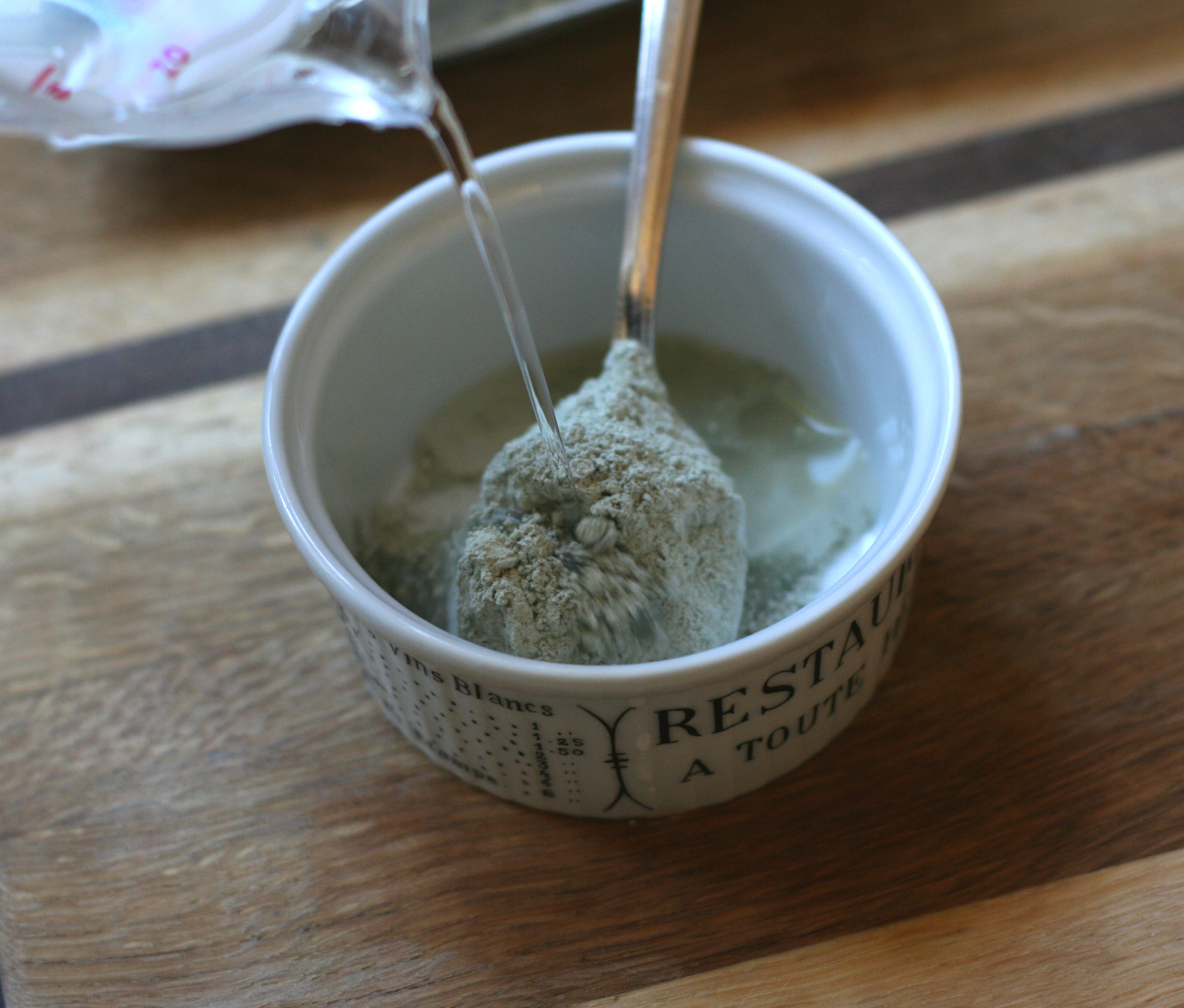
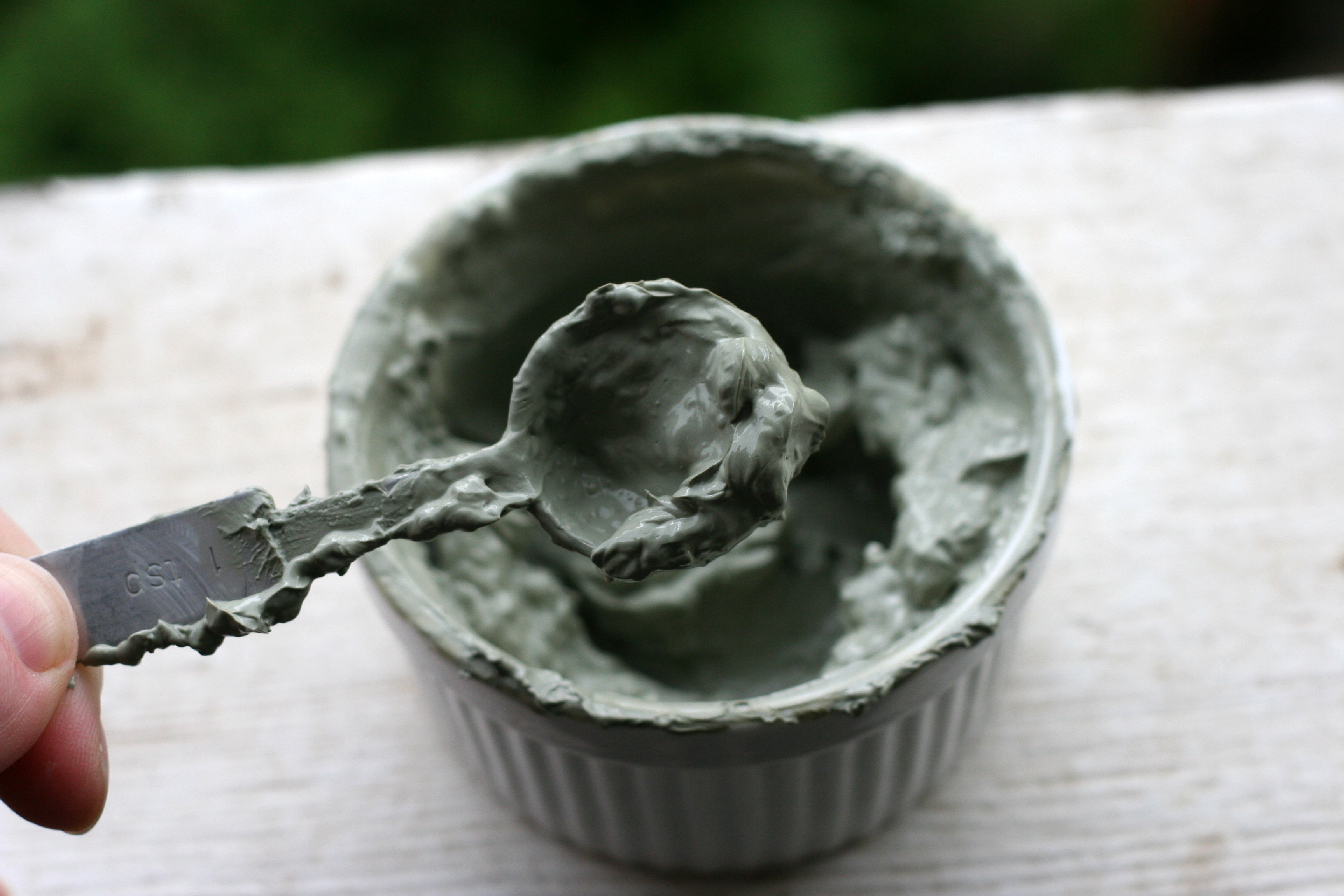
Measure out the clay into a ramekin and add the water.  Stir it until all the powder is incorporated and you have gotten most of the lumps out.  It should be thick.

The thickness makes it easier to get full coverage over the rash.  Too thin and it won’t work as well.

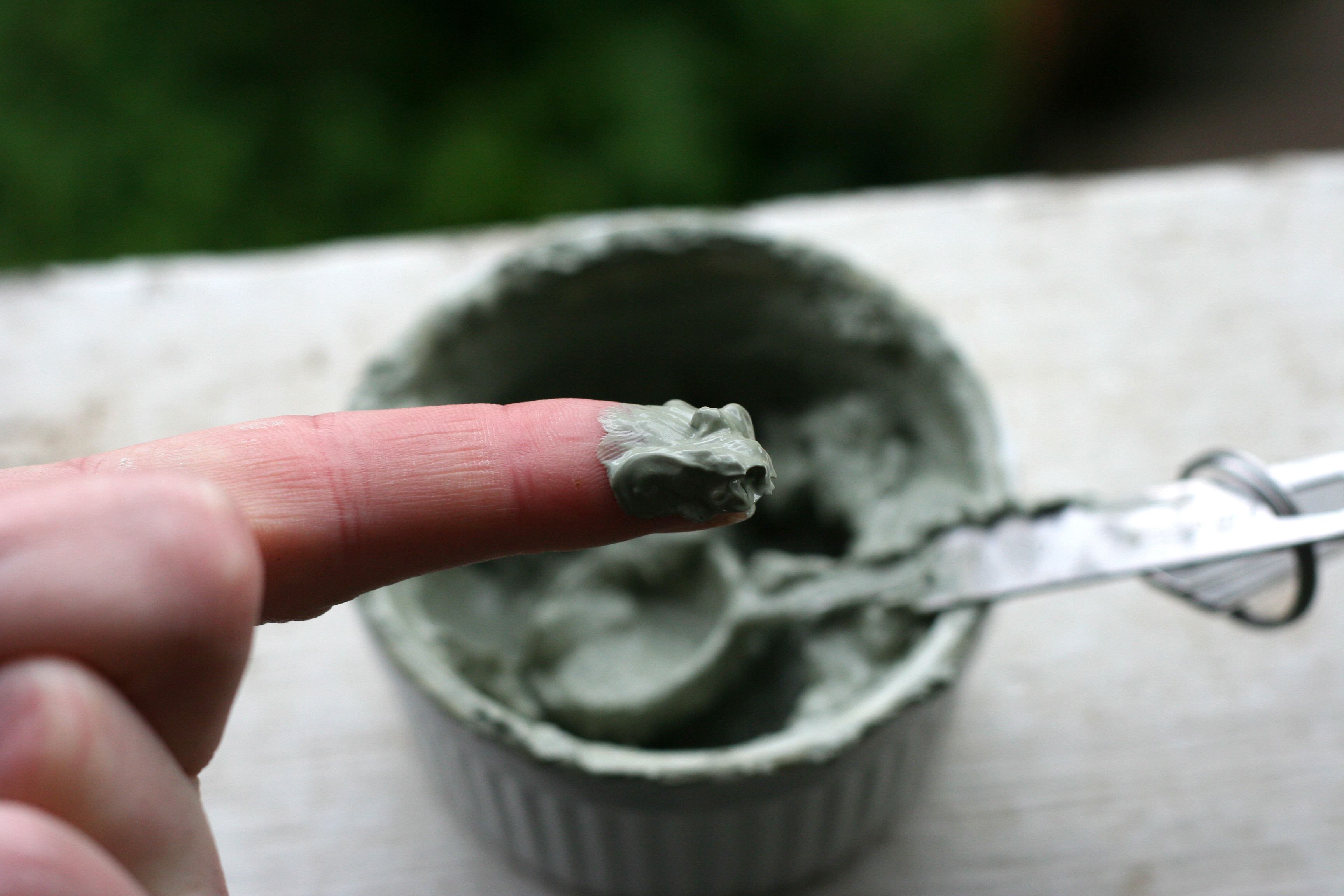
It should be thick enough that it doesn’t drip or slip when you scoop some up with your finger.

Apply it liberally to every area of your skin affected by the rash.  You may need to undress to do this.  Let it dry before covering it with clothes.

When you’re done applying the first round, you can put the rest of the clay in a small jar with a tightly sealing lid.  It will stay hydrated and ready for your next application if you keep the lid on when not in use.  How much you need will vary greatly depending on the extensiveness of your rash.  We used the clay treatment for a little over a week and I mixed up about this amount three times.  Use the above ingredients as a ratio and multiply to make a bigger batch ahead of time if you think you’ll need it.

An acquaintance of mine told me she uses clay for her son too, but she gets it directly from her property, so if you have clay in your yard do try to use that first!  You won’t even have to mix it up and it will be free!  She says it’s the only remedy that’s given relief to her son who is very sensitive to poison oak just like mine.

I bought my clay from an herb shop online, you may be able to find it at local shops that carry natural herbs and beauty supplies.

Poison oak information:

Poison Ivy, Oak, and Sumac Information Center

Cleveland Clinic: The Poison Plants

Andrew Weil on Poison Oak

Poison Oak FAQ

CDC on Poison Oak and other poisonous plants

Getting Back into the Garden with Mom

Most people clean their gardens up (and “put them to bed”) in the fall.  The reason they do this is so that when spring finally hurls itself at them, they can simply dig in and plant their earliest crops without first having to remove all of last year’s dead tomato plants or weeding the quack grass that was allowed to root itself in firmly.  It’s a great tradition.  I haven’t done it for years.

It is taking so much work to do this ritual cleaning now, in the spring, that we are in danger of not having enough beds prepared for planting this year!

In spite of being so far behind in all my yard maintenance (roses haven’t been pruned in two years) it is shaping up and looking better than it has in a long time, thanks to my mom.  My mom has a way of getting me out in the garden even though I’m just embarking on writing the third draft of my novel.  I have barely been out in my garden for a year.  My mom moves in, I say “Hey, even though we might have to move this year, we should plant some things anyway.” and she takes up the idea and before I know it Philip is digging holes, I am wrestling with quack grass, and she’s planning and plotting for our next best garden move, without us knowing quite how it all happened so fast.

I love this about my mom.  She is whipping us into shape without actually bossing anyone around.  It has felt so good to get out there, to see what’s growing and changing every week rather than hiding out in my eyrie of an office looking down at it from a distance.  It’s not that I ever forget how much I thrive by getting my hands dirty and being around my plants, it’s more a question of finding the energy, the motivation, and of keeping in the habit.  I’m still tired all the time from parenting a special needs kid, writing a novel, working for money, and trying not to drop every other ball in my life, yet I am now also spending more time in my garden.

Some of the things we’ve been doing:

  1. Cutting back the rampant brambles.
  2. Fighting the good fight against the heinously encroaching quack grass.
  3. Mulching the strawberries.
  4. planting pole bean seeds (Helda, Lazy Housewife, and violet podded stringless).
  5. Transplanting mullein volunteers.
  6. Pruning the fruit trees.
  7. Mowing the lawn (a big deal because Philip and I LOATHE lawn but can’t afford to get rid of it until we can afford to hire a rototiller and the materials to plant the vast lawn with other things-not a project to undertake if we’re going to have to move in the next year).
  8. Planting herbs (finally got some comfrey and planted it, among other herbs)
  9. Putting down cardboard and straw between the raised beds.

That’s quite a lot for people with little energy and a lot of distractions!  Yesterday my mom informed me that this coming fall we’re going to properly put the garden to bed and avoid all this hard work in the spring that we’ve been doing.  I just know she’ll get me to do it, if she says it’ll happen it’ll happen.  So how does she do it?  Easy- she is not in great health and has limited energy and battles with vertigo so seeing her out there mowing the lawn in the surprise sunshine makes me realize that if she can get out there and do that, then I can get out there with my shovel and other dastardly tools of quack grass destruction and put in at least a half an hour!  (Yes, it’s guilt at its gentlest and most effective)

I have at least five more 8×4 raised beds to clear of solid quack grass and top up with dirt.  That’s a lot of really hard work.  Quack grass is a formidable foe, in case you haven’t encountered and don’t know.  If you don’t recall, last year I broke my shovel on the stuff.  I think a nice blessing to bestow on a new born child is “May she/he grow strong like quack grass!” (translation “Should he or she grow as strong as quack grass he or she will outlive all nuclear events in the future!  Mazeltov!”)

The more I do out there the more I want to do out there.  I try to have modest garden goals (just a bed of beans and a bed of tomatoes will be plenty for a modest year of gardening) but I always get carried away.  I want a big section of beets, carrots, pickling cucumbers, slicing cucumbers; plus I need lots of my own summer squash and winter squash and…

I forget that I can get all these things from the farmer’s market too.  But nothing, I think most gardeners will agree, is more satisfying than going out in your own garden to see what’s for dinner.  I want it all.  Oh, right, forgot about all the dark leafies I need and the lettuce and…

No matter how much or how little I get planted or harvest, the important thing is that I’m out there to see the lilacs budding up and then opening, that I see the ladybugs flood the yard like they do every early spring, and that I see the shape of my monastery garden re-emerge.

Thanks mom!