Author Archives: angelina

Dried Thyme Yield for Spring 2011

I harvested over 2 lbs of thyme from a total of 8 thyme plants and yielded 6 oz of dried thyme.  I had wanted this report to be more accurate but I had a minor setback because I dried batch after batch of tyme but failed to dry the final (much smaller) batch.  I should have weighed what was left but I didn’t.  Instead I let it sit in the fridge in a paper bag.  For a week.  I made a curious discovery by doing this:

Thyme kept in a paper bag in the fridge for a week will dry itself.

However, not to my satisfaction.  I would have kept it if I’d been desperate for dried thyme and that was all I had, but it was dry yet still slightly supple making it hard to remove leaves from the stems.  I could have put it in the dehydrator to dry it out more thoroughly, but I was lazy, and threw it out.

Please don’t throw rotten potatoes at me!

The amount that was left I estimate to be approximately 4 ounces.  Even though my numbers, this time, might not be precise I think it’s still useful information.  This is the first harvest of 2011 and there will be at least one more this year.  I have more than 8 thyme plants but at least 2 of them are dying and need replacing.  What I love about growing and drying my own thyme is that the quality is superior and though it isn’t particularly expensive to buy dried thyme, it is a fraction of the cost to do it yourself.  My thyme plants are two years old and have given me at least 6 big harvests already.  If you keep harvesting them regularly you keep them from becoming too woody.  Plus they look nice in the garden if you do a nice job trimming them.

Although I use a pretty wide variety of herbs and spices in my food, thyme is the one I use the most.  I especially like it in a French style lentil soup.

8 plants yielded 2 lbs 4 oz fresh thyme

2 lbs (approx.) fresh thyme yielded 6 oz dried thyme

Essentials for Every Medicinal Herb Garden


My mother has a certificate in herbology and a lot of experience growing, using, and foraging medicinal herbs.  She’s shown me how to make salves and at one time made me and my siblings all herbal first aid kits which included tinctures and salves she made herself.  My favorite item from that kit was her comfrey salve which I found very useful for many applications.

I believe everyone should grow medicinal herbs in their gardens.  You don’t need to be an herbologist to make use of medicinal herbs safely.  A couple of good herb books is all you need.  I am no enemy to modern medicine and depend on it for a number of things I could never find relief for with herbal medicines.  I believe in an integrated approach to medicines: take the best from the East and the West, take the best from the present and the past.

I always grow medicinals because they are generally gentle, cheap, and can be incorporated into your everyday health regimen.  There’s another reason I think everyone should grow some medicinals: what if commercially produced medicines were to become unavailable to you?

You should have on hand some herbs that you can use in emergencies to do things like reduce fevers, bring swelling down in sprains, heal cuts and bruises, treat burns, calm nerves, detoxify your liver, disinfect wounds, and reduce the symptoms of influenza.  Growing herbs to meet all these basic needs is neither difficult nor need it take up too much space in your garden.

How do you choose the essentials?  My mom and I love this game.  There is a dizzying number of medicinal herbs and plants that you can choose from to grow in your own yard, so how do you narrow it down?

  • Make a list of common issues you and your family experience: skin issues, headaches, colds, anxiety, persistent coughs… think of all the things you routinely find yourself needing to treat and include all first aid things you keep on hand.
    • Consult a reliable herbal book.  Look through the lists of herbs, read what each of them do, and discover which herbs are the most recommended for the needs of your family.  Most libraries will have several you can check out if you don’t have any of your own.  I will list some titles you can rely on for good information (these are all books I personally own and trust):

      “Herbal Remedies for Vibrant Health” by Rosemary Gladstar

      “Desk Reference to Nature’s Medicine” by Steven Foster and Rebecca L. Johnson  (published by National Geographic)

      “The Essential Natural Health Bible” by Nerys Purchon

      “The Complete Herb Book” by Jekka McVicar

      • When you have a list of all the herbs most likely to fulfill your family’s particular needs and those of general first aid, cull the list down to the ones that will grow well in your climate and ones you have room for.  Don’t exclude culinary herbs from this list, many of them have great medicinal qualities that improve your health simply by being used frequently in your cooking.  Thyme, for example, is a powerful antiseptic properties in addition to adding great flavor to soups and other savory dishes.

        While I believe choosing the herbs you grow should be based on your personal needs, there are herbs I believe everyone should be growing in their gardens regardless of who they are.  I’m going to give you two lists to start with.  The first will be a list of the herbs I think every single garden should be growing, this will be the bare essentials.  The second list is the one my mother and I have come up with for our own garden.

        Essentials for Every Medicinal Herb Garden:

        Comfrey – absolutely essential for healing cuts, bruises, burns, and sprains; the roots are great made into tea for your bath as it will soften and heal skin.

        Calendula – great for all skin issues (softens, cleans, heals), anti- inflammatory, antifungal.

        Thyme – strong antiseptic, antibacterial, antifungal, and antispasmodic properties.

        Sage – sore throats, antiseptic, immune booster, colds, and treats nervous exhaustion (I should be drinking this every day!).

        Peppermint – stimulating, refreshing; good for relieving indigestion, tension headaches, and spastic complaints of the gastrointestinal tract.

        Aloe Vera – soothes cuts and burns, nourishes and moisturizes skin.

        Elderberry – reduces severity of influenza symptoms, immune system stimulant, reduces fevers, colds, and ear and throat infections.

        Rosemary – good for digestive ailments, increases circulation, colds and flus, mouthwash, dandruff, and may ease depression and fatigue.

        The only one from that list that not everyone may be able to grow in their own garden due to its size is the elderberry.  Elderberry can be kept pruned to a reasonable size but left to its own devices it will become a big tree.  If you have room: plant it!

        Here is a complete list of what I will have in my own medicinal garden with the items I already have planted asterisked:

        Echinacea, lovage, rosemary*, comfrey*, beebalm, arnica*, calendula, balm of Gilead, borage, sage*, tarragon*, winter savory, feverfew, peppermint*, nasturtiums, parsley*, thyme*, vervain*, elderberry*, mullein*, oregano*, marjoram*, plantain*, roses*(for rosehips), and lavendar*.

        There are so many amazing and useful herbs you can plant in your garden.  Aside from the benefits these herbs offer to you personally they are also great for attracting beneficial insects that will increase pollination in your other plants and help keep in balance the pests that hurt your soil and plant health.

        What herbs do you grow and what are you planning to add to your garden this year?  I want to know!


        Tomato Bread Soup

        bread soup 2.jpgThis is an uncomplicated comforting soup to eat on a cold early spring day.  It’s warm and filling without being heavy.  My mother said the pieces of bread in the soup were like eating clouds.  Seriously, I’m not kidding you, she really said that.  Best thing?  It gets even better by the second day.

        If you have a lot of home canned tomatoes this is an excellent recipe to make with them.

        Tomato Bread Soup
        serves 8

        Ingredients:

        1/2 cup olive oil
        1onion, diced
        2 quarts diced or stewed tomatoes (use the juice too)
        1 quart vegetable broth
        1/4 cup red wine
        8 cloves garlic, minced or pressed
        2 tsp salt
        1 tsp dried oregano
        30 grinds of pepper
        1 day old baguette, torn into small pieces

        Method:

        Heat the olive oil in a soup pot on med/high heat, then add the onion and saute until it slightly browns.  Add the tomatoes, broth, red wine, salt, oregano, and pepper.  Turn the heat down to med/low.

        Cook for twenty minutes.

        Remove from the heat and puree the soup with an immersion blender OR let it cool down and then blend it in a blender and then return it to the pot.

        Put the soup back on the stove, bring to a brief boil, then turn the heat to low and add the bread to it.  Stir it in well and let it cook for ten more minutes.  The bread should be completely saturated and soft but not disintegrated.  If you used particularly hard stale bread you may need to let it cook a little longer.

        It is very good just like this but I like to serve it with grated Parmesan.

        another bread soup 2.jpg

        Recipe notes: You can substitute commercially canned diced or stewed tomatoes – use 2 28 oz cans in place of the quarts.  It’s not precisely  the same number of ounces but it won’t hurt the recipe at all.  If you use fresh oregano then use a tablespoon of minced in place of the tsp of dried.  If you make this in the summer time you can use 4 1/2 pounds of fresh tomatoes with the seeds squeezed out.

        If you object to cooking with wine (or don’t have any on hand) you can substitute red wine vinegar for it – don’t leave it out if you’re using home canned.  If you use commercially canned tomatoes you can leave out the wine or vinegar all together, though I don’t think you should.

        Don’t cut down on the olive oil amount.  This is such a simple soup and the olive oil adds a very important richness to it.  It’s not so very much per person when divided into 8 portions.

        This recipe isn’t gluten free but I’d love it if one of my gluten free friends would try making it with gluten free bread and tell me if it’s good!


        This is a vegan recipe.

        Enhanced by Zemanta

        Illumination

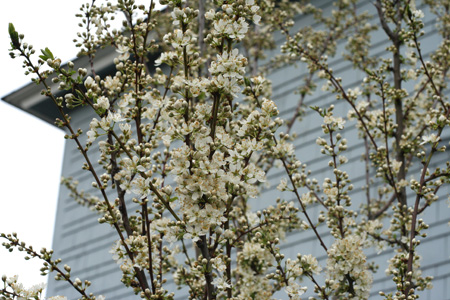
        Santa Rosa plum tree 2.jpgIt is terribly easy to become depressed and hopeless in times of war or when tsunamis unleash death and nuclear instability on the world.  Death trudges on its determined route and we sit stunned while counting our sorrows.  What have we got to look to for hope in times of darkness?

        gang of tulips 2.jpgDon’t ever dismiss the simple answer.  Never assume that the small things don’t count or can’t weigh against the big things meaningfully.  Maybe the bright coral of a tulip can’t bring back the loved ones you’ve lost.  No one is going to argue that.  But can you not see the joy that nature offers us, the color she splashes across our path to arrest thought, to provoke laughter?  Can you not recognize a path there to light?

        elephant heart blossoms 2.jpgWhat about the fruit tree that has hitherto never produced more than a meek smattering of blossoms and suddenly plasters itself with creamy flowers reaching sky high for the impossible spark of life?  Can you be blind to the hopeful ignorance of war and death your plum tree claims?  Listen.

        volunteer violets 2.jpgListen to the life around you.  See the fractional evidences of love and hope the world gives even in the grimmest hour.  There will always be grief.  We will always be losing ourselves in graves and the calamities that bring us down to the surface of soil.  We will always be mourning for something.  Therefore we must always be looking for light to mitigate the dark. 

        elderberry buds 2.jpgThe most life affirming gift I have ever received in my life were elderberry cuttings from a dear friend who is like a sister to me.  This very elderberry you see, budding as though it was a large-hearted lion of the landscape is nothing more than a sproutling declaring its love, its scrappy will to live, to thrive across continents, between friends.  This cluster of buds is promise, it’s new life, it’s a message of continuity and peace.

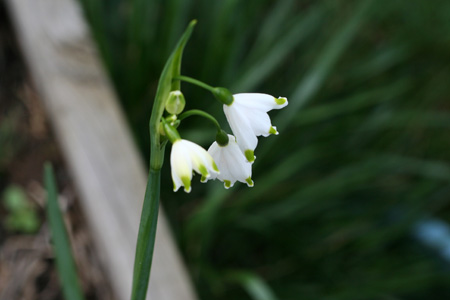
        surprise snow drop 2.jpg

        Never relinquish your most private dreams because even if they never play out in your life they will inform your hope, your ability to move forward, and your  belief that you deserve every scrap of love you have.  Never stop believing in the power of the small voice, the sliver of light in the dark, or in the regenerative power of the earth beneath your feet.

        I don’t care what your creed is, what your political views are, or what your country of origin is.  There is a universal truth to recognize.  It isn’t weakness to love.  It isn’t weakness to want peace.  It isn’t weakness to want to help your neighbor.  It isn’t weakness to listen to the early spring white violets call out for pale sunshine.  It isn’t weakness to stop to listen to them.

        What’s important in life is elemental and not the least bit complicated.  Don’t be afraid to love without sophistication.  Just love.  It isn’t all you need but it’s the best foundation on which to build a rich life.

        Love.

        And bury your hands in soil once in a while.

        Spinach and Nettles Spanakopita (crustless)

        spanakopita 2.jpgThe egg rose to the top there making this look more like a quiche.  I believe this happened because my greens were still a little too wet.  It’s not at all like a quiche.  When making it in a pie dish this didn’t happen.

        I have eaten a lot of spanakopita in my life.  I’m just saying this right now so you will understand that I know what it tastes like.  I wanted to make a crustless version of spanakopita and shared this ambition with my mother who at once let me know that without the crust it simply can’t be spanakopita.  I argued that what makes a spanakopita spanakopita isn’t the crust but the filling of spinach and feta and onions and dill. 

        After some fruitless brangling over this it was revealed that my mom just doesn’t see the point of spanakopita without the crust because she loves the crust.  I got the distinct feeling that if I put a plain wilted spinach leaf on a succulent nest of golden filo she would accept it as the real deal.  I’m not a dab hand at working with filo so I made a spanakopita with a buttery pate brisee for her.  She did agree that the filling was exquisite and tasted exactly like spanakopita.

        Next I made it without a crust and she saw the point of it after all. 

        Just as I was experimenting with this recipe spring happened.  With early spring in Oregon comes nettles season!  I don’t love the taste of stinging nettles.  Lots of people rave about it but I think it tastes like sea weed, that’s one of the few vegetables I truly can’t tolerate.  I’m motivated to keep trying to find ways to use nettles because of their dense nutritional content.  Nettles have been eaten in early spring by people for hundreds of years (possibly forever, but definitely for hundreds) in soups and teas.  At the end of winter people who didn’t have access to luscious produce from Chile were really in need of a boost to their steady diet of dried/stewed meats and root vegetables. 

        At last I have found the recipe to use them in where the taste doesn’t come through but I get the benefit of the the nutrition.  I added two cups of dried nettles to the spinach (and chard when I don’t have enough spinach) and it still tastes exactly like traditional spanakopita.  After I go on my first foraging hunt for fresh nettles I will make this again and report to you how much fresh to add to this recipe if you can get your mitts on it.

        If you like your spanakopita with a crust you can just use this recipe as your filling.

        My mom couldn’t stop eating it.  Cause it’s that good.  Argument solved. 

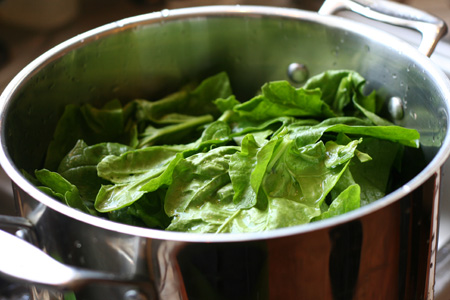
        pot of spinach 2.jpgTwo pounds of spinach seems like a lot.  Until it’s all cooked.  This big pot full becomes insignificant.

        dry nettles 2.jpgIt’s nettle season right now in some places and I ought to have made this recipe with fresh nettles so I could tell you how much to use if you have fresh on hand.  However, I haven’t gotten out to forage yet so I’m using what I dried from last year.  Notice that I haven’t crushed my dried nettles nor have I tamped them down.

        squeezed cooked greens 2.jpgSee how little it looks?  Still, divided in six this is one heck of a good serving of greens!

        Spinach and Nettles Spanakopita (crustless)

        Serves 6 – 8 if made in a pie dish
        Serves 4 in 8oz ramekins

        Ingredients:

        2  lbs spinach (or mix of spinach and chard)
        2 cups dried nettles
        3 cups water
        1/4 cup olive oil
        1 yellow onion, diced
        1 1/2 tsp dried dill
        1 tsp salt
        30 grinds of pepper
        8 oz feta (crumbled)
        2 eggs
        1 tbsp butter (for greasing the baking dish)

        Method:

        Preheat the oven to 350 degrees.

        Wash and stem your fresh greens (especially if you use some chard).  Bring the water to boil in a large pot and add all your greens and dried nettle to it.  Boil the greens (be sure to stir them well so the nettles get immersed) until tender (about ten minutes). 

        Drain the greens in a colander (and save the boiling water for use as soup stock for later).  When the greens are cool enough to handle squeeze all the water out of them that you can.  Chop and set aside.

        Heat the olive oil in a medium sauce pan.  Add the onions and saute until translucent.

        In a medium sized bowl whisk the eggs, dill, salt, and pepper with a fork until well mixed.  Add the greens, onion, and feta and stir again until completely mixed.  Spoon into a buttered pie dish or buttered ramekins and bake for 40 minutes. 

        spanakopita diff view 2.jpg


        Recipe Notes:  (Oh, you thought there were plenty of notes in the beginning?)  I like this best cooked in the pie dish.  Alternatively you could use a square baking dish and cut it in squares.  You could make this with any greens that cook up really tender, so what I’m saying is PLEASE DON’T USE KALE.  Traditional spanakopita is all spinach (hence the name “spinach pie“) but I made this twice with a mix of spinach and chard (because I didn’t have enough spinach) and it was just as good.  You could, if you’re a big fan of kelp flavor, do this dish entirely with nettles. 


        This recipe is gluten free.

        Enhanced by Zemanta

        Russian Pot Pie

        cooked Russian 2.jpg

        This is the perfect dish to serve after a hard day chasing yak on the tundra!

        Eastern Europe isn’t especially famous for its vegetarian food.  Occasionally I like to check out Russian, Ukranian, and Croatian cook books from the library.  Most of them were written and photographed so long ago that the photographs are somewhat dreary.  Still, I am attracted to the culture (and culture clashes), the food, and the architecture of Eastern Europe. 

        I did research about Ukranian and Russian food while writing my first (unpublished) novel “Jane Doe” and was fascinated by solyanka, a soup with pickles in it.  I feel sure I will one day make a meatless version of it.

        This dish was inspired by a recipe I tried first many years ago from the cookbook “Vegetarian Epicure” by Anna Thomas.  I don’t even have the book anymore and don’t remember how she made it or exactly what was in it but what I got from her recipe for a Russian style pie was the combination of marjoram, cabbage, and mushrooms with hard boiled eggs.  I have been making different versions of this combination for a long time and finally decided to make it into pot pies and change the marjoram to dill.

        I don’t have a pie crust recipe prepared for you but if you don’t already have your own favorite try this Simply Recipes pate brisee, it’s almost the same as the one I use.  You need enough pie dough for one crust and you’ll need 6 8 oz ramekins or other single serving dishes if you want to make the pot pies.  If you don’t want little pies you can make this as one single big pie.


        Russian Pot Pie

        makes 6 pot pies

        Ingredients:

        Enough pie dough for one crust, portioned into 6 pieces
        6 hard boiled eggs

        1/4 cup olive oil
        1 yellow onion, diced
        1 lb button mushrooms, sliced
        1 head cabbage, chopped small
        1/2 cup water (appx)
        1 1/2 tsp dried dill
        1 tsp salt
        30 grinds fresh pepper
        16 oz sour cream

        Method:

        Preheat oven to 350 degrees.

        Heat the olive oil in a large saute pan on med/high, add the onions and cook until they just start to become translucent.  Add all the mushrooms and cook until they are completely soft.  Add the cabbage, dill, salt, pepper, and the water and put the lid on the pan, removing every couple of minutes to stir and make sure the pan hasn’t gone dry.  If the cabbage isn’t tender yet but is starting to brown, add a little more water. 

        When the cabbage is tender turn the heat down to low and add the sour cream, stirring it in well.  When heated through, remove from heat.

        Put your ramekins on a baking sheet to catch any overflowing juices from the pies.  Fill each ramekin halfway with the cabbage and mushrooms.  Slice and layer a hard boiled egg into it.  Fill to the top with more mushroom and cabbage.  You should have enough to fill all six to a rounded mound, but if not, that’s okay.  It will vary depending on the size of your cabbage.

        Roll out the six pieces of dough into circles just a little bit bigger than the circumference of the ramekins.  Lay the dough on top of each one pushing the edges against the edge of each dish to seal it shut.  Use a small sharp knife to make little slashes in the dough to let the steam out while cooking.

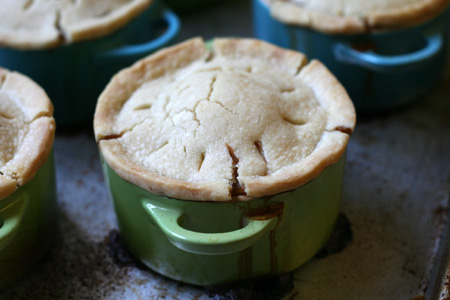
        Bake in the oven until the crusts are turning golden (about 45 minutes).


        Recipe Notes:
          I’ve made this with marjoram instead of dill and loved it both ways.  I have also made it without the sour cream which Philip and I loved but my mom thought it was too dry.  As I’ve mentioned before, I use a light sour cream but only because Tillamook makes a really flavorful one. 

        This could be vegan if you use a vegan crust, leave out the egg, and don’t use the sour cream.  That might not sound good to some people but what is most important in this dish is the cabbage, mushrooms, and seasonings- it’s really good right from the pan so I encourage my vegan friends to come up with their own version.  If you wanted it to have some protein I would add some white beans which won’t take away from the other flavors but would make it more hearty. 

        Enhanced by Zemanta

        Support the Safe Seed Pledge: no to GMOs!

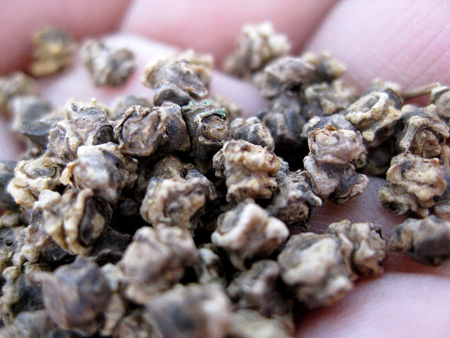
        beet seeds 2.jpg

        It’s no secret that I am adamantly against all use of GMOs.  I have done a lot of reading and considering on this subject and have come to the conclusion that having food with systemic pesticides cannot be good for either people or the planet.  I am already against pesticides applied externally on crops.  The wind takes it aloft spreading it across everything, not just the targeted crops, so that we all breath it whether we choose to or not.  It pollutes our water through runoff.  Traces of it stay in the food people eat, even after washing. 

        So why would I think it’s a good idea to create a plant whose dna includes a pesticide?  It can’t be washed off at all.  A pesticide in the genes can cross with clean plants giving it some of it’s altered genes without you even knowing it and this is what’s already happening: GMO crops contaminate other crops through their seed  being carried on the wind and by birds.  Even when we purposely choose to eat only non-GMO foods we still may be eating them because farmers planting GMO crops can’t prevent contamination to other farms.

        I am becoming increasingly angry and alarmed at the disregard my country shows towards my health and my ability to make what I consider to be good choices for my body.  There isn’t a lot you or I can do to stop the GMO companies from spreading their seeds to industrial farmers and it feels hopeless sometimes but I would like to suggest that our income is still the best place we can assert our power.  Our income and our voice through voting and protesting.

        Here are a few things we can all do to help fight against GMOs infiltrating our lives:

        • Do you purchase any packaged food?  Write letters, e-mails, or make phone calls to the producers of the food you buy to ask them if they use GMO produce in their products.  If they say they do, stop buying that product and find one that doesn’t use GMOs.  I have actually done this once and plan to do this more.  If you make your preference and your concerns known to companies it puts pressure on them to respond.  They need your money.

        • Don’t vote for any candidates who are known to support (in any way at all) the companies that produce and promote GMOs.  Read up on them and you can find out what corporations they are affiliated with.

        • Campaign for labeling.  Write letters to the government and also to the stores where you shop.  Labeling of all foods with GMO ingredients should be mandatory so that those of us who don’t want to ingest or support them can choose not to.  Here is a link with suggestions on how to use guerrilla tactics to get your message across:  Do it Yourself GMO and Factory Farmed Foods

        • Plant open pollinated seeds from seed companies who have taken the safe seed pledge.  The corporations who are selling GMOs aren’t targeting the civilian population any more (having failed to gain support) and are mostly targeting industrial farmers, but even so, supporting seed companies that have taken the safe seed pledge is important – these are the people preserving clean seeds and our future depends on our ability to save our own seeds (you can’t save your own seeds if you plant GMOs, it’s not only illegal, it is often not successful).

        I buy most of my seeds from Territorial Seed Company because they have seeds that have been acclimated to my climate, they’ve taken the safe seed pledge, and they offer a good variety of open pollinated seeds which is about 90% of what I plant. 

        If you would like to find out what other seed companies have taken the safe seed pledge you can look up “safe seed pledge” online or you can go to this link I found:

        Safe Seed Resources

        I also found this interesting article by Greenpeace on GMO seeds:

        Facts and Figures About GMOs

        (that will give you the link to download the article)

        Enhanced by Zemanta

        Urban Homesteading: you can’t own who we are

        reaching stem 2.jpg

        I have been calling myself an urban homesteader for years.  I knew
        it was a movement a decade ago.  In fact, it was a movement started in
        the sixties with my mom’s generation of people “getting back to the
        earth”. 

        Urban homesteading is a growing movement of people re-learning
        homesteading skills on a city-scale.  There is a fairly well known
        website of a family who’s also been a part of this movement who believe
        they are solely responsible for coining the name of this movement, so
        much so that they have trademarked the term “Urban Homesteading”.

        I have never personally liked the “Path to Freedom” website run by the
        Dervaes family but I was happy enough to see another website
        where people could get information about growing food on small
        city lots.  I have always thought that the more people talking about urban homesteading and sharing ideas the better.

        Now I’m angry. 

        The Dervaes family is trying to enforce their dubious trademark on the term “Urban
        Homesteading” (and “urban homestead” too, I believe).  I don’t know all the
        details but I don’t need to know much more than that it is a betrayal of
        this movement to try to own its name and control its use. 

        The spirit
        of the urban homesteading movement is a non-commercial, non-corporate
        approach to self sufficiency on a small scale.  What part of this
        movement is about ownership of its name?  What part of this movement is about owning what and who other people are?  None of it.  What I have loved about urban homesteaders across the board is their willingness to share information for free, their encouragement to others to come join the fun, to explore self sufficiency with the goal of becoming less dependent on corporate America.

        Supposedly all of us who have been calling ourselves urban homesteaders for years must no longer use that term.

        Trademarking the term urban homesteader and urban homesteading is no
        different than trademarking these terms: housewife, animal husbandry,
        homesteader, farmer, plant conservationist, home gardener, city dweller,
        marathon runner, anarchist, American citizen, nurseryman, self
        sufficiency, dairy farmer… and this list is infinite.

        You can’t own me.  You can’t own who I am.  You can’t own the life I lead and my ability to succinctly describe it to others.  You can’t own a grassroots movement.  If a movement can be owned at all (which I don’t believe it can) the minute someone owns any part of it it is no longer a grassroots movement but a business.  You can’t own what people call themselves.  You can’t own the words that describe what a person does and what they believe in.

        Trying to own the term “urban homestead” in any of its forms is like trying to own the term “Christian” and then forcing all Christians to come up with some other way to identify themselves and what person on earth is arrogant enough to try to own the faith of others?

        Urban homesteading is my faith.  It’s my spirit.  Growing my own food and herbs, raising chickens, sewing my own clothes, recycling, composting, choosing open pollinated plants, building raised beds and coops, making my own medicines… this is who I am.  It’s what I believe is more important than anything else.  Even when I’m not able to work on all the projects I want, even when all I can do is dry some of my own thyme and cook great food for my family, I am still an urban homesteader and no one can take that away from me.

        No one can own me.

        No one can own you either.

        Please read about this and if you can donate to the Electronic Frontier Foundation who is helping to fight this issue, please do.  If you have a blog or a website and can write about it- please do.  Everyone who has ever considered themselves an urban homesteader should speak up and shout out. 

        Riding the Fences of the “Urban Homestead”: Trademark Complaints and Misinformation Lead to Improper Takedowns 

        Urban Homesteading

        Take Back Urban Homesteading

        Enhanced by Zemanta

        Spring Approaching

        baked beans 2.jpg

        This is my latest baked bean batch.  I’ve been working on developing a good vegetarian baked bean dish for ages.  I’m closer now than I’ve ever been.  Philip and my mother loved this version.  It’s almost ready to share.

        A lot has been going on around my farmhouse.  We still don’t know if the bank will refinance and we’re at nine months of not knowing now.  My campaign to unload a lot of junk was going well (did I already mention I got rid of 6 boxes of craft stuff from my office alone?) and then my mother moved in with us permanently. 

        Her moving in was a decision we reached mutually for a lot of different reasons.  The number one reason is that she couldn’t afford to live in Portland any more.  She loves it there but it’s just too expensive.  Another reason is that if the bank refinances our loan she can contribute to our mortgage.

        The less official reasons are that her health isn’t great and neither of us wanted her to be so far away that if anything happened I wouldn’t be able to help out.  She’s had bronchitis for a month and has been experiencing vertigo and has been ordered by her doctor not to drive.  So now she’s on a leave of absence from work. 

        The minute she moved in it’s been complete chaos.  Not because of her.  My mom is pretty easy to live with now, something I never thought I’d say ten years ago, and she has a magic way of arranging and organizing things that I was not blessed with.  So she moves in and suddenly we have an amazing living room.  No dead space.  It’s wonderful!  What’s chaotic is how we’ve all been getting sick for a month and the pet situation is complicated and extremely stressful.

        We love pets.  We are all animal people.  By animal people I mean to say that we aren’t people who feel life is complete without animals being part of our family.  My mom arrived with two cats and two huge dogs.  My dog who has never chased her own kitties is suddenly responding to a cat-hunt vibe with the youngest of my mother’s two dogs (a big boy named Angus) and our cat Penny is really upset and is now peeing on things. 

        Angus is really the apex of all the trouble.  He can reach anything at all and is constantly chewing on whatever he can get his maw around.  Any boots or shoes left around are decimated in minutes.  He’ll eat everything in the kitchen.  I roasted a very expensive baking sheet of organic fennel and turned my back for less than three minutes and he had licked over it all and already eaten half of them.

        On the plus side my mom got our dishwasher fixed.  I don’t mind hand washing dishes but I confess that it gets overwhelming doing dishes here and never more so than with one more person living here.  Not only did she get our dishwasher fixed (it’s been broken for over a year) she actually cleans the kitchen every couple of days! 

        Stitch and Boots is meant to be my homesteading blog but lately I realize it’s mostly been my cooking blog.   I am not going to officially change the focus because I keep hoping to do some other household projects to share here.  I’m using this place as my flame of hope, if you don’t mind me saying such a silly thing.  I have not really done any garden planning for a year while writing my novel and working and trying very hard to hold everything together with thin threads. 

        I was reinspired the other day by a talk I had with my Kung Fu teacher and a couple of other students at our school about GMOs and though our talk was angry (not with each other- with the situation of not being able to keep GMOs from our own diet due to no labeling and contamination of non-GMO crops by a growing number of GMO crops) out of the anger I remembered something fundamental: growing your own food matters.  Growing my own food matters. 

        Even though I might have to leave this house mid-season, it’s also true that I might be here (in limbo) for as long as another year and in that time I can grow at least two crops in my garden.  I already have the beds, they just have to be cleared of quack grass (“just” is not doing justice to the problem- remember I broke a shovel on that stuff?!).  So I talked to my mother who is largely responsible for having given me a passion for gardening in the first place and she’s going to help me.  We’re going to do a small vegetable garden. 

        It will be an act of good faith that we’ll hopefully still be here a year from now.  Two years from now.  A decade from now.

        She has requested one whole bed for her own experimentation with square foot gardening.

        There is nothing more important than for all of us with yards and balconies to grow open pollinated food.  With all my house and life turmoil I lost sight of that.  I’m watching the spring bulbs surface and though I’m sad to see winter winding down I am feeling the excitement of spring and all the new growth it brings with it.  I’m excited to clean out the dead growth from my strawberries and let the new leaves up into the light.  Snow watch 2011 is over. 

        It’s time to plan the only part of my future I can be sure of which is that no matter where I live I will always grow food.  It’s the best offering of hope I can make.  It’s the grandest gesture of love I can share.

        Extreme Picky Eating: The Max Diet

        tater tots.jpg

        My kid may be an extreme picky eater but while the number of things he’ll eat is small, his food rules are complex.  Part of what makes feeding him so complicated is the fact that there are distinct cycles to his eating habits which change frequently and suddenly.  I am going to lay out (for your interest, not your criticism) all his food rules and the foods he eats to give others an idea of what it’s like to feed him and, more importantly, how hard it is for him to eat.  Other parents of picky eaters may find solace in reading this account.  Either you’ll realize your kid is way pickier and I’ve got it easier (but feel less alone) or you’ll realize your kid is easier to feed and maybe find things to appreciate about your own experience by comparison.

        The Rules:

        Only one food on a plate at a time.
          Any condiments need to be in their own container in order to avoid touching the food before it’s time to eat it.

        Plates, bowls, and glasses are frequently scrutinized for cleanliness.  Any suspicious speck will contaminate the food on the plate and it will be refused.

        Hand washing.
          Occasionally requests are made that we wash our hands before feeding the kid.  This always insults me and is met with a lecture about how my hands are always cleaner than his.  The truth is, he’s not worried about germs, he’s worried about unauthorized foods still being on my fingers such as the essence of cheese which may transfer to his food and make him lose his appetite.

        Food needs to be as even and same sized as possible.  This is one of the reasons why he likes crackers and other predictably uniform foods.  Most foods are amorphous and irregular, this is repugnant to him.  Holes in toast, for example, used to be met with panic and then a flood of tears.  Now he is much more polite about refusing to eat toast that isn’t “perfect”.  There must be no rips, shreds, stringy bits, dark specks or anything ruining the appearance of his food.

        Texture.  He mostly likes things to be crunchy and firm.  A limp carrot is an abomination.  A stale cracker is unacceptable.  mealy apples or crumbly anything is not okay.  Tater tots slightly underdone are an insult.  Texture is a very serious thing to Max and the wrong texture (such as a wet spot on a cracker) can be traumatic.   

        With a few exceptions (which remains a mystery to me) sticky textures
        such as jam or soft peanut butter in a piece of bread aren’t tolerated because if he gets it on his hands he panics (and used to cry).  He will eat cornbread with honey on it (this is one of the exceptions) and will immediately run to the bathroom to clean his hands afterward – should there be an impediment to his getting to the bathroom he will freak out.

        He does not eat at the table.
          He eats while watching movies.  I fought him from the time he was a baby in the highchair until he was about two years old trying to get him to eat at the table.  He would constantly try to get out of the chair and no food would be eaten.  I would give up and give him a snack while he watched a movie and the movie would keep him still and calm and I found he’d put food in his mouth and not examine it as closely.  This is true to this day.  I don’t care what any other parent thinks of me, if it weren’t for DVDs my child would not have enough distraction to eat.  It’s like needing white noise to sleep (which he also needs).  I am at peace with this.

        Flies or insects.
          If a fly or insect is seen in the same room in which he is eating he will lose his appetite for at least an hour, sometimes several.  For some reason ants inside the house, especially in any room he’s eating in, are disturbing to him.  He doesn’t mind them outside but he has nightmares that they are crawling on him in his bed. 

        Food odors.  He cannot tolerate the odors of most food he doesn’t himself eat.  He refuses to eat his food in the school cafeteria (a fact he didn’t tell me until I found out because he got into trouble trying to eat his protein bar in the hallway).  He finds most food visually disgusting with special disgust for all pasta dishes, beans, and pizza.  He is usually neutral about people eating salads near him.  He is still very rude in dealing with his strong food odor/visual aversions though we keep working on it.

        Temperature of foods matters.  If something like toast is supposed to be warm he will not eat it if it isn’t the right temperature.  He doesn’t eat much food that’s meant to be hot except for tater tots.  I don’t really blame him for not liking his tater tots cold but he’s pretty dramatic about how disgusting it is.  He likes his cold beverages to be really cold, but not iced. 

        “Old” water or old anything.  If it takes him too long to drink or eat something (say, longer than a half an hour) he will refuse to eat them because they’ve been sitting out for too long.  This drives me insane.  I do know that water grows stale but he is so sensitive to it that I have wanted to strangle his handsome little neck at constant requests for “fresh” water or new food.

        Unopened bags.  He has started requesting that all Goldfish be brought to him in an unopened bag because he believes they don’t taste right when they are opened by us though it seems to be fine if other crackers are put in a bowl by us. 

        One left on the plate.
          One of whatever he’s eating that is considered his “real” food (as opposed to snacks) must always be left on the plate.  For years he would always (ALWAYS) leave one tater tot or one carrot stick or one piece of apple.  Even if he was hungry enough to ask for more, one must remain uneaten.  He has, very lately, eased up on this.  I’ve asked him many times over the years why he does this and he would just tell me he had to do it.

        Food Cycles.
          There is a distinct cycle to his eating that I haven’t scientifically mapped but I can tell you that at one end of the cycle he’ll have about fifteen different foods in rotation that he’ll eat and at the other end of the cycle he’ll have only two foods in rotation.  There are mini cycles within the bigger cycles.  He’ll eat a few things obsessively until he gets a (literally) bad apple and then he won’t be willing to try that food again for a month, sometimes more.  So what foods he’ll eat are constantly changing.  This makes my head spin and my patience thin.

        Brand specific.
          Don’t switch brands on this kid.  He always can tell.  Have him try three vanilla ice creams without seeing the packages and he can tell you which one is the one he usually eats, which one is vanilla bean (which he hated for the specks in it), and which is the off brand you bought because they were out of the usual one. 

        The Actual List of Tolerated Foods in the Max Diet:

        Sugar toast.  Whole wheat toast with butter and brown sugar.

        Egg toast.  (this only makes the rotation rarely).  Whole wheat toast with a fried egg and ketchup.  (this is hard to make “perfect” so comes with a high chance of being rejected.

        Wheat hot dog bun with ketchup.

        Cornbread with honey.  When he loves it he LOVES it a
        nd usually he will only eat  few slices before it’s out of rotation for a long time.

        Tater tots.

        Apples.  Texture is extremely important.  The slightest bit of browning and he will stop eating them.  We’ve used lemon juice sometimes to help this.

        Carrots.  Only likes the “baby” carrots because they’re pretty uniform in shape and size.  Though he recently tried cut carrots again, unfortunately they didn’t taste that great.

        Grapes.  Only red grapes when they’re in season.  Mostly just the red grapes we get from a friend of ours.  He’ll eat bowls of those.

        Cucumbers.  But only in season.  When they’re good he LOVES them.

        Watermelon.  Only the seedless kinds.

        Strawberry “milkshakes”
        made with milk, frozen strawberries, and a little sugar.

        Crackers.
          An ever changing list of packaged crackers (organic saltines, Ritz style, Goldfish, Pop chips, and a few others that once in a while enter the rotation)

        Energy/Protein bars.
          This is his main source of protein.  We only buy Luna and Cliff because they don’t use corn syrup and are mostly organic.  Right now Cliff bars are NOT OKAY.  In each bar type he only likes two flavors and usually eats one flavor exclusively until he is sick of it.

        Juice popsicles.  Concord grape only.

        French fries.  When we go out to dinner we feed him at home and then let him order fries which are not good enough for him to eat 75% of the time.  When they’re good he really likes them.

        Peanut butter cracker sandwiches.  I put peanut butter (very smooth) between two natural Ritz-style crackers.  He’s not eating them now but it was a great favorite for at least two months.

        Peanut butter “breakfast” cookies.
          I adapted my peanut butter cookie recipe to have less sugar and wheat flour so he would eat something with protein in the mornings. 

        Home baked cookies.  A few select recipes I use are approved.

        Gingerbread.  He loves gingerbread. 

        Ice cream.  All kinds of ice cream (except not fruity). 

        Hot cocoa.  I count this as food because I make it with milk which has actual protein in it.  He doesn’t like it often because he hates milk but sometimes it hits the spot.

        Frozen yogurts.  But not the healthy natural ones.  He likes the tube yogurts made by Yoplait.  I hate Yoplait for having made them appealing to kids and then putting total crap in them.  Luckily, I guess, he seems almost to have permanently taken this off the acceptable foods list.

        Pancakes.
          Ten grain pancakes with a bucket of real maple syrup.

        Popcorn.  Not a lot of nutritional value but at least it’s something.

        Potato chips.  We don’t let him have these often but he loves them. 

        That’s 25 items total that he will eat, including desserts. 

        Remember that most of the time there are only 5 to 10 of those items in rotation. 

        Right now there are three:  Peppermint Luna bars, tater tots, and grape juice popsicles.

        Food is emotional for most people and necessary for everyone.  I was prepared to love my child if he was born without all his limbs, to find charm in him should he be born a dwarf, and forgiving should he grow up to be a jock… but I was not prepared for a picky eater because I believed, as most parents do, that as long as I always put healthy food in front of my kid he would eat what I gave him (barring the usual disdain for broccoli and kale that many kids have).  I believed that it’s parenting skill that makes good eaters, not something mental or physiological. 

        Every time Max rejects the food I make for him he rejects a part of me.  He doesn’t see it that way.  For eight years I’ve experienced his rejection of my tireless efforts to nourish his body and mind with good food.  I have compromised, worked hard at coming up with clever ways around his issues, and I have also given up a thousand times.  There have been times when I was so desperate to get him to eat anything that I let him eat crap that I don’t eat myself.  No normal parent will let their kids starve.  Many parents of non-picky eaters love to say that no child will starve themselves so if you hold out and insist they eat what you want them to eat with the threat of no other options they’ll cave in and bend to your awesome parental will.

        My child would rather die than eat soggy toast.  I know this to be true.  How can I know?  Because I would rather starve myself to death than eat any kind of meat.  Anyway, I don’t personally respect the kind of parenting that pits a parent’s will against its child’s with starvation as the threat.  I want a better relationship with my son than that.

        Now that Max is much older he doesn’t cry over his food issues, we discuss them and we work on them together.  I can’t change the fact that he’s picky, and neither can he, but he is more willing to try new things than he used to be and since he was diagnosed with OCD two years ago we know that many of his food issues are directly related to his OCD and this makes it easier for me to not take his food rejection personally and it helps Max to understand that his many frustrations with food aren’t his fault. 

        Enhanced by Zemanta